


TL;DR:
- Storage in transit temporarily holds household goods at a warehouse when immediate delivery is impossible. It is a regulated service that lasts typically 30 to 90 days, helping families manage timing delays during long-distance moves. Proper planning, early communication, and clear insurance coverage reduce costs and stress associated with SIT.
Storage in transit (SIT) is the temporary, secure holding of your household goods at an intermediate facility when immediate delivery to your new home is not possible. The industry abbreviation SIT is the standard term used by carriers, moving companies, and U.S. federal regulators alike. For families planning long-distance moves, SIT solves a common timing problem: your old home closes before your new one is ready. Ambmovingservices coordinates SIT as part of its nationwide moving operations, keeping your belongings safe and your move on track even when schedules shift.
What is storage in transit and how does it fit into a long-distance move?
Storage in transit is defined as a temporary warehousing service that holds your shipment at a carrier’s facility or approved warehouse between pickup and final delivery. It is not permanent storage. SIT exists specifically to bridge the gap when a delivery cannot be completed on the originally planned date.

The U.S. Department of State’s Foreign Affairs Manual (14 FAM 620) recognizes SIT as a formal logistics category. Federal regulations require carrier notification and approval from an authorized official before goods are placed into intermediate warehouse holding. That regulatory framework applies broadly across interstate moves, not just government relocations.
For families, the most common trigger is a closing delay. Your furniture leaves your old house in Ohio, but your new home in Texas won’t be ready for another two weeks. SIT holds your shipment securely in a climate-controlled facility until you give the green light for final delivery. Without SIT, you would face a hard choice between rushing into an unready home or leaving your belongings on a truck with no clear destination.
How does storage in transit work during a long-distance move?
The SIT process follows a clear sequence from pickup to final delivery.
- Pickup and loading: Your moving company collects your household goods on the agreed date and transports them toward your destination.
- Transfer to a facility: When delivery cannot be completed, the carrier routes the shipment to a warehouse or carrier terminal near your destination city.
- Check-in and inventory: Extra handling steps require precise documentation handover among carriers, warehouse staff, and final delivery agents. Every item is logged to maintain inventory control.
- Secure holding: Your goods remain in the facility under basic security. The holding period typically runs 30–90 days.
- Delivery scheduling: Once you confirm your new address is ready, the carrier arranges final delivery from the SIT facility to your door.
Three parties share responsibility during SIT: the original carrier, the warehouse operator, and the final delivery agent. Each handoff carries risk if documentation is incomplete. Ambmovingservices manages these handoffs directly, reducing the chance of miscommunication or lost inventory.
SIT is also used when a building has restricted delivery hours, when customs holds apply to international shipments entering the U.S., or when a family simply needs more time to prepare their new home. The service is flexible by design. That flexibility is exactly what makes it valuable for interstate moving scenarios where timing rarely goes perfectly.

Pro Tip: Ask your moving company to confirm in writing which facility will hold your goods during SIT, including the address and contact number. You should be able to reach that facility directly if questions arise.
What costs are associated with storage in transit?
SIT fees are classified as accessorial charges, meaning they are billed separately from your base moving rate. SIT fees include handling-in and handling-out charges plus a daily storage fee calculated by shipment weight or volume. Customers who do not budget for these fees separately often face surprise charges on their final invoice.
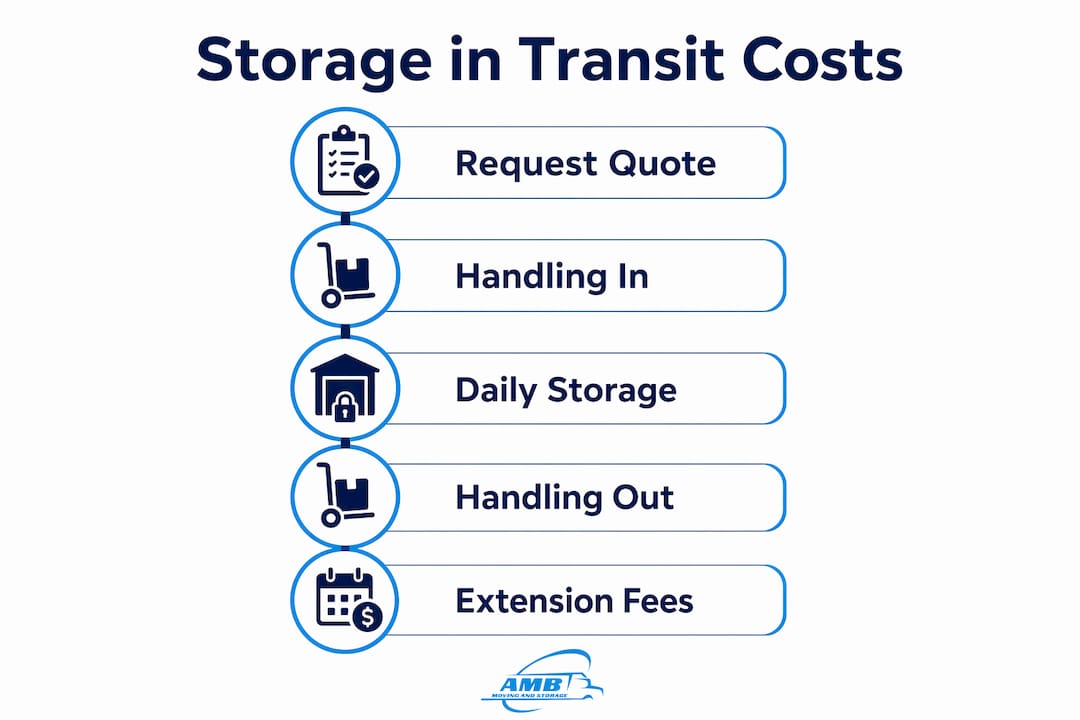
Carriers typically offer a free-time window before standard fees begin. Free time usually runs 1–3 days, after which daily rates apply. Those daily rates generally range from $25 to $100 depending on shipment size and the carrier’s pricing structure. A large household shipment held for two weeks can add several hundred dollars to your total moving cost.
The main cost drivers are:
- Shipment weight or cubic footage: Larger shipments cost more per day to store.
- Duration of holding: Every extra day adds to the bill. Short SIT periods are significantly cheaper.
- Handling events: Each transfer between carrier, warehouse, and delivery agent carries a separate handling fee.
- Location: Warehouse rates in major metro areas tend to run higher than in smaller markets.
Poor delivery coordination is the primary cause of unexpected SIT charges. A family that confirms their move-in date early and communicates it clearly to their carrier avoids most of these extra costs. Use the relocation expenses guide from Ambmovingservices to build a realistic budget that includes accessorial fees from the start.
What are the time limits and insurance considerations for SIT?
SIT is a temporary service with defined time boundaries. Holding periods typically run 30–90 days. Extensions beyond that window must be explicitly agreed upon in writing between you and the carrier. If your goods exceed the agreed SIT period without a formal extension, the carrier may reclassify them as permanent storage, which triggers a different and usually higher rate structure.
Insurance coverage during SIT differs from coverage while goods are actively in transit. Facility operators are responsible for basic security but do not automatically provide full-value replacement insurance. That distinction matters enormously if a fire, flood, or theft occurs at the warehouse.
Follow these steps to protect your belongings during SIT:
- Review your moving contract before signing. Confirm that SIT terms, maximum duration, and insurance coverage are spelled out explicitly.
- Ask about full-value protection. Standard carrier liability is limited. Full-value protection covers repair or replacement at current market value.
- Check your homeowner’s or renter’s insurance policy. Some policies extend coverage to goods in transit or temporary storage. Call your insurer before your move date.
- Document everything before pickup. Photograph high-value items and keep a written inventory. This record is your evidence if a damage claim becomes necessary.
- Get the SIT facility’s insurance certificate. Reputable warehouses carry their own liability coverage. Ask for proof.
Pro Tip: Clear contractual agreements specifying SIT terms and insurance coverage protect you from unexpected liability. Never assume coverage carries over automatically from your transit policy.
How can you reduce SIT costs and manage the process effectively?
The single most effective way to reduce SIT costs is to schedule your final delivery appointment before your shipment even leaves your old home. Early communication with your mover to confirm delivery dates directly reduces SIT time and the fees that come with it. Every day you shave off the holding period is money back in your pocket.
Practical steps that make a real difference:
- Confirm your move-in date as early as possible. Even a tentative date gives your carrier a target window to work toward.
- Use shipment tracking. Tracking tools and alerts flag delivery delays early so you can reschedule appointments before SIT fees accumulate.
- Ask about climate control. If you are storing wood furniture, electronics, or artwork, confirm the facility maintains temperature and humidity controls. Not all warehouses do.
- Avoid peak moving season when possible. Summer months drive up both moving rates and warehouse demand. A fall or winter move often means shorter SIT wait times and lower daily rates.
- Coordinate building access at your destination. Apartment buildings and condo complexes often restrict delivery hours. Book your elevator and loading dock in advance to avoid a same-day delay that triggers SIT.
What most families overlook is that SIT is not just a cost. It is also a coordination tool. When you use it intentionally rather than reactively, it gives you flexibility to handle closing delays, renovation timelines, or travel schedules without forcing a rushed move-in. Ambmovingservices offers storage solutions that integrate directly with your moving plan, so SIT becomes a planned buffer rather than an emergency fix.
Key Takeaways
Storage in transit is a temporary, regulated holding service that protects your household goods and your budget when long-distance move timing does not align perfectly.
| Point | Details |
|---|---|
| SIT is an accessorial charge | Budget for handling and daily storage fees separately from your base moving rate. |
| Free time is limited | Carriers typically offer 1–3 days free before daily fees of $25–$100 apply. |
| Time limits are firm | SIT holding periods run 30–90 days; extensions require written agreement. |
| Insurance differs during SIT | Confirm full-value protection in writing before your goods enter a storage facility. |
| Early scheduling cuts costs | Confirming your delivery date before pickup is the most effective way to minimize SIT fees. |
What I have learned coordinating SIT for interstate families
After coordinating hundreds of long-distance moves at Ambmovingservices, the pattern I see most often is this: families treat SIT as a last resort instead of a planning tool. They call us in a panic two days before their closing falls through, and by then the options are limited and the costs are higher.
The families who handle SIT well are the ones who ask about it during the initial quote conversation. They want to know the daily rate, the facility location, and the insurance terms before they sign anything. That level of preparation takes maybe 15 minutes but saves real money and real stress.
The other misconception I encounter regularly is that SIT means your belongings are sitting on a truck somewhere. They are not. Your goods are unloaded, inventoried, and placed in a secure warehouse facility. That process involves more handling than a direct delivery, which is why documentation matters so much. A missing item is almost always traceable to a handoff where the paperwork was incomplete.
My honest recommendation: treat SIT as a line item in your moving budget from day one. Plan for at least one week of holding time as a buffer, even if you do not end up using it. The cost of that buffer is far lower than the stress of scrambling when your closing date shifts by ten days. For families using nationwide moving services, SIT is not an exception. It is a standard part of the process that works well when you plan for it.
— AMB
Ambmovingservices and your storage in transit needs
Planning a long-distance move means managing details that most families have never dealt with before. SIT is one of those details that can either cost you money or save you stress, depending on how well it is handled.
Ambmovingservices specializes in long-distance moving across all 50 states, with integrated storage solutions built into every move plan. The team coordinates SIT facilities, handles documentation at every handoff, and keeps you informed throughout the holding period. Whether you need two days of temporary holding or a full month, the process is managed so you are never left guessing. Get a free quote at ambmovingservices.com/quote/ and ask about SIT options during your consultation.
FAQ
What is the definition of storage in transit?
Storage in transit (SIT) is the temporary holding of household goods at a carrier’s warehouse or approved facility when final delivery cannot be completed on the original date. It is a standard accessorial service used in long-distance and interstate moves.
How long can goods stay in storage in transit?
SIT holding periods typically run 30–90 days. Extensions beyond that window require explicit written agreement between the customer and the carrier, or the shipment may be reclassified as permanent storage at a higher rate.
Are SIT fees included in my moving quote?
SIT fees are accessorial charges billed separately from your base moving rate. They include handling-in, handling-out, and daily storage fees. Ask your moving company to itemize these costs in your contract before you sign.
Does my insurance cover goods in storage in transit?
Standard carrier liability does not automatically extend full-value coverage during SIT. Confirm full-value protection in writing, and check whether your homeowner’s or renter’s insurance policy covers goods in temporary storage.
How do I avoid unexpected SIT charges?
Confirm your move-in date as early as possible and communicate it clearly to your carrier. Use shipment tracking to catch delays before they extend your holding period. Early scheduling is the most reliable way to keep SIT costs low.