


TL;DR:
- A multi-state move is an interstate move that crosses one or more state lines and is regulated by federal authorities. It requires license verification, written estimates, and adherence to federal rules that influence costs and timing. Proper planning and experience are essential for smooth logistics and compliance across jurisdictions.
A multi-state move is defined as any relocation that crosses one or more state lines, placing your shipment under federal jurisdiction rather than state control. The industry standard term for this is an interstate move, and the two phrases describe the same legal reality. The moment your household goods cross a state border, the Federal Motor Carrier Safety Administration (FMCSA) takes regulatory authority, and a specific set of federal rules governs every aspect of your move. Understanding this distinction protects you from unlicensed carriers and unexpected costs before you sign a single contract.
What does a multi-state move mean legally?
A multi-state move, or interstate move, triggers federal oversight under 49 CFR Part 375, the federal regulation that governs all household goods carriers operating across state lines. This is not optional compliance. Every mover transporting your belongings between states must follow these rules.
The key requirements under federal law include:
- USDOT number: Every interstate carrier must hold an active USDOT number issued by the FMCSA.
- Household Goods operating authority: A USDOT number alone is not enough. Movers must hold a separate “Household Goods” operating authority, which carries stricter consumer protections than standard commercial freight authority.
- Written estimates: Federal rules mandate written estimates and binding contracts for all interstate shipments.
- Consumer rights document: Carriers must provide the document titled Your Rights and Responsibilities When You Move before your move begins.
- Bill of lading: This serves as your legal contract and receipt for the entire shipment.
Intrastate moves, by contrast, stay within one state and fall under state agency oversight, such as a Public Utilities Commission or a state Department of Transportation. The rules, fees, and consumer protections vary widely by state.
Pro Tip: Verify any mover’s credentials on the FMCSA SAFER system before signing anything. You can confirm both a valid USDOT number and active Household Goods operating authority in under 60 seconds.
How does a multi-state move affect costs and pricing?
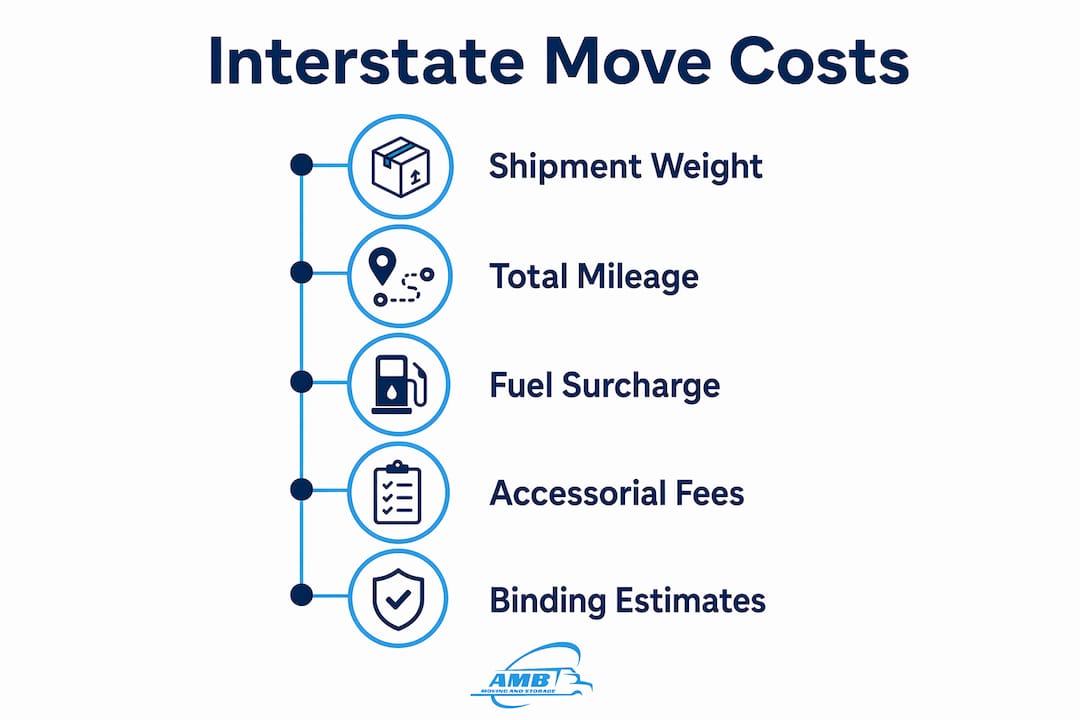
Interstate move pricing works differently from local moves. Local movers typically charge by the hour. Interstate pricing is based on two primary factors: the total weight of your shipment and the distance traveled.
The base cost is called the linehaul rate. For a typical three-bedroom household moving over 1,000 miles, linehaul costs range between $4,000 and $7,000. That figure covers transport only. Additional charges stack on top.
Common accessorial charges include:
- Fuel surcharges: Applied as a percentage of the linehaul rate, adjusted for current fuel prices.
- Packing services: Full or partial packing by the crew adds labor and materials costs.
- Long carries: If the truck cannot park close to your door, carriers charge for the extra distance.
- Stair carries: Multiple flights of stairs at either location trigger additional fees.
- Storage in transit: If your new home is not ready, your goods may go into temporary storage at your expense.
| Cost component | Basis for calculation |
|---|---|
| Linehaul rate | Weight of shipment and total mileage |
| Fuel surcharge | Percentage of linehaul rate |
| Packing services | Labor hours and materials used |
| Accessorial charges | Specific conditions at origin or destination |
| Storage in transit | Daily rate per unit of storage space |
Pro Tip: Request a binding estimate rather than a non-binding one. A binding estimate locks in your price regardless of actual weight, protecting you from surprise charges on delivery day.
What logistical challenges come with multi-state relocations?
A multi-state relocation is not a single transport event. It is a series of jurisdictionally distinct segments that each require their own compliance steps. Treating it as one simple transaction is the most common planning mistake.

Each additional state your shipment passes through or terminates in adds documentation requirements. For vehicle or fleet relocations, each state adds an average of 6 to 14 days to the overall timeline due to individual registration, titling, and documentation rules. Household goods moves face similar friction through permit requirements, weight station compliance, and delivery window coordination.
A phased approach to planning solves most of these problems. Here is how to structure it:
- Confirm federal compliance first. Verify your mover holds both a USDOT number and active Household Goods authority before any other planning begins.
- Map your route and identify state-specific requirements. Some states require advance notice or permits for oversized loads. Know this before moving day.
- Build a realistic timeline. Add buffer days for each state your move crosses. Delays at state borders or delivery windows are common.
- Secure all documentation in advance. Your bill of lading, written estimate, and inventory list should be complete before the truck is loaded.
- Maintain direct communication with your carrier. Confirm delivery windows, driver contact information, and escalation contacts before the truck departs.
“Multi-state moves must navigate different state regulatory frameworks, impacting documentation, costs, and timing. Effective planning requires understanding and coordinating compliance across jurisdictions.” — Ambmovingservices
Choosing a mover with direct experience in state-to-state relocations reduces the risk of delays caused by unfamiliar compliance requirements. Ask any prospective mover how many multi-state moves they complete per year and which states they operate in most frequently.
How do intrastate, interstate, and long-distance moves differ?
These three terms are often used interchangeably, but they describe legally distinct categories. Getting the classification right determines which regulations apply, what consumer protections you receive, and how your mover is licensed.
Intrastate move: Your goods stay within one state from pickup to delivery. State agencies regulate these moves. Consumer protections vary by state and are often weaker than federal standards.
Interstate move: Your goods cross at least one state line. Federal FMCSA rules apply immediately, regardless of distance. A move from northern New Jersey to Philadelphia, Pennsylvania, for example, is federally regulated even though the physical distance may be under 30 miles.
Long-distance move: This is an industry trade term, not a federal legal category. The moving industry generally defines a long-distance move as one covering more than 100 miles. A long-distance move within one state is still intrastate and regulated by state law, not federal law.
The distinction matters for three practical reasons:
- Licensing: Only federally licensed carriers can legally perform interstate moves.
- Pricing: Interstate moves use weight and distance pricing. Intrastate moves may use hourly rates.
- Consumer protections: Federal rules under 49 CFR Part 375 provide stronger, more consistent protections than most state equivalents.
The clearest way to classify your move is simple. If your goods cross a state line at any point, your move is interstate. If they stay within one state regardless of distance, it is intrastate. The federal versus state distinction is the one that controls your legal rights.
Key Takeaways
A multi-state move is legally an interstate move, placing your shipment under FMCSA federal authority the moment it crosses a state line, which determines your pricing structure, mover licensing requirements, and consumer protections.
| Point | Details |
|---|---|
| Federal jurisdiction applies | Any move crossing a state line falls under FMCSA rules, not state agency oversight. |
| Verify Household Goods authority | Movers need more than a USDOT number. Confirm active Household Goods operating authority on FMCSA SAFER. |
| Pricing is weight and distance based | Interstate moves use linehaul rates, not hourly rates, with accessorial charges added on top. |
| Plan for multi-state complexity | Each state crossed adds documentation and timeline requirements. Treat it as a phased process. |
| Classification drives your rights | Interstate, intrastate, and long-distance are distinct categories with different legal and pricing consequences. |
What experience with multi-state moves has taught us
The biggest mistake people make is assuming a multi-state move is just a longer version of a local move. It is not. The regulatory environment changes the moment you cross a state line, and that changes everything from how your mover is licensed to how disputes are resolved.
We have seen clients arrive at delivery day without a binding estimate, only to face a bill significantly higher than the original quote. Federal rules require written estimates, but not all carriers explain what “non-binding” actually means in practice. A non-binding estimate can legally increase by up to 10% over the original quote on delivery. Knowing that before you sign protects you.
The other pattern we see consistently is underestimating the timeline. Clients plan for a five-day move and end up waiting ten days because they did not account for delivery windows, state permit requirements, or storage-in-transit delays. Building a realistic buffer into your schedule is not pessimism. It is good planning.
The movers who handle multi-state relocations well are the ones who treat compliance as a core competency, not an afterthought. Ask your mover directly: “What states do you operate in most, and how do you handle compliance across jurisdictions?” The answer tells you everything about their experience level.
— AMB
Ambmovingservices is ready for your multi-state move
Planning a multi-state relocation means managing federal regulations, weight-based pricing, and multi-jurisdiction logistics all at once. Ambmovingservices specializes in exactly this type of move, operating as a licensed nationwide moving company with active FMCSA Household Goods authority.
Whether you need long-distance moving services for a cross-country household relocation or a fully managed interstate move with packing and storage, Ambmovingservices provides written estimates, transparent pricing, and direct support for every compliance requirement your move involves. Get a personalized quote and know exactly what your move will cost before the truck is loaded.
Get your free moving quote today and work with a team that knows federal moving regulations from the ground up.
FAQ
What does multi-state move mean in simple terms?
A multi-state move means relocating your household goods across one or more state lines. The industry term is an interstate move, and it places your shipment under federal FMCSA regulation.
Is a multi-state move the same as a long-distance move?
Not always. A long-distance move covers more than 100 miles but may stay within one state. A multi-state move crosses a state line, which triggers federal regulation regardless of distance.
How do I verify a mover is licensed for interstate moves?
Check the FMCSA SAFER system for both a valid USDOT number and active Household Goods operating authority. A USDOT number alone does not confirm the mover is licensed for household goods shipments.
What federal document must interstate movers provide?
Interstate movers must provide the document titled Your Rights and Responsibilities When You Move before the move begins. This is required under 49 CFR Part 375.
Why does interstate pricing differ from local move pricing?
Interstate pricing is based on the weight of your shipment and the total distance traveled. Local moves typically charge by the hour. Federal regulations also require written estimates and binding contracts for all interstate moves.