
October 28, 2026
Partial Packing vs Full Packing: Which Fits Your Move?
Partial packing vs full packing for an interstate move: what each covers, how it is priced, how it affects liability, and a simple way to choose.

Full packing means the moving crew packs every box in your home. Partial packing means the crew packs only part of it, usually the fragile, awkward or high-value items, and you pack the rest. Full packing costs more and saves the most time. Partial packing keeps the bill lower and leaves you in charge of the everyday belongings. For a long-distance move, the right choice depends on your timeline, your budget and how much of your inventory would be expensive or hard to replace.
Below we explain what each option includes, how packing is priced, how it can affect liability if something breaks, and how to split the work so you pay for professional packing only where it earns its cost.
TL;DR
- Full packing: the crew packs every room and supplies the materials. It is the fastest and most hands-off option, and it costs the most.
- Partial packing: the crew packs selected rooms or items (kitchen, china, art, electronics) and you pack the rest. It is the usual middle path for a budget-conscious interstate move.
- Price: our professional packing runs $1-2 per cubic foot, so the total depends on how much volume you hand over, not on a flat label.
- Liability: read your contract. Moving contracts often limit liability to items the mover packs, and valuation coverage is a separate decision.
- Next step: get moving cost estimates that price both options side by side, then decide.
Table of Contents
- What Is the Difference Between Full and Partial Packing?
- What the Crew Packs, and What You Still Handle
- Can You Choose Specific Rooms or Items?
- How Packing Is Priced
- Packing Choices and Liability on an Interstate Move
- How to Decide: A Five-Question Test
- Prepare Before the Crew Arrives
- Our Perspective on Partial vs Full Packing
- Get Packing and Moving Cost Estimates in One Place
- Frequently Asked Questions
- Sources
What Is the Difference Between Full and Partial Packing?
The difference is who packs what, and who is responsible for the contents of each box.
Full packing is a packing service in which the crew packs everything that needs a box, wrap or crate. That normally covers kitchens, closets, bookshelves, bathrooms, garage items and decor, plus the materials. You are not expected to touch a box before the truck arrives.
Partial packing hands the crew only the items you choose. Common choices are the kitchen, dishes and glassware, mirrors and artwork, lamps, electronics, and anything with sentimental or resale value. You pack books, clothing, linens, toys and the rest.
The third option, packing everything yourself, is not what this article compares, but it sets the baseline. Both professional options sit on a spectrum between doing it all yourself and doing none of it.
| Full packing | Partial packing | |
|---|---|---|
| Who packs | Crew packs every room | Crew packs chosen rooms or items, you pack the rest |
| Your time before moving day | Minimal, mostly sorting and decluttering | Moderate, you still pack most everyday items |
| Cost | Highest | Lower, scales with what you hand over |
| Best for | Tight timelines, large homes, no help available | Budget control, a few fragile or valuable categories |
| Control over how things are packed | Lower | Higher for items you pack |
| Typical risk | Higher bill, less visibility into what went where | Mixed packing quality if boxes are not sealed and labeled well |
What the Crew Packs, and What You Still Handle
No packing option covers every item in a home. Crews decline some categories for safety and legal reasons, whether you chose full or partial service. Flammables, aerosols, propane, cleaning chemicals, ammunition and perishable food are typical examples, and you should also expect to carry valuables such as jewelry, passports, medications and important documents yourself. Our checklist of items movers won’t move lists the categories to plan around before packing day.
Within what a crew will pack, the split usually looks like this.
Items worth handing to the crew
- Kitchen: dishes, glassware and small appliances take the longest to pack and break the easiest. Crews wrap them in a repeatable way that holds up over a multi-state drive.
- Mirrors, framed art and décor: these need the right-size cartons or crates, not a stack of generic boxes.
- Electronics and TVs: the original box is often long gone, and a crew can build a proper fit.
- Heavy specialty items: disassembly and crating for pianos, safes and similar pieces is a job for professionals, not a weekend task. We handle specialty items from $200.
Items most households can pack themselves
- Books, in small boxes so they stay liftable.
- Clothing, linens and shoes.
- Toys, tools and garage supplies.
- Closet contents and bathroom items you can sort quickly.
The pattern is simple: pay for skill where damage is likely, and use your own time where a mistake costs little.
Can You Choose Specific Rooms or Items?
Yes. That is the point of partial packing. You can ask a crew to pack only the kitchen, only fragile items, or only the rooms you will not have time to reach. The practical requirement is that you decide before the estimate, so the estimate reflects the real scope. A crew that arrives expecting a kitchen and finds an entire house to pack is a scheduling problem and a billing problem.
When you request estimates, describe the scope in plain terms:
- Name the rooms or categories you want packed.
- State what will be packed by you before the crew arrives, and by what date.
- Ask how the estimate changes if you add or remove a room later.
- Ask whether packing materials are included in the price. A professional moving organization advises asking whether all materials, including boxes and plastic wrap, are included when comparing three companies.
How Packing Is Priced
Most packing quotes combine labor, materials and, sometimes, accessorial charges. The factors that move the price are consistent across moves:
- Volume of what is packed. More cubic feet means more labor and more cartons.
- Fragility and item type. Dishes, art and electronics take more material and time than linens.
- Access. Stairs, elevators and long carries can add charges. We list elevator and stair fees from $75 and long carry charges from $75.
- Timing. A last-minute pack day is harder to staff than one booked weeks ahead.
Our professional packing is priced at $1-2 per cubic foot. As a simple illustration of that rate, if a crew packs 500 cubic feet of belongings, the packing line would fall between $500 and $1,000. If you hand over only the kitchen and fragile items, the volume is smaller, and so is the bill. If you hand over the whole house, the volume rises and so does the total. That is why the right comparison is never full vs partial as a label, but the cubic feet you are handing over.
Federal rules also govern how estimates work. Movers must specify the form of payment on estimates and determine charges for accessorial services before preparing the order for service and bill of lading. In plain terms, packing, stairs and similar extras should be written down before moving day, not discovered on it.
If you store part of your belongings between homes, storage is priced separately. Our storage services start from $0.50 per cubic foot, and the current rates are on our moving cost guide.
Packing Choices and Liability on an Interstate Move
This is the part many comparison pages skip, and it is where packing choices have real consequences.
For interstate moves, movers must offer Full Value Protection, which provides replacement value for lost or damaged goods, and a level of liability limited to 60 cents per pound per article. Those are contractual levels of liability, not insurance in the strict sense. Under the lower level, a 50-pound television that is destroyed is valued at 50 times $0.60, or $30. Our guide to Full Value Protection for interstate moves walks through that math in detail.
Packing enters the picture in a few ways:
- Contract language. Moving contracts often limit liability to items the mover packs. If you pack a box yourself, ask in writing how a claim for its contents would be handled.
- Carrier-specific terms. Published tariffs can carve out categories. One state-filed tariff, for instance, says the carrier is not liable for damage to internal electronic or mechanical items, whether packed by the carrier or the shipper. Terms vary by carrier, so read yours.
- Acceptance at delivery. The same tariff treats acceptance of a shipment by the shipper’s or consignee’s representative as acceptance of the property and the shipment’s terms and conditions. Note any visible damage on the paperwork before you sign.
If you choose the lower level of protection, FMCSA suggests you may want separate third-party insurance, and check first whether your homeowner’s policy already covers you. Our pages on homeowners insurance and moving and moving insurance for interstate moves cover how those layers fit together, and this overview of transport insurance for moves explains how goods-in-transit cover works from the insurance side. Be careful with add-on policies too: our explainer on third-party moving insurance shows where payouts can fall short.
The practical takeaway: if a box contains something you could not easily replace, either let the crew pack it or photograph and document it before sealing, and choose your protection level knowing the numbers.
How to Decide: A Five-Question Test
Use these questions in order. Most households have an answer by the third.
- How many weeks until moving day? With 60 days, you can pack most of a house yourself in evenings and weekends. With two weeks, full packing starts to make sense.
- Is anyone able to pack during the day? Two working adults with young children rarely finish a three-bedroom home in a month. A kitchen alone can take a full weekend.
- What would hurt to lose? List the breakables, electronics and heirlooms. Those go to the crew in a partial pack.
- What does the budget allow? Price your scope at both levels. If the gap is small, full packing may be worth it. If large, partial gives you most of the protection.
- How long is the haul? A cross-country drive means more vibration, more handling and more days in the truck than a short move, so poorly packed boxes are less forgiving.
Scenarios from real interstate moves
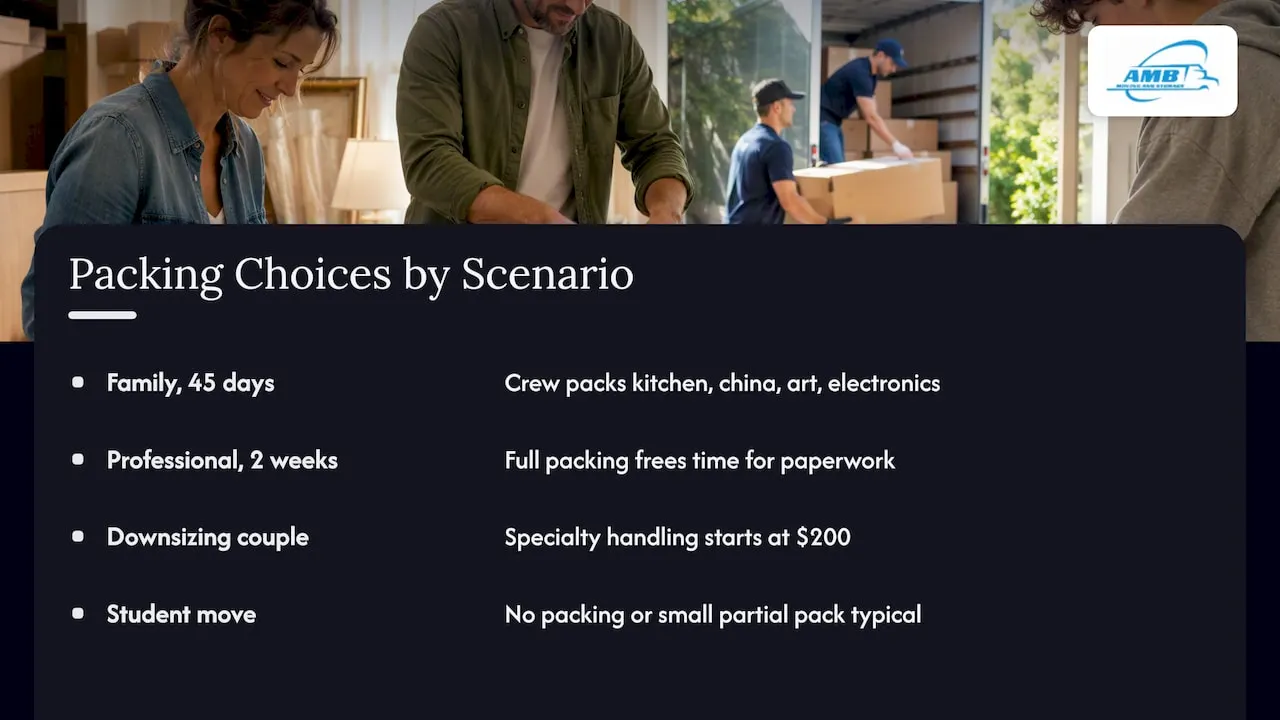
A family of four, three-bedroom home, 45 days out. They pack closets, toys, books and the garage themselves. The crew packs the kitchen, dining room china, wall art and the home office electronics. This is the classic partial pack.
A relocating professional with two weeks’ notice. The employer’s start date will not move. Full packing removes the biggest bottleneck, and the household spends its time on paperwork, school records and the new home.
A downsizing couple. They are sorting decades of belongings anyway. They pack personal items, sell or donate the rest, and hand the crew only the glassware, a piano or a safe, which we price as specialty handling from $200.
A student or first-apartment move. Very little needs professional wrapping, so no packing or a small partial pack is typical. If that is you, see how we handle student moves.
Prepare Before the Crew Arrives
Whichever level you pick, the same preparation makes the day smoother:
- Declutter first. Every item you remove is cubic footage you do not pay to pack or ship.
- Finish your own packing before the crew arrives, and seal and label each box by room.
- Set aside a “keep with me” box or bag with documents, medications, chargers and a few days of essentials.
- Walk the home with the crew lead, point out what is and is not to be packed, and confirm it matches the estimate.
- Photograph high-value items and keep a short inventory of what is in the boxes you packed.
- Verify the company before signing. FMCSA tells consumers to check the mover in its registered-mover database and review the federal booklet on their rights and responsibilities.
Our Perspective on Partial vs Full Packing
We move households across state lines, and we see the same pattern. People overpay when they choose a label instead of a scope, and they take on risk when they save money on the wrong boxes. Full packing is excellent when time is the real constraint. It is not the best value for a household with two months and a willingness to pack closets. Partial packing works best when you decide, room by room, where professional skill matters.
Our advice is to ask for the estimate both ways. Put the kitchen, fragile items and electronics in one version, and the whole house in the other. Then compare cubic feet, materials, accessorial fees and the valuation option, not just the total. An estimate that spells all of that out is a sign of a mover who plans carefully. It also lets you build a budget with your eyes open, using our moving cost guide to see how packing, storage and access fees fit together.
— AMB
Get Packing and Moving Cost Estimates in One Place
AMB Moving & Storage Inc. is a licensed and insured nationwide moving company that handles long distance moving, interstate moves and nationwide relocations for homeowners, families and businesses. Our professional packing services can cover a whole home or only the rooms and items you pick. Tell us your destination, timeline and which rooms you want packed, and we will build moving cost estimates around that scope. Request your quote.
Frequently Asked Questions
Can movers pack only the kitchen?
Yes. Kitchens are the most common partial packing request because dishes, glassware and small appliances take the longest and break the easiest. Tell the mover before the estimate so the volume and materials are priced correctly. You can then pack the rest of the house at your own pace.
Is partial packing cheaper than full packing?
Usually, yes, because you pay only for the volume the crew packs. Our packing is priced at $1-2 per cubic foot, so handing over fewer cubic feet lowers the packing line directly. Whether the savings are worth your time depends on your schedule and how much fragile property you own.
Does packing it myself affect damage claims?
It can. Moving contracts often limit liability to items the mover packs, and terms differ by carrier. Read the contract and ask in writing how a claim for a box you packed would be treated. Your protection level matters too: Full Value Protection covers replacement value, while Released Value Protection is limited to 60 cents per pound per article.
Can I change my mind about packing after getting an estimate?
Often you can, but the price will change with the scope, and a late change is harder to staff. Ask how adding or removing a room is handled before you sign, and get any revision in writing. Early decisions keep the move on schedule and the final bill close to the estimate.
What should I never pack in boxes for the movers?
Keep valuables and essentials with you: jewelry, passports, medications, laptops and important documents. Movers also decline hazardous and perishable items, such as flammables, aerosols and open food. Check the list of items movers won’t move before packing day.
Sources
- Summary of Transportation of Household Goods, Consumer Protection Regulations (FMCSA)
- Tips for a Successful Move (FMCSA)
- Frequently Asked Questions (FMCSA)
- Protect Your Move (FMCSA)
- Choosing a Mover: Right Mover guide
- Household goods carrier tariff filed in Massachusetts
- Transport insurance for moves