
October 24, 2026
How to Pack Glassware for Moving: Step-by-Step Guide
Learn how to pack glassware for a move: wrap, box and label glasses and stemware, and see how packing affects damage claims on interstate moves.

To pack glassware for moving, wrap every piece on its own in packing paper, stand glasses on their rims in a small, sturdy box with dividers, fill every gap so nothing shifts, and label the box fragile with the side that faces up. That takes about two minutes per glass. If your move crosses state lines, one more decision matters as much as the wrapping: who packs the box. It changes what you can recover if something breaks.
This guide covers both: the hands-on method for everyday glasses, wine glasses and heirloom crystal, and the claim rules that apply to long-distance moves.
TL;DR
- Wrap each glass separately, pad the bottom of the box, stand glasses upright on their rims, and leave no empty space.
- Use small, strong boxes with dividers, and keep fragile boxes under 45 lb.
- On an interstate move, items you pack yourself can limit what the mover owes you if they break. Fine crystal and china are the usual candidates for professional packing.
- Under basic Released Value protection, a damaged item pays 60 cents per pound. Ask for Full Value Protection and declare high-value pieces in writing.
- We can pack your glassware for you. See our packing services or request a quote.
Table of Contents
- Why glassware breaks in a move
- Supplies you need before you start
- How to pack everyday glasses and tumblers
- How to pack wine glasses and stemware
- Weight, box size and stacking
- Wrapping the glass you can’t replace
- Who packs it matters: your coverage on an interstate move
- Valuation: what a broken glass is worth on paper
- What professional glass packing costs
- Our perspective on packing glassware
- When to start and how to schedule it
- If something arrives broken
- Moving long distance with AMB
- FAQ
- Sources
Why glassware breaks in a move
Glass rarely breaks because a box was dropped from a great height. It breaks in the quiet ways: a gap that lets glasses knock together for 1,500 miles, a box so heavy the bottom gives way, or a stack on top that crushes a thin rim. Stemware fails at the stem and the rim, the two thinnest parts. Heavy tumblers fail when they hit each other.
Every step below goes after one of those three causes: contact between pieces, movement inside the box, and weight on the box. A long-distance move adds hours of vibration, several loading and unloading handoffs, and stacking in a truck with other households’ goods or your own. Pack as if the box will be shaken for days, because on a cross-country move it will be.
Supplies you need before you start
Buy or collect supplies before you wrap anything. Stopping halfway to find tape is how people end up wrapping with newspaper and tucking in towels.
- Clean packing paper. Plain, unprinted paper is better than newspaper, which leaves ink on glass and on your hands. Buy more than you think you need. Glassware eats paper.
- Small or medium corrugated boxes. Choose new or lightly used double-wall boxes where you can. A big box full of glasses becomes too heavy and too tempting to overload.
- Cell dividers (a glass pack kit). These cardboard grids keep each glass in its own cell. They are the best protection for stemware.
- Bubble wrap. Use it for the outer layer on delicate or heirloom pieces, and for padding the bottom.
- Packing tape and a marker. Tape every seam, top and bottom, and label the box on the top and at least two sides.
- Padding for gaps. Crumpled paper, foam sheets or towels you do not mind packing.
One point on cost: when a mover uses its own paper and bubble wrap as part of a service, the tariff rules may spell out whether those materials are included in the rate or charged separately. New York’s mover guide, for instance, has a rule on packing supplies and protective materials. Ask your mover for the line item in writing before packing day.
How to pack everyday glasses and tumblers
This method suits drinking glasses, mugs and water tumblers, and it works for most kitchen glassware.
- Build the base. Tape the bottom of the box twice along the seam. Add 2 to 3 inches of crumpled paper or a layer of bubble wrap.
- Wrap one glass at a time. Lay a sheet of paper flat, set the glass near one corner, and roll it diagonally, tucking in the sides as you go. Add a second sheet for heavier glasses. Wrap the rim with an extra layer.
- Pack heavy items first. Heavier tumblers and thick-walled glasses go on the bottom layer. Lighter, thinner ones go higher.
- Stand them on their rims. Glass is strongest along its rim, so place wrapped glasses upright rather than lying on their sides. Pack them snugly in rows, with a paper layer between each row.
- Fill every gap. Press down lightly on the contents. If anything shifts or you hear a clink, add more paper.
- Add a cushion on top. Finish with a crumpled layer so the lid does not rest on rims.
- Seal and label. Tape the top, write “FRAGILE: GLASS” and “THIS SIDE UP,” and note the room it belongs in.
Mugs and cups with handles follow the same method. Wrap the handle in extra paper because it is the first thing to snap.
How to pack wine glasses and stemware
Stemware is the hardest category, so give it a dedicated box with cell dividers if you can.
- Use dividers or build your own. A cell kit gives each glass its own compartment. If you have none, wrap each glass well and place them in rows separated by thick paper layers.
- Wrap the stem first. Roll a sheet loosely around the stem and the base, then wrap the bowl. Twist the paper at the top of the bowl, then tuck it inside.
- Stuff the bowl lightly. A small wad of paper inside the bowl adds crush resistance. Do not pack it so hard that it pushes the sides out.
- Stand them upright. Place stems pointing up, bowls resting against the cell wall, not against each other.
- Do not stack layers on delicate stems. Put a firm paper layer and divider between levels.
- Label the box. Mark it “FRAGILE: STEMWARE” and keep it on top in the truck, not underneath.
For decanters, pitchers and glass vases, wrap the neck and any spout in extra bubble wrap, then place the piece in its own small box with foam or paper on every side. Glass stoppers travel separately in their own wrapping so they cannot chip the neck.
Weight, box size and stacking
The heavier the box, the more likely the bottom fails or a handler drops it. We recommend that you keep fragile boxes under 45 lb on long-distance moves. Glass packs dense, so a small box reaches that limit faster than you expect. Lift the box before you tape it shut. If you struggle to carry it, move some glasses into another box.

On load day, tell the crew which boxes hold glass. Fragile boxes should ride on top of sturdy boxes, never at the bottom of a stack and never under furniture.
Wrapping the glass you can’t replace
Family crystal, a collection of decanters or a set from a grandparent deserves more than the standard method:
- Wrap each piece in paper, then in a layer of bubble wrap, then in paper again.
- Put each wrapped piece in a small box of its own, or in a cell compartment with padding on all sides.
- Photograph each piece before packing, along with any appraisal or receipt. If a claim ever arises, that file counts.
- Keep a written list of what is in each box.
Before deciding to pack these yourself, read the next section.
Who packs it matters: your coverage on an interstate move
Most packing guides stop at the tape. On a long-distance or interstate move, the rules about liability are part of the packing decision.
The federal consumer rules say that in general your mover is legally liable for loss or damage during the transportation and the related services listed on the bill of lading, according to the Federal Motor Carrier Safety Administration (FMCSA). There are exceptions, and packing your own boxes is one of them. The FMCSA lists this among the actions that may limit a mover’s liability: packing your own boxes. Its handbook also notes that improper packing of containers you pack yourself can leave you without protection when damage results from it, as described in Your Rights and Responsibilities When You Move.
New York’s state transportation department gives balanced advice in its summary for household goods shippers: the care with which goods are packed determines their condition on arrival, and doing it right yourself can save money. Government guidance for relocating federal employees goes further for the most fragile goods and advises against packing your own china and glassware.
In practice, this gives you a simple rule:
| Item | Reasonable approach |
|---|---|
| Everyday glasses, mugs, tumblers | Pack yourself with good boxes, or add them to a professional packing order |
| Wine glasses and stemware | Professional packing if budget allows, or dividers and a careful DIY job |
| Fine crystal, heirloom pieces, collectibles | Professional packing, plus written declaration of value |
| Mirrors, glass tabletops, framed glass art | Custom crating or specialized packing |
If you pack yourself, expect a harder conversation if something breaks. A mover may argue that the cause was packing, not handling, and the movers also may refuse to load boxes they judge too flimsy. That is a common arrangement on long-distance moves, and it is one of the reasons professional packing exists.
Valuation: what a broken glass is worth on paper
There is a second part that surprises people. Even when the mover is liable, the amount depends on the protection level you chose.
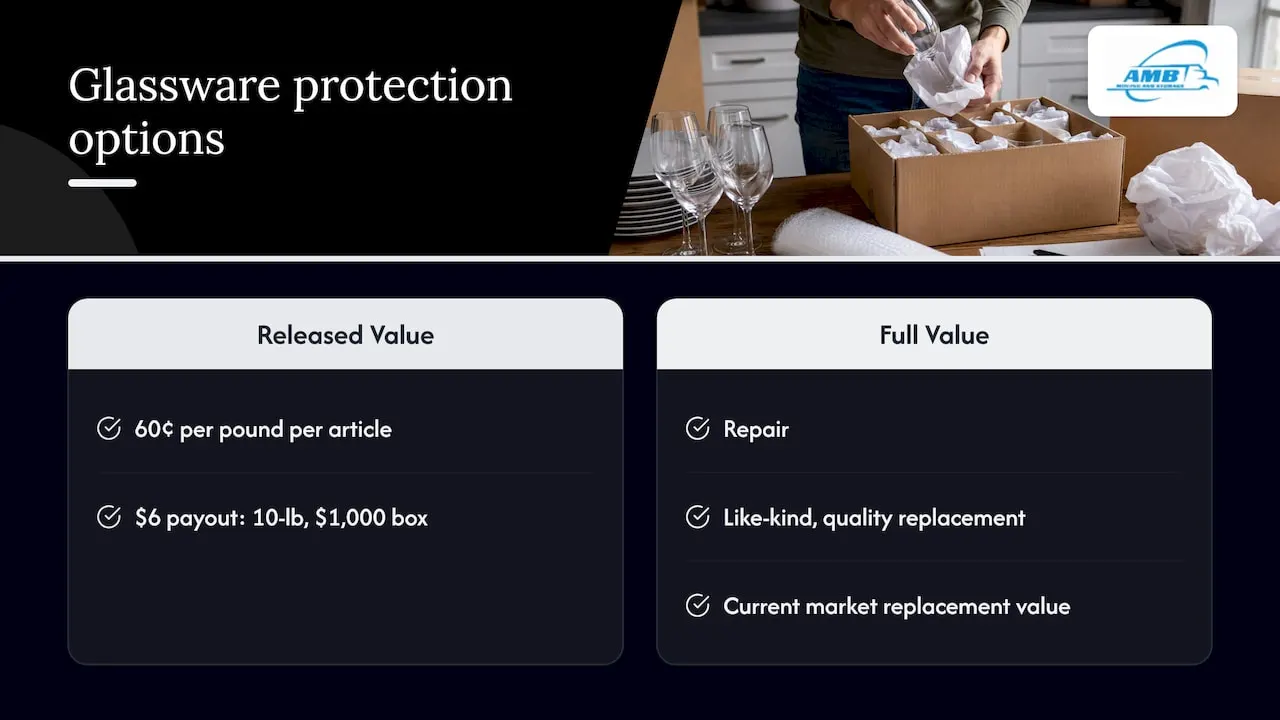
Under basic Released Value protection, compensation is limited to 60 cents per pound per article, according to FMCSA guidance. Do the math on glassware: a 10-pound box of glasses worth $1,000 would bring back $6.00. With Full Value Protection, the mover must repair, replace with like kind and quality, or pay current market replacement value. The FMCSA also says that Full Value Protection must be included in the estimate unless you waive it in writing, so read the paperwork before you sign. For a deeper explanation, read our guide to Full Value Protection on interstate moves and our overview of moving insurance for interstate moves.
Declare items of extraordinary value
An article of extraordinary value is one worth more than $100 per pound, such as fine china or crystal, and the FMCSA says these must be listed in writing on the shipping documents. Without that, recovery can be restricted even if you bought the higher coverage. Before packing day:
- Pick out the pieces that may qualify, and weigh them roughly.
- Photograph them and gather receipts or appraisals.
- Ask the mover how to list them on the inventory and bill of lading.
- Keep your copies.
What professional glass packing costs
Professional packing is priced on volume. Our published rate for packing services is $1-2 per cubic foot. For a kitchen with glassware, dishes and breakables, that is a small share of the total, and it moves the packing risk to a crew that packs for a living. Specialty items such as pianos and safes start from $200, and storage starts from $0.50 per cubic foot, as listed in our moving cost guide.
A practical middle path many families choose: pack books, linens and clothes yourself, and hand the kitchen and dining room to the crew. You save labor where mistakes are cheap and pay for expertise where they are not. Mixed packing is easy to arrange. Tell us at the estimate stage which rooms you want packed so the moving cost estimate reflects it.
Our perspective on packing glassware
We move households across state lines, and we see the same pattern: the claims people worry about on moving day are rarely the big furniture pieces. They are the boxes of glassware that were packed in a hurry the night before.
Our advice is plain. Pack what you can afford to replace, and let professionals pack what you cannot. Start the kitchen at least two to three weeks before a cross-country move, since glassware takes longer than most people plan. Keep boxes small. Mark them clearly. For crystal and anything with sentimental value, tell your mover before the estimate, not on load day, so protection and paperwork match what is actually in the truck.
We also believe the valuation choice deserves as much time as the packing choice. A well-wrapped glass that is covered at 60 cents per pound is still a weak position, and we would rather you understand that before the truck arrives than after.
— AMB
When to start and how to schedule it
A workable timeline for a move 30 to 60 days out:
- Four to six weeks before: Decide who packs which rooms. Request estimates and ask about valuation options. Order supplies.
- Three weeks before: Pack glassware you do not use daily: serving pieces, decanters, holiday sets, crystal.
- One week before: Pack the everyday glasses, leaving four to six per person for the last days.
- Moving day: Keep paper cups in your essentials box. Point out fragile boxes to the crew.
- At delivery: Check box exteriors before you sign anything, and note visible damage on the paperwork.
If something arrives broken
Do not throw anything away. The FMCSA says to contact the mover immediately, tell them about the loss or damage and file a claim, and to list the missing and damaged items. Keep the box, the paper and the broken pieces until the claim is settled, and photograph everything where it lies. Your inventory, photos and receipts from before the move now carry the weight.
Moving long distance with AMB
We are a licensed and insured nationwide company handling long-distance moving, interstate and state-to-state relocations and nationwide moving services for families and businesses. Our crews can pack your kitchen, glassware and china, and we can store items before delivery if your new home is not ready.
If you are comparing interstate movers or cross-country movers, ask each one the same questions: Who packs fragile items? What valuation level is in the estimate? How do I declare high-value pieces? Then send us your inventory and request a quote for a clear moving cost estimate with packing options listed.
FAQ
What is the best way to pack wine glasses when moving?
Use a box with cell dividers, wrap each glass in packing paper starting at the stem, and stand the glasses upright. Pad the bottom and top and fill the gaps. Label the box fragile and ask the crew to load it on top.
Should glasses be packed vertically or horizontally?
Vertically, resting on their rims, which are the strongest part of the glass. Laying glasses on their sides puts pressure on the thin walls and stems. Add a paper layer between rows and cushion every gap.
Will movers pay for glass I packed myself?
Not always. The FMCSA lists packing your own boxes among the actions that may limit a mover’s liability, and a mover may dispute a claim if the packing caused the damage. Ask your mover how it handles claims for owner-packed boxes before you decide.
How long before a move should I start packing glassware?
Two to three weeks before is a sensible start for a long-distance move. Begin with the pieces you rarely use, such as crystal and serving dishes. Keep a few everyday glasses out until the last week.
Do I need extra coverage for expensive crystal?
Possibly. Basic Released Value pays 60 cents per pound per article. Full Value Protection offers more, but items worth over $100 per pound must be listed in writing as extraordinary value. Talk to your mover before the move.
Sources
- Before Requesting Services from Any Mover (Subpart B), FMCSA
- Protect Your Move Brochure, FMCSA
- Your Rights and Responsibilities When You Move, FMCSA
- Discovered Loss and/or Damage to your Household Goods Shipment, FMCSA
- Summary of Information for Shippers of Household Goods, New York State DOT
- The Mover’s Guide to Transporting Household Goods in New York State
- Shipment of Household Goods, Program Support Center