


For most cross-country moves, the smartest way to handle mattress moving across country is to bundle it into a full long-distance shipment with a professional mover or, for a single mattress traveling alone, book it as LTL freight. Either route beats parcel shipping on cost and damage risk for anything larger than a compressed twin. Budget a moderate amount depending on method and distance, and replace rather than ship any mattress older than seven years or already sagging.
TL;DR:
- Shipping a single mattress as part of a full household move is generally cheaper and safer than shipping it alone, especially if under five years old.
- Cross-country costs for shipping vary by method, with courier services around $130 to $210, LTL freight approximately $613 to $776, and higher costs for larger, bulky moves involving containers.
- Proper packing, including double-bagging and correct compression for different mattress types, is essential to prevent damage and ensure insurance claims are valid.
- Reliable scheduling requires confirming addresses, requesting delivery windows, and ensuring someone is available to receive the mattress to avoid delays and extra costs.
- For longevity and cost reasons, consider replacing older or sagging mattresses rather than shipping, especially if shipping costs exceed a significant portion of new mattress prices.
Table of Contents
- Best Ways to Move a Mattress Long Distance
- How Much Does It Cost to Move a Mattress Cross Country?
- How to Pack a Mattress for a Long-Distance Move
- Loading and Securing a Mattress for Transit
- Insurance and Liability: What Happens If Your Mattress Is Damaged?
- Should You Move Your Mattress or Buy a New One?
- How Long Does It Take to Ship a Mattress Cross Country?
- AMB’s Recommended Workflow for Interstate Mattress Moves
- Are There Rules on Transporting Used Mattresses Across State Lines?
- Sustainable Options for Mattress Disposal or Reuse
- Coordinating Pickup and Delivery Across State Lines
- What I’ve Learned Handling Interstate Mattress Shipments
- Get a Quote for Your Interstate Mattress Move
- Sources
Best Ways to Move a Mattress Long Distance
Six methods handle mattress moving across country, and the right one depends on whether you’re shipping one item or an entire household.
- Full-service movers (bundled with your move): Best overall value for a full household relocation. Adding a mattress to an existing shipment usually costs far less than shipping it alone, since you’re only paying incremental weight, not a new minimum charge.
- LTL/freight: Best for a single mattress traveling alone, especially innerspring or hybrid models that need pallet support. Typical cross-country cost runs several hundred dollars depending on mattress type and carrier.
- UPS/FedEx ground (vacuum-sealed or boxed): Best for compressed memory foam or latex mattresses in smaller sizes. Cheapest option by dollar amount, but oversize and dimensional-weight fees erase the savings fast on queen and king sizes.
- PODS/portable container: Best when you’re moving a mattress plus a garage full of other items and want a flexible loading schedule. Costly for a single mattress.
- Truck/van rental (one-way): Best for hands-on movers relocating an entire apartment who don’t mind driving and loading themselves.
- Peer-to-peer hauling (uShip, GoShare): Best for budget-conscious shippers on regional routes who are willing to accept variable service quality and lighter insurance coverage.
If you’re already planning a household move, start with long distance moving services rather than treating the mattress as a separate shipping problem.
How Much Does It Cost to Move a Mattress Cross Country?
Cost depends less on distance than on dimensional weight, and that single factor trips up more first-time shippers than anything else.
Courier shipping (UPS/FedEx Ground) runs about $130 for shorter regional distances up to roughly $210 for full cross-country routes, assuming the mattress is vacuum-sealed and reasonably sized. Uncompressed queen and king mattresses often trigger oversize surcharges that carriers apply based on combined length and girth, and those penalties can add anywhere from $100 to $900 on top of the base rate, depending on carrier and route. That swing alone explains why two people shipping the same mattress size can get wildly different quotes.

LTL freight for a cross-country single mattress typically lands in the $613 to $776 range, with minimums that make it a poor fit for short trips but a solid one for long hauls, especially for spring or hybrid mattresses that need a pallet underneath them.
Bundling with a full-service move is usually the cheapest per-item option. Movers price by total shipment weight, so a queen mattress added to an existing interstate load might add a modest incremental charge rather than a whole new line-item minimum. Nolah Sleep’s guidance to movers confirms what most logistics coordinators already know: including the mattress in your larger household shipment beats shipping it solo in nearly every case, because standalone shipments run into fixed minimums that a bundled item skips entirely.
PODS and one-way truck rentals make sense mainly when you’re moving more than a mattress. Cross-country PODS pricing can run into the multiple thousands depending on container size and route, so using one just for a mattress rarely pencils out.
Peer-to-peer hauling platforms like uShip or GoShare often undercut standard carriers by 20 to 40 percent on regional lanes, but you’re trading price for consistency. Insurance coverage tends to be thinner, and service quality varies driver to driver.
What actually drives the price:
- Size and weight (king and California king cost more everywhere)
- Combined length plus girth (the number that triggers oversize fees)
- Total distance and specific lane (some cross-country routes have better freight availability than others)
- Residential pickup and delivery versus terminal drop-off
- Fuel surcharges and peak-season pricing, which spike around summer months when moving volume nationwide peaks
Quick cost snapshot by method:
| Method | Typical cross-country cost | Best for |
|---|---|---|
| UPS/FedEx Ground | $130–$210+ (plus oversize fees) | Compressed foam, single item |
| LTL freight | $613–$776 | Single mattress, no other cargo |
| Bundled with full move | Incremental weight charge | Full household relocation |
| PODS/container | Multiple thousands | Moving many large items |
| Peer-to-peer hauling | 20–40% below standard carriers | Regional routes, budget priority |
If you’re comparing quotes, ask each provider whether the number includes fuel surcharges and residential delivery. Those two line items are where estimates diverge the most.
How to Pack a Mattress for a Long-Distance Move
Packing mistakes cause most of the damage claims filed after interstate mattress shipments, and nearly all of them are preventable with a few extra minutes of prep.
- Measure the mattress and check the manufacturer’s transport guidance. Manufacturers publish specific handling rules, and ignoring them can void a warranty even if the mattress arrives physically intact.
- Choose the right protective layer for your mattress type. Memory foam and some latex mattresses can be vacuum-compressed for shipping, but compression beyond about 48 hours risks damaging the foam structure unless the manufacturer explicitly allows longer compression. Innerspring and hybrid mattresses generally should never be compressed. Transport them flat in a heavy-duty mattress bag instead.
- Palletize for LTL freight. If you’re shipping via freight, palletizing an innerspring or box-spring mattress lets terminal staff handle it with a forklift instead of dragging it across a dock, which cuts down on edge damage significantly.
- Photograph the mattress before pickup. Take wide shots and close-ups of any existing wear, stains, or tears from multiple angles, timestamped if possible. This documentation becomes essential if you need to file a damage claim later.
- Label clearly. Mark the bag with your name, destination address, and “This Side Up” if the mattress must stay flat.
Pro Tip: If you’re shipping a memory foam mattress compressed in a box, unpack and let it fully expand within 72 hours of arrival. Leaving it compressed longer than the manufacturer’s stated window can create permanent dents that no amount of fluffing will fix.
For a broader packing checklist beyond the mattress itself, see best packing practices for long-distance moves.
Loading and Securing a Mattress for Transit
Getting the mattress into the truck correctly matters as much as how you wrapped it.
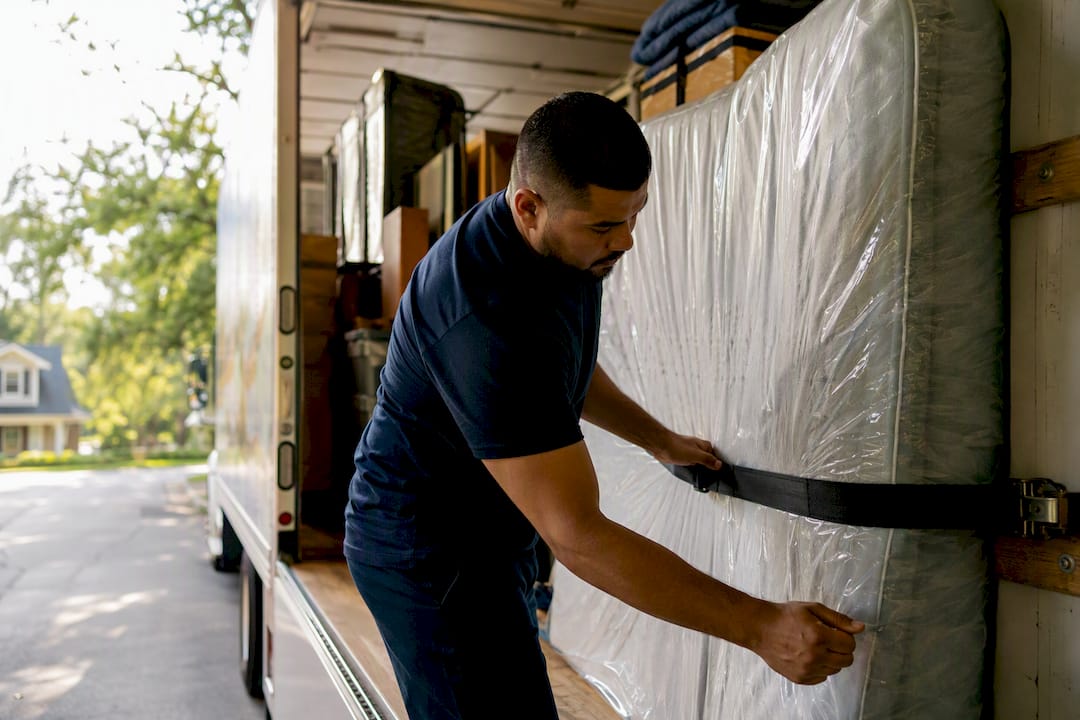
Flat positioning is the default rule for innerspring and hybrid mattresses. Storing or transporting these on their side for extended stretches can cause the internal coils and frame to warp, and that damage often isn’t visible until the mattress has been in use for a few weeks. If upright placement is unavoidable for a short leg of the trip, brace it firmly against a flat wall and avoid leaving it in that position for more than a day or two. Memory foam and latex mattresses tolerate upright transport better, but flat is still safer when you have the space.
Inside a moving truck or container:
- Position the mattress against a flat interior wall, never against ridged or uneven surfaces that can press through the bag.
- Use ratchet straps or tie-downs to keep it from shifting during highway driving, particularly on long interstate hauls with sustained speed changes.
- Avoid stacking heavy boxes or furniture directly on top. Mattresses aren’t built to bear point-loads for hundreds of miles.
- For freight shipments, confirm the pallet is shrink-wrapped and secured to the truck bed, not just resting loose.
If you’re hiring movers or booking freight, specify what you need up front: liftgate service for buildings without a loading dock, white-glove delivery if you want the mattress carried into the room rather than left curbside, and a scheduled delivery window if you’re coordinating around a work schedule. Details on securing larger loads are covered in loading and unloading a moving truck.
Insurance and Liability: What Happens If Your Mattress Is Damaged?
Every interstate carrier provides some baseline liability coverage, but it’s rarely enough to replace a mattress at full value. Basic carrier liability is typically calculated by weight, not replacement cost, which means a damaged $1,500 mattress might only be covered for a fraction of that under the carrier’s default terms.
Declared valuation coverage or third-party moving insurance closes that gap. You pay a modest premium based on the declared value of the item, and in exchange the carrier is liable for the full amount if something goes wrong. For a mattress in the $800 to $2,000 range, that added coverage is usually worth the cost, especially on a route with multiple transfers or terminal handling stops.
To file a successful claim, you’ll need:
- Photos taken before pickup, showing existing condition
- The bill of lading or shipping receipt noting declared value
- A written damage report filed within the carrier’s claim window (often 9 months for interstate household goods shipments, though this varies)
- Photos of the damage upon delivery, taken before the item is moved or used
Ambmovingservices handles valuation coverage and claims documentation as a standard part of every interstate move, which removes the guesswork of tracking carrier-specific claim deadlines and paperwork requirements yourself.
Should You Move Your Mattress or Buy a New One?
Not every mattress is worth shipping across the country. A simple rule of thumb: move it if the replacement cost exceeds $1,200 and the mattress is under five years old. Replace it if it’s older than seven years, already sagging, or if shipping would cost more than 25 to 30 percent of what a new one would run.
- Move it if: it’s a premium mattress under five years old, still under warranty, or a custom size that’s hard to replace quickly.
- Replace it if: it’s past the seven-year mark, shows visible sagging or lumps, or belongs to a mattress-in-a-box category that ships cheaply anyway.
- Consider alternatives if: you’re downsizing temporarily. Selling locally, donating to a shelter that accepts mattresses in good condition, or placing it in short-term storage can all beat shipping costs for a mattress you’re on the fence about.
Sentimental or custom-size mattresses are the exception to every rule above. If it doesn’t fit standard dimensions or holds real sentimental weight, the shipping cost calculation matters less than just getting it there safely.
How Long Does It Take to Ship a Mattress Cross Country?
Transit times vary meaningfully by method, and booking too late is the single most common reason people end up paying rush surcharges.
- UPS/FedEx Ground: 3 to 7 business days for cross-country delivery, depending on origin and destination zones.
- LTL freight: 5 to 10 business days, sometimes longer with multiple terminal transfers.
- PODS/container: Delivery scheduling is flexible, but transit typically runs 7 to 14 days once the container ships.
- One-way truck rental: As fast as your own driving schedule allows, though most cross-country routes take 3 to 5 days of actual driving.
Book at least three to four weeks ahead if you’re moving during peak season (May through September), when demand for interstate moving capacity climbs and both movers and freight carriers raise rates. For terminal freight delivery, confirm whether you’re picking up at a terminal or getting scheduled residential delivery. Terminal pickup is often faster but requires you to arrange transport from the terminal to your home.
AMB’s Recommended Workflow for Interstate Mattress Moves
Ambmovingservices’ approach to mattress moving across country comes down to four steps: inspect the mattress and check manufacturer guidance, choose the transport method that fits your mattress type and budget, pack to spec with the right bag and compression limits, and schedule with declared valuation coverage in place before pickup day.
For most households already planning an interstate relocation, full-service bundling beats standalone shipping every time, since you avoid separate minimums entirely. For a single mattress moving alone, LTL freight or a properly compressed courier shipment are the next best options depending on mattress type. As a licensed, insured carrier operating nationwide, Ambmovingservices builds mattress handling into its standard cross-country moving process rather than treating it as an afterthought, which is where a lot of damage claims originate with less experienced movers.
Are There Rules on Transporting Used Mattresses Across State Lines?
Federal law doesn’t impose blanket restrictions on transporting a personal used mattress you already own across state lines. The regulations that do exist mostly target commercial sale of used mattresses, not household relocation.
Where rules get stricter is at the disposal end. Many states and municipalities require used mattresses to be tagged, bagged, or labeled as sanitized before they can go into standard waste streams or secondhand donation channels, particularly for bed bug and hygiene control. California, for instance, runs a statewide mattress recycling program through the Mattress Recycling Council that sets specific handling standards for mattresses entering disposal or recycling facilities. If you’re planning to discard your old mattress rather than move it, check your destination city’s bulk waste pickup rules before assuming curbside disposal is allowed.
If you’re moving the mattress yourself in a personal vehicle or via a licensed carrier, no special permit is required. The practical restriction that trips people up isn’t legal, it’s logistical: some apartment buildings and HOAs have move-in rules requiring mattresses to arrive in a sealed plastic cover for pest control reasons, so check your new building’s move-in policy before delivery day.
Sustainable Options for Mattress Disposal or Reuse
If you decide replacing beats shipping, the mattress doesn’t have to end up in a landfill. Mattresses are bulky, slow to decompose, and take up disproportionate landfill space relative to their weight, which is why a growing number of cities now run dedicated mattress recycling programs.
Component recycling breaks a mattress down into steel coils, foam, and fabric, each of which gets processed separately. Steel springs get melted down for scrap metal, foam padding can be repurposed into carpet underlay, and wood frames from box springs often go into mulch or biomass fuel. Many mattress recyclers accept drop-offs directly, and some retailers offer haul-away recycling when you buy a replacement mattress.
Donation is another option if the mattress is still in usable condition. Shelters, transitional housing programs, and some nonprofit furniture banks accept mattresses that meet basic cleanliness and structural standards, though many require the mattress to be less than a few years old and free of stains or damage.
If you’re shipping the mattress rather than disposing of it, sustainability still factors in. Bundling it into an existing long-distance move (a full truckload already headed cross-country) has a lower per-item carbon footprint than a dedicated single-item freight shipment, since you’re not adding a separate trip to the transportation network.
Coordinating Pickup and Delivery Across State Lines
Long-distance mattress moves fail most often because of address and scheduling errors, not damage. Before booking any method, confirm the exact pickup and delivery addresses with unit numbers, gate codes, or loading dock access noted clearly. A truck that can’t find building access on delivery day adds cost and delay fast.
Request a delivery window rather than an exact date whenever you’re shipping cross-country. Interstate carriers and freight lines build in buffer days for weather, traffic, and multi-stop routes, so a firm date promise is often unrealistic beyond regional distances. Ask your provider for a window (a 2 to 3 day range is typical) and confirm how they’ll notify you as the delivery date approaches.
If you won’t be at the new address to receive delivery, arrange for someone else to be present or ask about scheduled delivery appointments that let you confirm a specific day once the shipment gets closer to its destination. For terminal freight delivery, find out in advance whether you need to pick up from the terminal or whether residential delivery is included, since that changes both your cost and your logistics on delivery day.
What I’ve Learned Handling Interstate Mattress Shipments
The biggest mistake I see is underpacking. People assume a plastic mattress bag from a hardware store is enough for a 2,000-mile trip, and it usually isn’t. The second biggest mistake is compressing the wrong mattress type. Vacuum-sealing an innerspring mattress because “it worked for my friend’s foam mattress” is how coils get bent out of shape. Third: skipping photo documentation before pickup, which turns a legitimate damage claim into a he-said-she-said dispute. Fourth: choosing the cheapest insurance option without checking what it actually covers.
My workflow for anyone shipping a mattress cross-country is simple: assess the mattress type and condition, choose the transport method that fits it, pack to the manufacturer’s actual specs, then book with declared valuation in place before pickup. Skipping any one of those steps is where things go wrong. If you’d rather have someone handle the decision-making, Ambmovingservices’ team can walk through the specifics of your move and recommend the right approach for your mattress and timeline.
— AMB
Get a Quote for Your Interstate Mattress Move
Ambmovingservices is the direct alternative to piecing together your own mix of freight quotes, courier shipping, and rental trucks. One licensed, insured carrier handles the mattress alongside the rest of your household goods, with declared valuation coverage and claims support built into the process instead of bolted on afterward.

Services relevant to a mattress move include full-service long distance moving, white-glove delivery for mattresses and bulky furniture, and short- and long-term storage if your new place isn’t quite ready. Because Ambmovingservices operates nationwide moving services under federal licensing and insurance compliance, you get one point of contact for pricing, scheduling, and claims instead of juggling separate carriers for different parts of your move.
Ready to see what your move actually costs? Request a free quote and get a realistic estimate that accounts for your mattress, your timeline, and your specific route, not a generic ballpark.
Sources
Cost figures and method comparisons in this guide draw on Red Stag Fulfillment’s mattress shipping cost breakdown for UPS Ground and LTL freight pricing, Nolah Sleep’s guidance on shipping mattresses to another state for the bundling recommendation, Mattress Nut’s analysis of cross-country mattress moving options for PODS and freight comparisons, Amerisleep’s DIY mattress shipping guide for compression and mattress-type rules, and ATOShip’s 2026 mattress shipping cost guide for peer-to-peer hauling rates. Additional dimensional-pricing context comes from ClickPost’s breakdown of mattress shipping costs, and packing best practices reference PODS’ step-by-step mattress moving guide.
- How much does it cost to ship a mattress? Cheapest method | Red Stag Fulfillment
- How To Ship A Mattress To Another State (2024) | Nolah Sleep
- Moving a Mattress Across the Country: Options and Costs – Mattress Nut
- How to ship mattress by yourself | Amerisleep
- Cheapest Way to Ship a Mattress 2026 (From $100) | ATOShip