


Most homeowners and higher earners come out ahead moving from California to Texas, since they trade a high-cost housing market and state income tax for cheaper homes and zero income tax, while renters and lower earners see smaller gains once Texas property taxes and insurance are factored in. The math gets more complicated in hot climates, uneven healthcare access, and the usual logistics of a cross-country relocation, all of which the Federal Motor Carrier Safety Administration (FMCSA) and the Texas Department of Motor Vehicles (TxDMV) regulate or guide, and which we handle regularly. If you want the numbers, the cost comparison below is a useful place to start.
TL;DR:
- Compare your California income tax savings with Texas property taxes at market value and insurance costs, since Proposition 13 can protect long held California homeowners.
- Get a dated written estimate; when the mover is within 50 miles, request an on site survey, because nonbinding estimates can rise 110% at delivery.
- After establishing Texas residency, secure Texas insurance, complete any required county inspection, and register your vehicle within 30 days to avoid late fees or holds.
- Families should contact the specific Texas school district before moving, since enrollment requires proof of residency and records, and popular programs may fill early.
- Request medical records and prescription histories before leaving California; check insurance networks and search for Texas specialists early, because appointments may take time.
Table of Contents
- Pros and cons of leaving California for Texas
- Detailed cost comparison: housing, taxes, utilities, and transportation
- Interstate moving rules, estimates, and typical fees
- How to establish Texas residency after your move
- Top Texas metros Californians choose, and how to decide
- Timeline and budget for a California-to-Texas move
- How we help Californians move to Texas
- School enrollment and education differences for relocating families
- Transferring medical care when you relocate
- Planner’s takeaway
- Get a written estimate for your move to Texas
- FAQ
- Sources
Pros and cons of leaving California for Texas
The appeal of Texas rests on a few concrete advantages, but it comes with real tradeoffs that depend on your income, family situation, and tolerance for heat.
On the plus side:
- Housing costs and rents run substantially lower across most Texas metros than in California’s major cities.
- Texas charges no state income tax, which matters most to higher earners and anyone with significant investment income.
- Gas, groceries, and many everyday goods tend to cost less than in California.
- Job markets in Austin, Dallas, and Houston have kept adding positions across technology, healthcare, and energy, according to the Texas Workforce Commission.
On the downside:
- Effective property tax rates in Texas run higher than California’s, which can offset income tax savings for homeowners.
- Summers are hotter and more humid, with real hurricane and severe storm exposure in parts of the state.
- Uninsured rates and healthcare access vary more by region in Texas than in California.
- Distance from family, friends, and familiar culture is a real adjustment, not just a logistics problem.
This move tends to favor homeowners selling into Texas’s lower prices, remote workers who keep a California-level income, and higher-income households escaping California’s top tax bracket. It tends to favor renters and fixed-income households less, since their savings are smaller and the climate and distance tradeoffs stay the same regardless of income.
Detailed cost comparison: housing, taxes, utilities, and transportation
The biggest line item in this move is housing. Home prices and rents in Texas run well below California levels statewide, though the gap narrows considerably in hot markets like Austin, where demand from relocating Californians has pushed prices closer to national averages.
Taxes are where the math gets interesting. Texas has no state income tax, while California’s top income tax rate can be substantial on high earners on the highest earners, according to Tax Foundation data. That sounds like an automatic win, but Texas offsets the missing income tax with higher property tax rates, and California’s Proposition 13 caps annual increases in assessed value for existing homeowners, which protects long-tenured owners from the kind of property tax growth Texas residents see on reassessment.
Here’s how to think through your own numbers:
- Estimate your current California state income tax bill for a typical year.
- Estimate the property tax difference between your current home’s assessed value and a comparable Texas home’s market value, applying Texas’s higher effective rate.
- Subtract the property tax increase from the income tax savings to see your rough annual net.
A household earning a high six-figure income with a modest-value home sees a clear net gain. A retiree with a long-held, low-assessed California home under Proposition 13 protection and no plans to buy a large Texas property may see a smaller benefit, since they’re giving up a locked-in tax advantage for one that resets at market value.
Utilities add another variable: electricity costs in Texas can spike in summer given the cooling demands of the climate, so a lower baseline utility rate doesn’t always translate into a lower annual bill. Industry analysts also caution that headline tax savings get partially offset by higher property taxes and insurance costs, so it pays to run the full homeowner math rather than stopping at the income tax line, per NerdWallet.
Transportation costs shift too: gas is typically cheaper in Texas, but longer commutes in sprawling metros like Houston and Dallas-Fort Worth can erase some of that savings. For a detailed breakdown of what a cross-country move itself costs, an interstate moving cost guide walks through the variables that affect your specific quote.
Interstate moving rules, estimates, and typical fees
Interstate moves, meaning any move that crosses a state line, fall under federal oversight. The FMCSA requires licensed movers to provide a written estimate before the move and to give customers the “Your Rights and Responsibilities When You Move” booklet. Non-binding estimates can legally increase up to 110% of the quoted price at delivery, which is why a vague verbal quote can turn into an unpleasant surprise on move day. Any relocation that crosses a state line, or starts or ends outside your home state, counts as interstate under FMCSA’s own definition, which brings it under these federal protections.
Several factors drive your final price: the weight of your shipment, the distance between California and your new Texas address, accessorial charges like long carries or elevator fees, specialty items such as pianos or safes, and any storage time between pickup and delivery—see more about classic car shipping options and vetting carriers if you’re transporting specialty vehicles.
To get an accurate quote:
- Request a physical, on-site survey whenever you live within roughly 50 miles of the mover’s office, rather than accepting a phone or video estimate alone.
- Insist on a written, dated estimate that spells out binding or non-binding terms before you sign anything.
- Confirm the mover’s FMCSA registration number and ask directly whether a binding estimate carries any additional fee.
- Clarify accepted payment methods for delivery day before the truck arrives.
Pro Tip: Keep your inventory list, signed estimate, and a valid ID together in one folder so you can verify everything against the shipment the moment the truck arrives.
How to establish Texas residency after your move
Once you arrive, Texas gives you a defined window to switch over your vehicle and license paperwork. The TxDMV’s checklist for new Texas residents lays out the required order of operations.
- Obtain Texas auto insurance that meets state minimum coverage before registering any vehicle.
- Complete a vehicle inspection, which is required in some counties and not others.
- Register your vehicle with your county tax office within 30 days of establishing residency.
- Apply for a Texas driver license at a Texas Department of Public Safety (DPS) office.
Bring these documents to the county tax office and DPS:
- Valid photo ID or current out-of-state driver license.
- Proof of Texas insurance.
- Out-of-state title or registration.
- Proof of Texas residency, such as a lease or utility bill.
Missing the 30-day window can mean late fees and registration holds, and commercial vehicles face additional requirements beyond this standard checklist, so check with your county if you’re relocating a business fleet alongside your household.
Top Texas metros Californians choose, and how to decide
Where you land in Texas matters almost as much as the decision to move at all.
- Austin draws tech workers and creatives who want a culture closest to the Bay Area, with a dense startup and corporate tech presence.
- Dallas-Fort Worth appeals to families chasing suburban space and strong job diversity across finance, logistics, and corporate headquarters.
- Houston offers one of the most diverse economies in the state, spanning energy, medical research, and shipping, which suits specialized professionals.
- San Antonio is the most affordable of the four, attracting budget-conscious households and retirees.
Austin most closely echoes a California tech hub, while Dallas’s suburbs resemble the kind of family-oriented sprawl many Bay Area transplants already know. When picking a metro, weigh your commute tolerance, school district quality, how fast local housing moves, and how well you handle extended summer heat, since all four cities run hotter and more humid than most of California.
Timeline and budget for a California-to-Texas move
A cross-country move runs smoothest on an 8 to 12 week schedule:
- Weeks 1-2: Request estimates from licensed movers and compare written quotes.
- Weeks 3-4: Book your mover and pay any required deposit.
- Weeks 5-7: Sort belongings, schedule packing services, and arrange specialty-item handling.
- Week 8: Move week: final walkthrough, loading, and departure.
- Weeks 9-12: Delivery, unpacking, and Texas vehicle and license registration.
Budget realistically across three tiers:
- A smaller, lighter shipment moving a short interstate distance sits at the lower end of typical long-distance pricing.
- A full three- or four-bedroom household moving California to Texas lands in the typical mid-range.
- Large households with specialty items, extra stops, or temporary storage push toward the higher end.
Book your mover early, since peak summer months fill up fastest.
How we help Californians move to Texas
We build our services around the parts of this move that cause the most stress: accurate pricing, compliant paperwork, and careful handling of your belongings across a long haul. Our core offerings for this route include:
- Long-distance moving for full household relocations between states.
- Interstate moving services built around state-to-state compliance requirements.
- Professional packing services, billed per cubic foot, for households that want full-service preparation.
- Specialty item handling for pianos, safes, and other oversized belongings.
- Secure storage for households that need a gap between move-out and move-in dates.
We operate under FMCSA rules, which means every customer receives a written, dated estimate, the option of a physical survey, and clear binding or non-binding terms before any truck leaves the driveway.
Pro Tip: Share your full inventory, including specialty items, when you request your estimate. That’s what makes the number you see upfront the number you pay at delivery.
School enrollment and education differences for relocating families
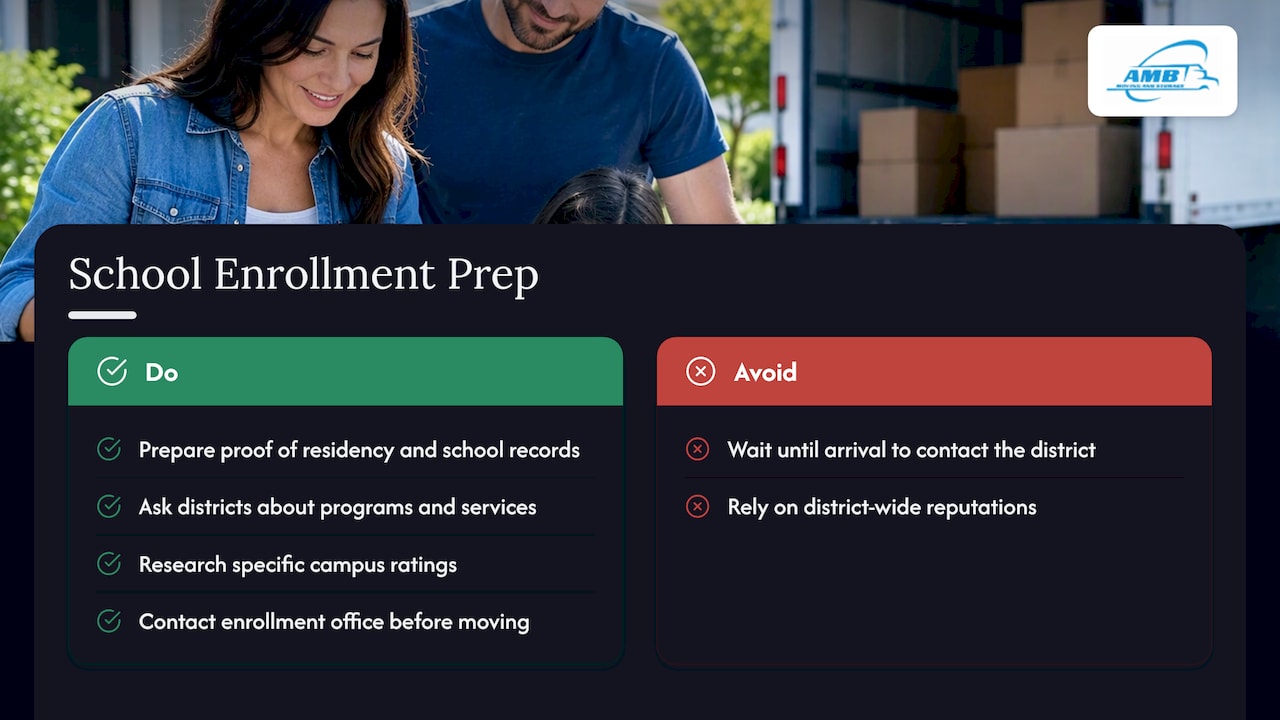
Texas public schools enroll students by home address, so you’ll need a Texas address, proof of residency, and your children’s prior school records, immunization history, and birth certificates on hand before the first day of class. Enrollment timing matters more in Texas than it might have in California, since some popular districts in fast-growing suburbs around Austin and Dallas-Fort Worth fill specific schools or programs before the school year starts.
Curriculum standards differ too. Texas follows its own set of state standards rather than the Common Core framework California schools use, which can mean a short adjustment period for students mid-way through a grade level. Families should also ask new districts directly about gifted and talented programs, special education services, and advanced placement course availability, since offerings vary widely by district and even by individual school within the same metro.
If you’re weighing neighborhoods partly on school quality, research specific campus ratings rather than district-wide reputations, since large Texas districts can include both top-rated schools and struggling ones within the same boundary. Visiting or calling the district’s enrollment office before your move date, rather than after you arrive, gives you a clearer picture of what paperwork and deadlines apply to your specific situation.
Transferring medical care when you relocate
Continuity of care is one of the more overlooked parts of a long-distance move. Start by requesting copies of your full medical records, including prescription history and any specialist notes, from your California providers before you leave, since transfers can take weeks once you’re no longer a local patient.
If you have employer-sponsored insurance, confirm whether your plan network extends into Texas or whether you’ll need to select new in-network providers during open enrollment or a qualifying life event window. Marketplace and Medicaid coverage rules also differ by state, so check your eligibility and plan options under Texas rules well before your coverage lapses.
Finding new providers takes more lead time in some Texas metros than in major California cities, particularly for specialists, so start that search as soon as you know your new address. Pharmacies can typically transfer prescriptions directly between locations within the same chain, which simplifies at least one part of the transition. For ongoing treatment plans, ask your current provider for a written summary you can hand directly to your new doctor, which speeds up that first appointment considerably.

Planner’s takeaway
Run your personal housing and tax math before you commit to a metro, and lock in a written binding estimate once you book, since price certainty matters more than a slightly lower verbal quote.
— AMB
Get a written estimate for your move to Texas
The paperwork and compliance side of this move is handled to allow you to focus on the decision itself. Every quote starts with a written, dated estimate under FMCSA rules, with licensing and insurance coverage, and with full packing services, specialty handling, or short-term storage as needed.
To get an accurate number:
- Share your full inventory, including any specialty or oversized items.
- Tell us your preferred move dates and whether you need storage in between.
- Ask about binding versus non-binding estimate options before you sign.
Request your free quote and get a written estimate built around your actual household, not a rough guess over the phone.
FAQ
Is it a good idea to move to Texas from California?
For homeowners and higher earners, moving to Texas often makes financial sense, since lower home prices and no state income tax can outweigh higher property taxes. Renters and lower-income households see smaller gains, so it’s worth running your own housing and tax numbers before deciding.
What is the #1 state people are leaving?
Migration reports show California among the states with the largest outbound flows to other states, with Texas consistently receiving one of the largest shares of that movement. The exact ranking shifts year to year depending on which report and time period you check.
Why are people moving out of California to Texas?
The main draws are lower housing costs, no state income tax, and a job market that has kept expanding across technology, healthcare, and energy sectors. Many relocating households are also drawn by more space and shorter commutes compared to crowded California metros.
What is the best moving company for a California-to-Texas move?
Look for a company licensed and insured for interstate moves, registered with FMCSA, and willing to provide a written, dated estimate before you book. We provide long-distance and interstate moving services built around those federal requirements, including packing and specialty-item handling for this exact route.
How much does it cost to move from California to Texas?
Cost depends on your shipment’s weight, the distance between your old and new address, and any specialty items or storage you need. Request a written estimate with a full inventory to get an accurate number rather than relying on a rough per-mile average.