


A binding “not to exceed” estimate guarantees you will not pay more than the stated total at delivery, provided the shipment and services listed on the estimate do not change. This guarantee comes from FMCSA rules under 49 CFR Part 375. We prepare written binding estimates for interstate moves so you know your total cost before loading day arrives.
TL;DR:
- A binding estimate guarantees no additional charges at delivery as long as your shipment inventory remains unchanged and the survey is accurate.
- The estimate must be based on an in-person or virtual survey, with a detailed, written, and itemized list of services and charges.
- Red flags include lack of a proper survey, incomplete paperwork, unverifiable U.S. DOT numbers, or demands for cash-only payments.
- Excess charges over the binding estimate are limited to 100% at delivery, with any additional fees billed within 30 days after the move.
Table of Contents
- What a Binding Estimate Is and Its Legal Basis
- Binding vs Non-Binding: Payment Caps and Price Risk
- How to Get a Valid Binding Estimate
- Red Flags That Undermine Binding Protection
- If Charges Exceed Your Estimate
- How We Apply Binding Estimates at AMB
- Request a Binding Estimate for Your Move
- FAQ
- Sources
What a Binding Estimate Is and Its Legal Basis
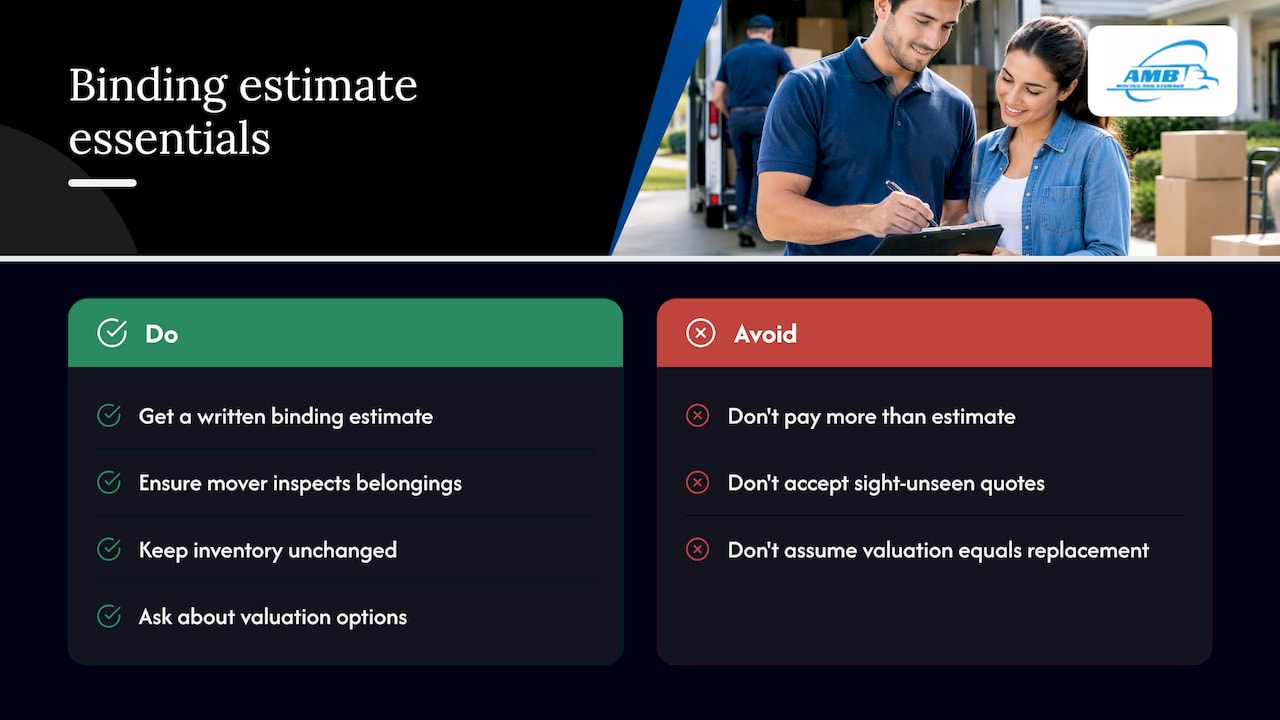
A binding estimate is a written agreement that locks in your total moving cost based on the goods and services listed on that document. Under FMCSA guidance, you cannot be charged more than this amount at delivery as long as your shipment inventory stays the same. The estimate covers transportation, accessorial charges, and advance charges that appear on the paperwork. Add a service after you sign, and the mover needs to issue a new binding estimate rather than tack the cost onto your final bill.
49 CFR Part 375 spells out exactly what movers must provide: a written estimate, a bill of lading, and the federal consumer booklet. These three documents form the paper trail that protects you if a dispute comes up later. The regulation also requires that estimates reflect a real inspection of your belongings, not a guess made over the phone.
Binding protection only works when the underlying survey is accurate. A rushed walkthrough or a sight-unseen quote leaves gaps that a mover can later point to as unlisted items. This is also where valuation coverage matters: a binding price covers the cost of the move itself, not the replacement value of your belongings if something breaks or goes missing, so ask separately about valuation options versus third-party moving insurance before you sign.
Binding vs Non-Binding: Payment Caps and Price Risk
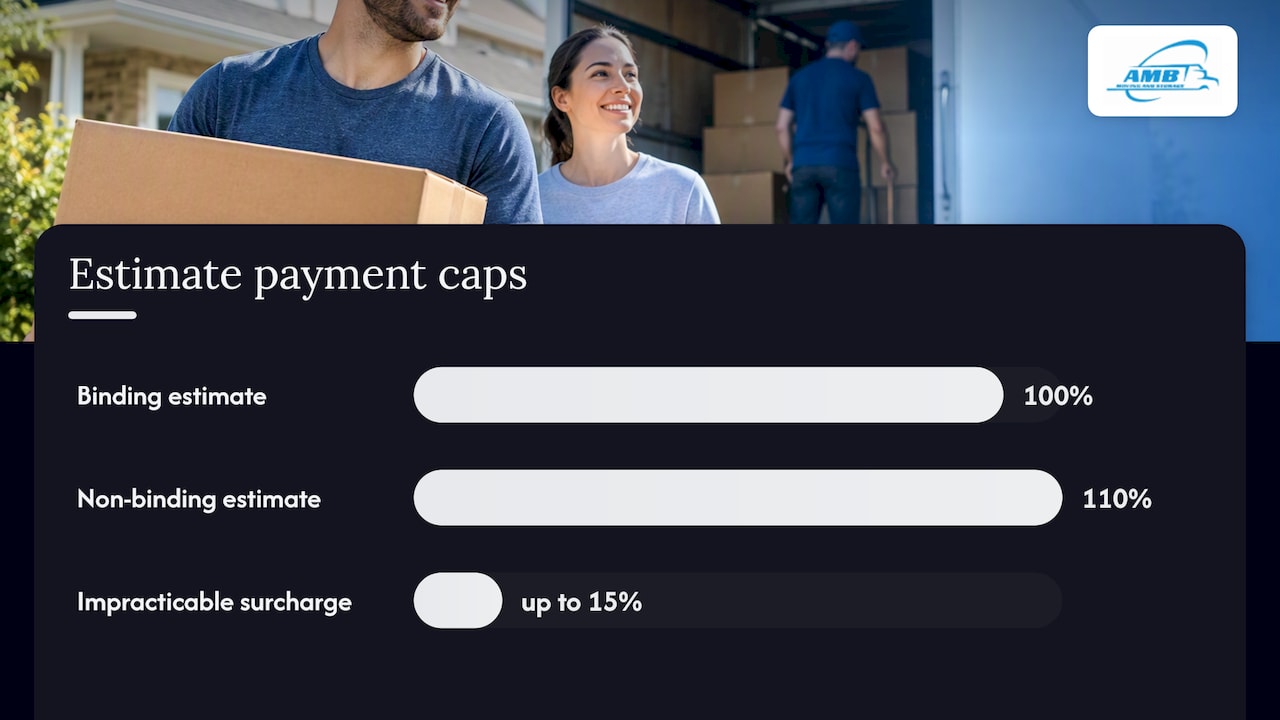
Choosing between a binding and a non-binding estimate comes down to how much price uncertainty you can tolerate. A binding estimate caps your payment at 100% of the quoted total, while a non-binding estimate allows the mover to collect up to 110% of the original figure at delivery, with final charges based on your shipment’s actual weight. Our guide to estimate types breaks down how that 110% cap plays out in practice for long distance moving shipments.
Weight is the variable that makes non-binding estimates riskier. A mover can estimate your shipment at a lower weight to win your business, then bill closer to the 110% ceiling once your boxes hit the scale. Binding estimates remove that risk because the price is fixed regardless of actual weight, as long as the inventory matches what was surveyed.
A few scenarios illustrate where things go wrong with non-binding pricing:
- A family estimates their own inventory low, underestimating boxes in the garage and attic, and the actual weight pushes the bill toward the 110% cap.
- A renter skips the in-home survey, accepts a phone quote, and finds the final weight ticket adds thousands to the non-binding total.
- A business relocating an office adds filing cabinets after the estimate, triggering a weight increase that a binding agreement would have required rewriting in advance.
Movers can also bill up to 15% extra for impracticable operations like a long carry from the truck to your door or a stair carry when no elevator is available, even under a binding estimate, if those conditions were legitimately unforeseeable.
How to Get a Valid Binding Estimate
Getting binding protection that actually holds up starts with the survey, not the signature. Here is the sequence we recommend for anyone preparing for an interstate movers quote.
- Schedule a physical or virtual survey and confirm in advance what rooms, storage areas, and specialty items the surveyor will inspect.
- Request a written, itemized estimate that lists every service, accessorial charge, and accepted payment method, not a verbal number over the phone.
- Verify the mover’s U.S. DOT number through FMCSA’s registration database and ask for the Your Rights and Responsibilities When You Move booklet before you sign anything.
- Confirm in writing how added items will be handled, since a legitimate binding estimate requires a new written agreement before loading if your inventory changes.
Our planning guide on moving estimates walks through how a detailed inventory list protects you from accessorial surprises later in the process.
Pro Tip: Photograph large or high-value items during the survey and note them on the inventory sheet so there is no ambiguity about condition or quantity at delivery.
A legitimate binding estimate should never feel rushed. If a cross country movers company offers a number without seeing your belongings, either in person or over video, treat that as a quote that is not yet reliable.
Red Flags That Undermine Binding Protection
Certain warning signs tell you a binding estimate is not worth the paper it is printed on. The FTC and FMCSA both point to a consistent set of problems that show up before a move goes wrong.
- A mover skips the survey entirely and offers a price based only on a verbal description of your home.
- Paperwork arrives with blank spaces left for the mover to fill in later, rather than a fully itemized document.
- The company demands a large cash deposit or will only accept cash at delivery.
- The mover cannot produce a valid U.S. DOT number when asked, or the number does not match the company name.
- You never receive the Your Rights and Responsibilities When You Move booklet, which federal rules require for interstate shipments.
Billing traps often hide in vague language rather than outright refusal. A tariff that lists “additional services as needed” without specifics, or an estimate that omits stairs and long carries you mentioned during the survey, both create room for disputes after your belongings are already on the truck. Insist on specific wording for every accessorial charge before you sign, and keep a copy of the signed estimate and inventory for your own records.
If Charges Exceed Your Estimate
If a bill comes in higher than expected, federal rules limit what a mover can lawfully collect at delivery: 100% of a binding estimate, or 110% of a non-binding one, with impracticable operations potentially added up to 15% when conditions genuinely warrant it. Anything above those caps cannot be demanded at your door.
If the mover believes you owe more than what was collected at delivery, federal rules require billing any remaining amount within 30 days after delivery, giving you time to review the charges against your signed estimate and inventory. Keep every document: the estimate, bill of lading, and consumer booklet. If a dispute arises, you can file a complaint with FMCSA and reference the booklet’s dispute guidance. Our rights and responsibilities page outlines these steps in more detail for readers preparing for an interstate move.
How We Apply Binding Estimates at AMB
Binding estimates are built on a physical or virtual survey, never a phone guess, and are backed by a written, itemized quote that lists services, accessorial charges, and accepted payment forms up front. This process aligns with federal compliance standards that govern interstate movers nationwide.
When items are added after the initial survey, a new binding estimate is issued before loading rather than adjusting the bill after the fact. For a deeper look at how estimate types affect your total cost, our estimate online guide walks through what to expect when requesting pricing for a long distance moving project.
— AMB
Request a Binding Estimate for Your Move
We handle long distance moving, interstate and state-to-state relocations, packing, specialty item handling, and secure storage for households and businesses planning a cross country move. Every binding estimate we prepare starts with a real survey of your belongings, not a guess, so the total you sign is the total you pay at delivery.
Getting started is simple:
- Schedule a physical or virtual survey so we can see exactly what you are moving.
- Review a written, itemized estimate that lists services, accessorials, and payment terms before you commit.
- Confirm your inventory in writing so any later additions get a new binding estimate rather than a surprise invoice.
Our packing services and moving cost guide give you a fuller picture of what a cross-country relocation involves, from per-cubic-foot packing rates to elevator and long carry fees. When you are ready to lock in a number you can rely on, request your binding estimate from AMB and get a written quote built around your actual inventory, not a phone estimate.
FAQ
What are red flags when hiring movers?
Red flags include a mover skipping the survey, offering a quote without seeing your items, demanding cash-only payment, or lacking a verifiable U.S. DOT number. Missing paperwork, like blank estimate forms or no consumer rights booklet, is another sign to walk away.
What is a binding fee?
A binding estimate is not a separate fee; it is a written price guarantee covering the services and inventory listed at the time of signing. It fixes your total at 100% of the quoted amount, provided nothing changes before loading.
What does a binding quote mean?
A binding quote means the mover cannot charge you more than the agreed total at delivery, as long as the shipment and services match what was surveyed and listed in writing. If you add items afterward, the mover must issue a new binding estimate rather than adjust the original one.
How is a binding estimate different from a non-binding estimate?
A binding estimate caps your payment at the quoted total, while a non-binding estimate allows the mover to collect up to 110% of the original estimate based on actual weight at delivery. Binding estimates remove weight-related price risk; non-binding estimates do not.
What happens if a mover tries to charge more than my binding estimate?
You are not required to pay more than the binding total at delivery, and any additional amount the mover believes is owed must be billed within 30 days after delivery. Keep your signed estimate and inventory as documentation if you need to dispute the charge.
Sources
- What is a binding move estimate? | FMCSA
- eCFR :: 49 CFR Part 375 – Transportation of Household Goods in Interstate Commerce; Consumer Protection Regulations
- Avoid scams when you hire a moving company | FTC