


Start planning now: sort your belongings and reserve your transport 4 to 8 weeks before move-in, choosing between a rental truck, a container service, or a licensed interstate mover based on how much you own, your budget, and your timeline. For any interstate move, federal rules require movers to give you a written estimate before your things leave the ground.
TL;DR:
- Moving peaks in May through August, requiring early booking four to eight weeks in advance to secure preferred dates and avoid last-minute delays.
- Sorting belongings into keep, sell, or donate piles before packing helps reduce volume and can offset moving costs through local sales.
- Both container freight and full-service movers often cost similar amounts for long-distance moves, with the choice depending on how much labor you are willing to do yourself.
- A federal nonbinding estimate legally caps final costs at 110% of the original quote, but you should confirm whether the estimate is binding or nonbinding at booking.
- Coordinating move-in dates with college housing and utility setup is crucial, with advice to schedule utilities and move-in to align closely with arrival and to book early during peak move season.
Table of Contents
- Sort, purge, and pack: what to keep, sell, donate, or ship
- Compare transport options for out-of-state student moves
- Timeline and booking: when to reserve movers, trucks, or containers
- Costs, hidden expenses, and insurance: budgeting an out-of-state college move
- Legal basics and paperwork for interstate student moves
- Move-in day and storage tips for dorms and student housing
- AMB perspective: professional moving help for student interstate moves
- Managing utility setup and shutoff timing for both homes
- Coordinating move-in dates with college housing availability
- Updating your address across banks, the DMV, and school records
- Health and safety considerations during an out-of-state move
- Quick checklist and takeaways
- How AMB can help your out-of-state college move
- Sources
- FAQ
Sort, purge, and pack: what to keep, sell, donate, or ship
Before you touch a box, sort everything into three piles: keep, ship, and sell or donate. A simple rule from student movers: if an item costs less to replace at your destination than it costs to ship, it goes in the sell or donate pile, not the truck. Bulky furniture, old textbooks, and worn dorm decor rarely survive that math. Selling those items locally through campus groups or marketplace apps before you leave also cuts down what you need to pack for a long-distance move and can offset part of your moving budget.
For what remains, pack smart:
- Use vacuum-seal bags for bedding and off-season clothing to save space.
- Label every box by room and priority, not just contents.
- Pack a separate essentials bag with a change of clothes, chargers, and toiletries for your first 48 hours.
Keep valuables and documents (passport, Social Security card, transcripts, prescriptions) in a bag that travels with you, never in the moving truck.
Pro Tip: Photograph electronics and any item with visible wear before it’s packed, in case you need to file a claim later.
Compare transport options for out-of-state student moves
Three transport paths cover most student moves, and each trades cost against convenience differently.
- Rental truck: You drive, you load, you unload. It’s the cheapest option upfront but demands time, physical labor, fuel, and comfort driving an unfamiliar vehicle across state lines.
- Full-service interstate movers: Crews pack, load, transport, and deliver, with a defined delivery window and insurance coverage built into the process. Cost is higher, but so is convenience, and you avoid the risk of damaging items yourself.
- Container freight (PODS-style): You load a container at your own pace, and a carrier hauls it. This lands in the middle: less labor than fully DIY, less cost than full-service, and containers double as temporary storage if your move-in date slips.
According to a practical shipping guide for graduating students, container moves and full-service movers often land in similar cost bands for a cross-country move, and the real decision usually comes down to how much labor you’re willing to do yourself versus how much you value a fixed delivery window. Rental trucks remain the budget default for smaller loads and shorter distances, but factor in fuel, tolls, and the physical toll of a multi-day drive before assuming it’s the cheaper choice.
Timeline and booking: when to reserve movers, trucks, or containers
Peak moving season runs May through August, which overlaps directly with move-out and move-in season for most colleges. Booking 4 to 8 weeks ahead during that window is the difference between getting your preferred date and scrambling for whatever’s left.
- 8 weeks out: Research and request quotes from movers, truck rental companies, or container services.
- 6 weeks out: Book your transport and confirm insurance or valuation coverage.
- 4 weeks out: Begin sorting and selling items you won’t ship.
- 2 weeks out: Confirm pickup and delivery dates in writing.
- 1 week out: Pack your essentials bag and confirm move-in time with residence life.
If you’re working a tight timeline, call multiple companies the same day, ask about cancellations, and stay flexible on pickup dates. A short delivery window almost always beats a lower price when time is scarce.
Costs, hidden expenses, and insurance: budgeting an out-of-state college move
A realistic student moving budget includes more than the base transport quote. Line items to expect:
- Base transport cost (truck rental, mover’s quote, or container fee).
- Accessorial charges like elevator or stair fees and long carry charges when a truck can’t park close to the entrance.
- Fuel and tolls if you’re driving yourself.
- Packing materials or professional packing services.
- Storage if your move-in date and move-out date don’t line up.
Beyond the obvious, universities advise weighing the cost of flights or gas for trips home, tuition differences between in-state and out-of-state schools, and the reality that dorms close for summer, often forcing a storage decision.
A federal consumer protection worth knowing: a nonbinding estimate legally caps your final bill at 110% of the original quote at delivery, which limits how much a surprise fee can inflate your total cost.
Renter’s insurance often excludes belongings in transit, so check whether your mover’s valuation coverage or a separate moving insurance policy fills that gap.
Legal basics and paperwork for interstate student moves
Interstate movers are bound by federal rules, and knowing them protects you from surprise costs. Before your move, a licensed mover must provide:
- A written estimate based on an actual or virtual inspection of your belongings.
- The Your Rights and Responsibilities When You Move booklet and the Ready to Move brochure.
- A clear explanation of whether your estimate is binding or nonbinding.
A binding estimate locks in your price except for services you add later; a nonbinding estimate can rise, but only up to that 110% cap at delivery. Separately, check with your college’s financial aid office early: FAFSA and state residency rules vary, and establishing residency in your new state can affect tuition and aid eligibility.
Move-in day and storage tips for dorms and student housing
Move-in day runs smoother with a plan set days in advance.
- Pack an essentials box with bedding, chargers, toiletries, medications, and ID, separate from everything else.
- Confirm your delivery slot, elevator reservation, and any dorm-specific move-in rules with residence life before you arrive.
- Label boxes destined for summer storage separately from those you’ll unpack immediately, so movers or storage staff know what stays sealed.
If your school year ends before your lease or new semester begins, short-term storage bridges the gap. Container services and dedicated storage facilities both work, but confirm access hours and any size limits before you commit.
Pro Tip: Reserve your elevator or loading dock slot with the dorm at least a week ahead. Move-in weekends are usually the building’s busiest days.

AMB perspective: professional moving help for student interstate moves
Watching students move across the country, the pattern is consistent: the moves that go smoothly are the ones booked early with clear paperwork, not the ones with the fanciest truck. AMB Moving & Storage Inc. offers student moving services, professional packing, and secure storage, which cover the three points where student moves usually break down: fragile items, timing gaps between leases, and the labor of packing an entire dorm room alone.
As a licensed interstate carrier, AMB provides written estimates and documentation consistent with FMCSA requirements, and we’d encourage any student to ask any mover for that paperwork before booking. Hiring a professional crew tends to make the most sense when you’re moving a full apartment’s worth of belongings, coordinating a tight delivery window, or simply don’t have a way to drive a truck across the country yourself.
Managing utility setup and shutoff timing for both homes
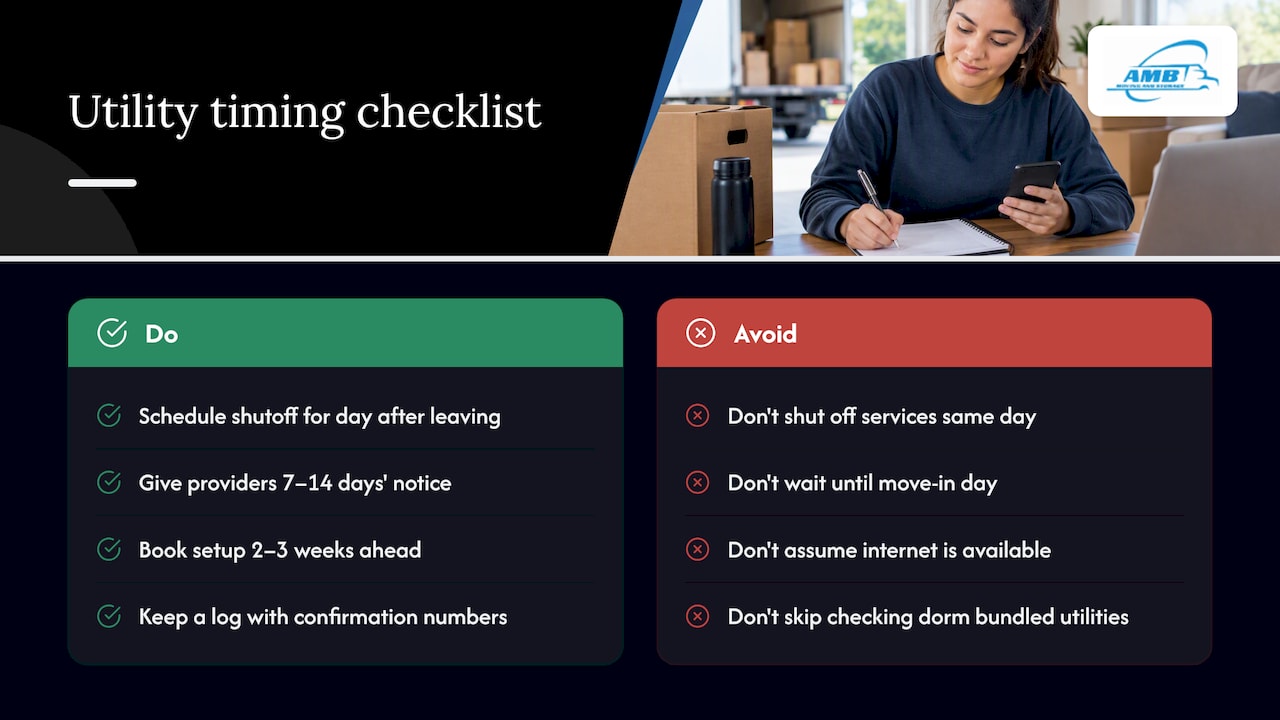
Utilities are easy to forget until the internet doesn’t work on move-in day. Start with your current residence: schedule shutoff for electricity, internet, and water for the day after you leave, not the day you leave, in case your departure slips. Most providers require 7 to 14 days’ notice for cancellation, so build that into your timeline alongside your transport booking.
At your destination, contact utility providers as soon as you have a confirmed address and move-in date. Many college towns have limited internet providers, and back-to-school season creates its own installation backlog, so booking a setup appointment two to three weeks ahead avoids a delayed connection. If you’re moving into a dorm, check with residence life first: many campus buildings bundle electricity and internet into housing fees, meaning you may only need to handle utilities for an off-campus apartment in later years.
Keep a simple log of what’s been shut off and what’s been started, with confirmation numbers for each. It sounds like overkill until a final bill from your old address shows up two months late because a shutoff never went through. For students switching between dorms and off-campus housing year to year, this utility checklist becomes a repeatable habit rather than a one-time scramble.
Coordinating move-in dates with college housing availability
Dorm move-in dates are usually fixed by the school, but the timing between your lease end, your transport booking, and that date is where most conflicts happen. Check your college housing portal as early as possible for your assigned move-in window, since many schools stagger arrivals by class year or last name to manage traffic.
Once you have that date, work backward: book your transport to arrive the same day or one day before, never after. A truck or container arriving a day late means sleeping on a bare mattress or scrambling for a hotel. If your delivery window is wide, as it often is with container freight or full-service movers on long routes, build in a buffer day and pack a full set of essentials so a delayed delivery doesn’t derail your first days on campus.
For students moving between off-campus leases and dorm assignments, the gap can run the other way: your dorm might open a week before your current lease ends. In that case, short-term storage or a friend’s floor for a few nights solves more problems than trying to force both moves onto the same weekend. Confirm your specific arrival window with residence life directly rather than assuming a general “move-in weekend” applies to you.
Updating your address across banks, the DMV, and school records
An out-of-state move touches more institutions than most students expect, and missing one usually means a delayed bill, a lost check, or a registration problem. Work through this list in the weeks around your move:
- Banks and credit cards: Update your mailing address online or by phone before you leave, so statements and replacement cards follow you.
- College administration: Update your local address with the registrar and financial aid office, since some schools mail time-sensitive documents there.
- DMV: Most states require registering a vehicle and updating your driver’s license within a set window after establishing residency, and rules vary by state, so check your new state’s DMV site directly.
- USPS mail forwarding: Set up forwarding at least a week before you leave to catch anything mailed to your old address.
- Employers, insurance, and subscriptions: Update payroll, health insurance, and any recurring deliveries or subscriptions tied to your old address.
Doing this in one sitting, rather than piecemeal after problems appear, saves the most time. Keep a simple list of every account tied to your old address and check them off as you go, since it’s easy to remember the bank and forget the insurance card in your wallet.
Health and safety considerations during an out-of-state move
Long-distance moves put strain on your body and your health routine, especially if you’re driving a rental truck or lifting boxes for the first time. Stretch before heavy lifting, use proper form for boxes and furniture, and don’t attempt to move anything that genuinely requires two people alone.
If you take regular medication, pack a supply that covers the move plus a buffer in case of delays, and keep it with you rather than in checked boxes or a moving truck. Bring copies of prescriptions and a basic first-aid kit in your essentials bag.
For respiratory illness precautions relevant to shared spaces like moving trucks, elevators, or dorm hallways during peak move-in weekends, follow standard practices: masking in crowded indoor spaces if you’re feeling unwell, washing hands frequently during a multi-stop move, and checking your new campus’s current health guidance before arrival, since policies vary by school and can change between semesters. If you or a family member helping you move feels sick close to your moving date, most rental companies and movers allow date changes with enough notice, so call ahead rather than pushing through it.
Quick checklist and takeaways
- Sort belongings into keep, ship, and sell/donate before you pack anything.
- Book transport 4 to 8 weeks ahead, especially during peak season.
- Request a written estimate and ask whether it’s binding or nonbinding.
- Confirm your move-in date and delivery window with residence life.
- Update your address across banks, the DMV, and your college’s records.
| Action | Timing |
|---|---|
| Sort and purge belongings | 6 to 8 weeks before move |
| Book transport (truck, mover, or container) | 4 to 8 weeks before move |
| Confirm written estimate and coverage | At booking |
| Update address across institutions | 2 to 4 weeks before move |
| Confirm delivery window with residence life | 1 to 2 weeks before move |
The short version: plan early, sort ruthlessly, book your transport before peak season fills up, and get every estimate in writing.
— AMB
How AMB can help your out-of-state college move
Moving an entire dorm room or apartment across state lines is a lot to manage around classes, finals, or a summer job. AMB Moving & Storage Inc. offers student moving services, professional packing, and secure storage built around exactly this kind of timeline, so you’re not doing it all solo the week before move-in.
- Professional packing services including for fragile items and furniture.
- Secure storage solutions if your move-out and move-in dates don’t align.
- A written estimate with required documentation provided before shipment.
If you’d rather hand off the logistics than manage a rental truck yourself, get a quote from AMB and ask for your estimate in writing before you book.
Sources
- What is a binding move estimate? | FMCSA
- Graduating and Moving Out of State? A Practical Guide to Shipping Your Belongings – Indiana Daily Student
- Should I Go Far Away for College? | UC Fit Guide | University of Cincinnati
FAQ
Should I move out of state for college?
That decision depends on tuition differences, travel costs, and the opportunities a specific school offers, all of which universities recommend weighing before committing. If you do move, planning your transport and budget early makes the transition far less stressful.
What is the easiest way to relocate to another state?
For most students, the easiest path is sorting belongings early, booking transport 4 to 8 weeks ahead, and choosing between a rental truck, container service, or full-service interstate mover based on volume and budget. Getting a written estimate upfront, as federal rules require, also prevents surprise costs at delivery.
Are colleges more likely to accept out-of-state students?
Admission likelihood varies by school and depends on each institution’s own enrollment goals and residency mix, not a single national pattern. Check directly with each college’s admissions office for its specific approach to out-of-state applicants.
What are the best states to move to after college?
The “best” state depends on your career field, cost of living, and personal priorities rather than a fixed ranking. Weighing job opportunities and living costs against what matters most to you, the way universities suggest evaluating any out-of-state move, is a more reliable approach than following a generic list.
What should I ask an interstate mover before booking?
Ask for a written estimate, confirm whether it’s binding or nonbinding, and request the Rights and Responsibilities booklet that federal rules require movers to provide. Also confirm the delivery window and what insurance or valuation coverage applies to your belongings in transit.