


Yes, you can move firearms across state lines when relocating your residence, but federal law sets strict conditions. Under 18 U.S.C. § 926A, firearms must be unloaded and inaccessible from the vehicle’s passenger compartment during transit. You also need to notify your mover in writing, confirm whether any items require ATF Form 5320.20, and check your destination state’s rules before the truck loads.
TL;DR:
- Moving firearms across state lines requires they be unloaded and stored in a secure container, with additional state-specific registration and possession laws applying upon arrival.
- NFA-regulated items need ATF Form 5320.20 approval before transport, and moving companies must be notified in writing, with copies of approved documents kept accessible during transit.
- Mailing firearms domestically is possible for non-license holders shipping rifles or shotguns to licensed dealers, but handguns are subject to stricter restrictions; flying with firearms requires declaration, locked cases, and compliance with TSA rules.
- Safes over 500 pounds or NFA items require specialty handling, early booking, and detailed coordination with the mover to ensure compliance and proper equipment use.
- The average cost to move a gun safe begins at $200, with additional fees for stairs, elevators, or long carries, and budget should include state registration or permit fees if applicable.
Table of Contents
- Federal rules you must follow when moving firearms interstate
- State to state differences you need to check before you move
- Working with professional movers on firearm transport
- Special cases: NFA items, mailing firearms, and flying with firearms
- Packing and safe transport practices for a long-distance move
- What legally moving firearms actually costs
- Industry perspective on firearm relocation logistics
- Get a compliant quote for your firearm and safe move
- Sources
- FAQ
Federal rules you must follow when moving firearms interstate
Federal law gives you a clear baseline, and it starts with 18 U.S.C. § 926A. If you can legally possess a firearm and aren’t otherwise prohibited, you may transport it between states as long as the firearm is unloaded and not readily accessible from the passenger area. Vehicles without a separate trunk need the firearm and ammunition locked in a container other than the glove compartment or console.
The Bureau of Alcohol, Tobacco, Firearms and Explosives adds a layer specific to household moves. If firearms are part of your household goods shipment, you must notify the moving company. NFA-regulated items, machine guns, short-barreled rifles or shotguns, and destructive devices need prior written approval through ATF Form 5320.20 before they travel, and the carrier must have a copy of that approval on hand if a common or contract carrier handles the shipment.
Keep these documents accessible during the move:
- Written notification to your mover confirming firearms are part of the shipment
- ATF Form 5320.20 approval, if any NFA items are involved
- A personal inventory listing make, model, and serial number for each firearm
The federal penalty for violating firearm transport rules under TSA enforcement can reach $17,062 per violation, according to TSA’s guidance. That figure applies to airline transport specifically, but it signals how seriously federal agencies treat undeclared or improperly packed firearms in any shipping channel.
State to state differences you need to check before you move
Federal transit protection under 18 U.S.C. § 926A does not erase state law. It protects you while you’re moving through or into a state, but once you arrive, that state’s registration, storage, and possession rules apply in full. States vary widely on magazine capacity limits, registration requirements for certain firearm types, and what features are restricted altogether. A rifle that’s perfectly legal to own in your current state might need modification, registration, or in rare cases surrendering, once you cross into your destination state.
Before the move, work through this sequence:
- Check your destination state’s attorney general or public safety department website for current firearm possession and registration rules.
- Call the local police department or sheriff’s office in your new city to confirm any local ordinances that go beyond state law.
- Review reciprocity information if you hold a concealed carry permit and plan to carry during or after the move.
- Build permit or registration lead time into your moving timeline, since some states require action within a set window after establishing residency.
Don’t wait until moving week to research this. Some jurisdictions require new residents to register certain firearms within days of establishing residency, and delays in paperwork can leave you technically noncompliant while your other move logistics are still underway.
Working with professional movers on firearm transport
Your mover needs specifics, not a vague heads-up. Once you’ve booked a long distance moving company, put your firearm inventory in writing and get written confirmation back on how the company handles them. Some movers transport firearms as part of standard household goods; others require a separate arrangement or a different carrier entirely for regulated items.
Ask the mover directly about:
- Whether their insurance covers firearms and ammunition during transit
- Written procedures for handling, loading, and securing firearm containers
- Whether they accept gun safes over 500 pounds and what additional fees apply
- Their process if an NFA item requires the carrier to hold a copy of ATF Form 5320.20
Pro Tip: Photograph each firearm’s serial number before the move and store the photos separately from the paperwork you hand the mover, so you have a backup record if anything is questioned in transit.
If you’re moving a heavy safe along with your firearms, plan that conversation early. Safes over 500 pounds often require specialized equipment and a different quote entirely, and our gun safe moving guidance covers what movers need to know to price and staff that job correctly.
Special cases: NFA items, mailing firearms, and flying with firearms
Not every firearm moves the same way, and three categories deserve separate attention.
- NFA items (machine guns, short-barreled rifles or shotguns, suppressors, destructive devices) require ATF approval via Form 5320.20 before interstate transport, and a common or contract carrier must have a copy of that approval during the move, according to ATF guidance.
- Mailing firearms through USPS is possible for non-license holders shipping rifles and shotguns to a licensed dealer, but the shipment must use a mail service with tracking and signature capture, per USPS Publication 52. Handguns mailed by non-license holders face much tighter restrictions.
- Flying with firearms means the firearm must be unloaded, locked in a hard-sided case, and declared at the airline ticket counter as checked baggage, following TSA rules. Ammunition has its own packaging limits, and you keep the case keys, not airline staff.
If your mover won’t transport a particular firearm, these two channels, mail and air, are the practical fallback, provided you follow each one’s packaging and documentation rules exactly.
Packing and safe transport practices for a long-distance move
Getting the packing right protects you legally and keeps the firearm undamaged over hundreds or thousands of miles.
- Unload every firearm completely and verify the chamber and magazine are both clear.
- Lock each firearm in a hard-sided case, and keep the keys with you rather than packing them in the moving truck.
- Pack ammunition separately from firearms, following the quantity and packaging limits set by TSA or USPS depending on your transport method.
- Record make, model, and serial number for each firearm, and keep that documentation with you rather than inside the shipment.
- Label containers only as required for carrier handling. Avoid writing “firearm” or “gun” on the outside of boxes visible during loading.
Pro Tip: Use a case with foam inserts cut to the firearm’s shape. It keeps the weapon from shifting during transit and doubles as proof, if ever needed, that it was packed securely and unloaded.
Our best packing practices guide covers additional detail on hazardous materials handling and items movers typically decline to transport.
What legally moving firearms actually costs
Most of the cost in a firearms move comes from the same line items as the rest of your household goods shipment, not from firearm-specific fees. Professional packing services run $1 to $2 per cubic foot, and a locked hard-sided firearm case falls well within that range for secure packing.
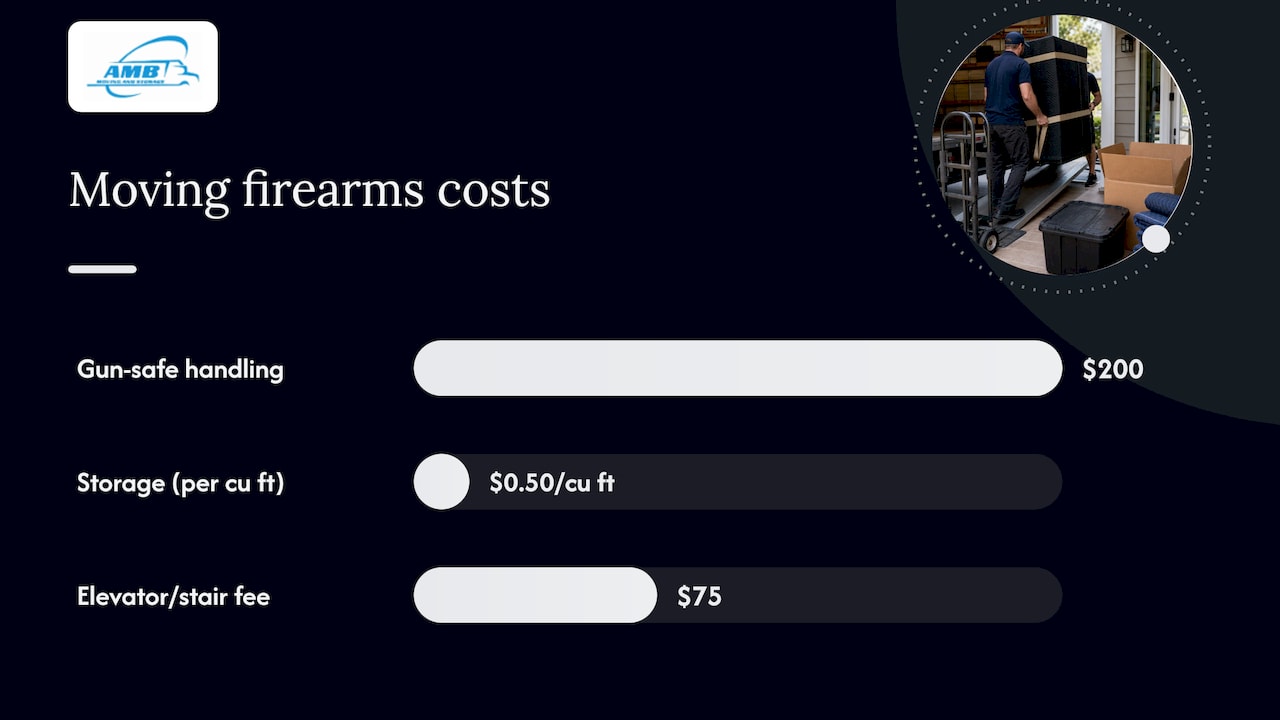
If you’re moving a gun safe, specialty item handling starts at $200, reflecting the extra equipment and labor heavy safes require. Storage between pickup and delivery, useful if your destination-state paperwork isn’t finalized when the truck arrives, starts at $0.50 per cubic foot. Elevator or stair access and long carry distances from the truck to your door each add a fee starting at $75.
Beyond moving-company charges, budget for state-specific costs: registration or permit fees where your new state requires them, and any additional insurance coverage you request for high-value firearms or safes. ATF Form 5320.20 itself carries no filing fee, but processing time can affect your moving timeline if NFA items are involved, so file it as early as your move planning allows.
Industry perspective on firearm relocation logistics
Most delays in firearm moves come from paperwork timing, not the law itself. Families assume a mover can sort it out day of, but NFA approval and destination-state registration both take lead time no carrier can shortcut. A licensed, insured nationwide mover built around federal compliance handles firearm shipments with written notification and documentation review as required for regulated items. A safe over 500 pounds or an NFA-regulated firearm both mean one thing: book the specialty handling conversation before the general moving quote, not after.
— AMB
Get a compliant quote for your firearm and safe move
Moving firearms interstate does not have to be complicated when the right mover asks the right questions up front. AMB Moving & Storage Inc. builds firearm and gun safe handling into standard long distance moving and interstate moving quotes, with transparent fee disclosure for specialty items and insured, licensed compliance across every leg of a nationwide moving route.
When you request a quote, include:
- The number and type of firearms, including any NFA-regulated items
- Your gun safe’s weight and dimensions, if applicable
- Pickup and delivery states, since state rules affect timing
| What to send us | Why it matters |
|---|---|
| Firearm inventory (make, model, serial) | Confirms accurate packing and carrier requirements |
| NFA status of any items | Determines whether ATF Form 5320.20 applies |
| Gun safe weight and dimensions | Sets specialty handling and equipment needs |
| Pickup and delivery states | Flags destination-state registration timing |
Start the conversation early, especially if NFA paperwork, a heavy safe, or multi-state coordination is involved. Request your quote today and get a plan built around your firearms, your timeline, and your destination state’s rules.
Sources
Bookmark these while planning: ATF’s firearms Q&A and Form 5320.20 for NFA transport, the text of 18 U.S.C. § 926A, USPS Publication 52 for mailing rules, TSA’s firearm travel guidance, and PHMSA’s interpretation on hazmat rules for commercial drivers carrying personal firearms.
This article is general information, not a substitute for advice from a qualified lawyer. Consult a qualified legal professional about your own circumstances before acting on anything here.
- Firearms Questions and Answers | ATF
- 18 U.S.C. § 926A — Interstate transportation of firearms
- USPS Publication 52 — Mailing firearms
- Transporting firearms and ammunition | TSA
FAQ
Can I legally move firearms to another state with my household goods?
Yes, federal law under 18 U.S.C. § 926A allows this as long as the firearm is unloaded and inaccessible during transit. You still need to notify your mover in writing and confirm your destination state’s registration and possession rules.
Do I need to tell my moving company I’m shipping firearms?
Yes. ATF guidance requires written notification to movers when firearms are part of a household goods shipment, and NFA items need the carrier to hold a copy of the approved Form 5320.20.
Can I mail a firearm instead of having the mover transport it?
Non-license holders can mail rifles and shotguns domestically to a licensed dealer using a service with tracking and signature capture, per USPS Publication 52. Handguns mailed by non-license holders face significantly tighter restrictions.
What are the rules for flying with firearms during a move?
TSA requires firearms to be unloaded, locked in a hard-sided case, and declared at the airline ticket counter as checked baggage. Violations can carry civil penalties up to $17,062, so declaring correctly matters.
How much does it cost to move a gun safe long distance?
Specialty item handling for gun safes starts at $200 with AMB Moving & Storage Inc., depending on weight and access requirements at pickup and delivery. Elevator, stair, or long carry fees starting at $75 each may apply on top of that if the safe requires extra distance or equipment to move.