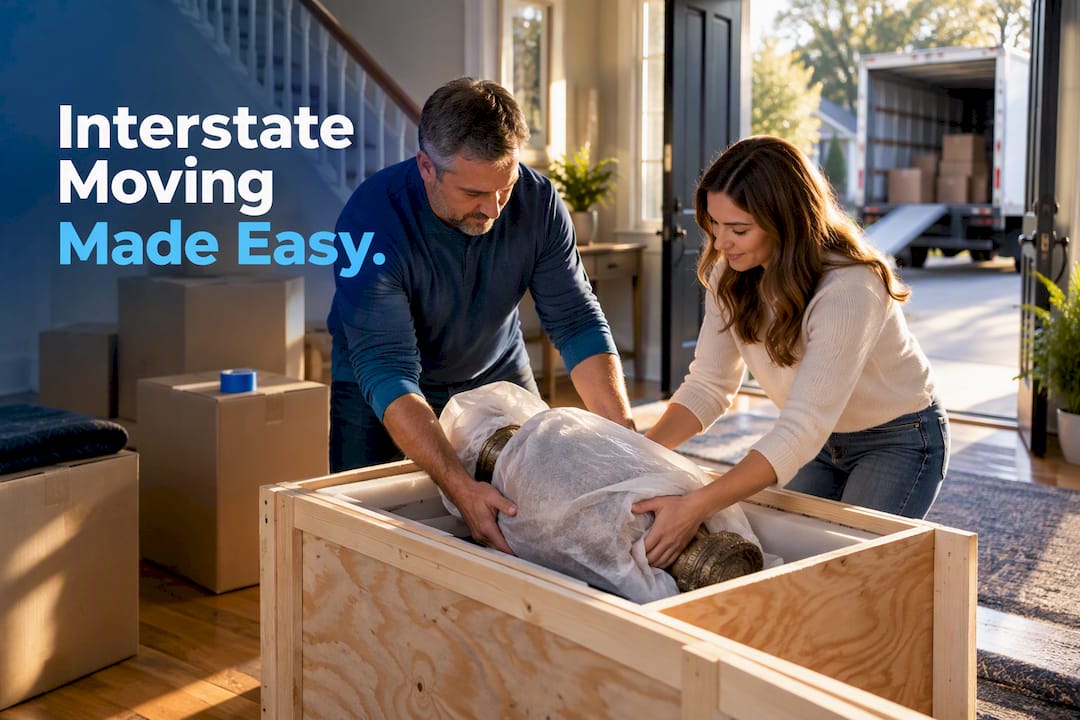
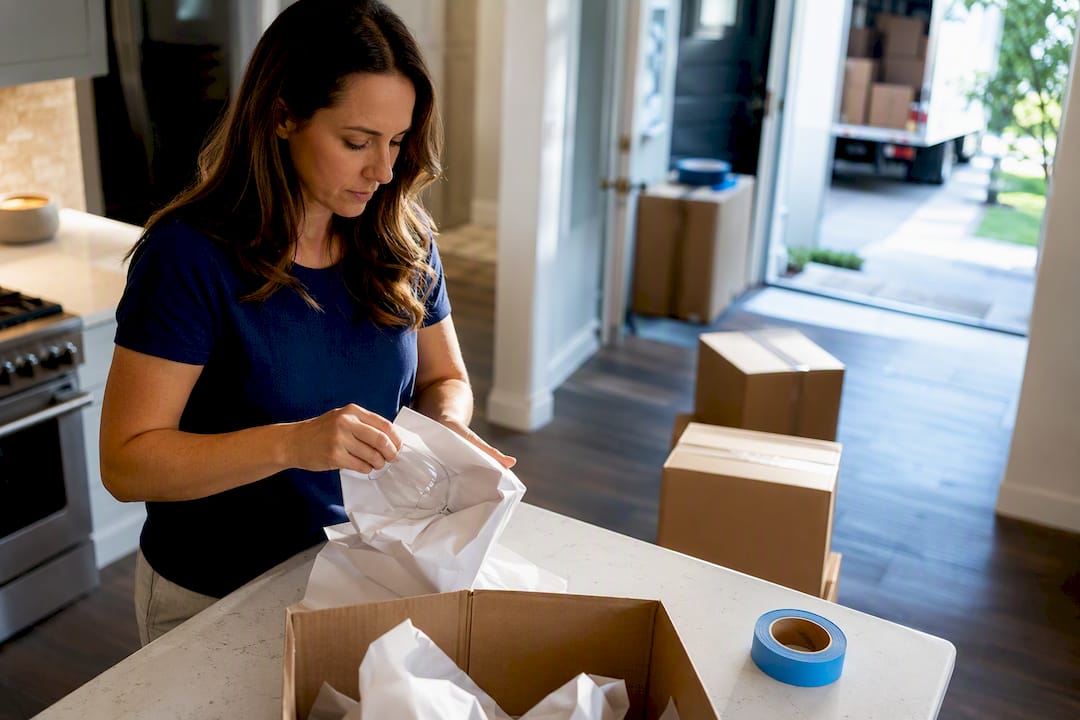

Wrap each fragile item individually, size the box to the weight of what’s inside, fill every void so nothing shifts, and label the box on multiple sides. Do those four things consistently and most breakage during a move is preventable. If you’re short on time or moving across state lines, a fragile-only packing service from professional movers closes the gaps DIY packing tends to leave open.
TL;DR:
- Wrapping each item individually, filling all voids, and labeling boxes on multiple sides are essential to prevent breakage during long-distance moves.
- Using impact-enhancing materials like bubble wrap paired with structural support reduces the risk of damage, especially on lengthy hauls.
- Smaller boxes under 45 pounds with properly reinforced bottoms are safer, and packing plates vertically helps distribute impact forces effectively.
- Double-boxing high-value or fragile items and labeling boxes as fragile on all sides ensures better protection and handling during transit.
- Outsourcing fragile-only packing to professionals can save time, improve safety, and cost between $1 and $2 per cubic foot for specific items.
Table of Contents
- How Do You Pack Fragile Items for Moving?
- What’s the Best Way to Pack Different Fragile Items?
- What’s the Right Order to Pack a Fragile Box?
- When Should You Double-Box or Crate an Item?
- How Should You Label Fragile Boxes?
- How Should Fragile Boxes Be Loaded and Transported?
- Why Trust AMB’s Packing Guidance?
- The Realistic Take on Packing Fragile Items
- Get Fragile-Only Packing Help From AMB
- Sources
- FAQ
How Do You Pack Fragile Items for Moving?
The materials you choose to determine whether a box survives a 2,000-mile truck ride or arrives with shattered contents. Packing paper wraps most dishware and glass without much cost, but skip actual newspaper against anything delicate. The ink transfers onto porous or light-colored surfaces, so wrap with clean, unprinted paper first if newsprint is all you have on hand.
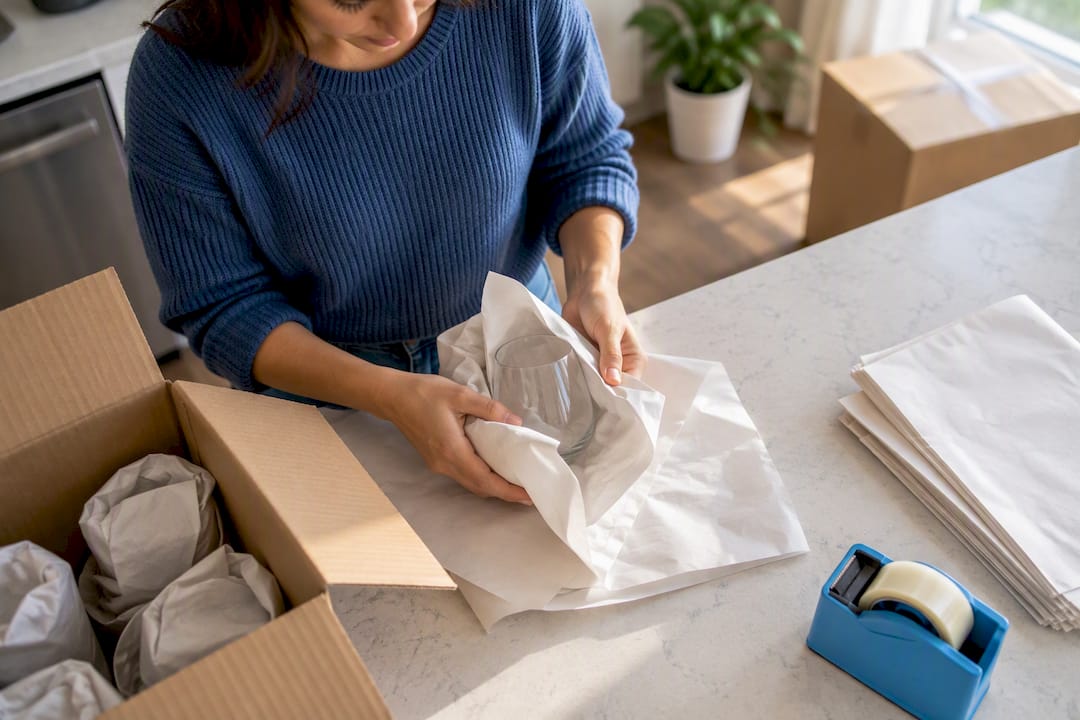
Bubble wrap earns its reputation for a reason, but it has a weakness on long hauls: the air cells can flatten under sustained weight over days on a truck, so pair it with something structural, like a folded piece of cardboard or a foam sheet, rather than relying on bubble wrap alone. Foam sheets work well for lightweight items with delicate finishes since they will not scratch glazes or paint. For glassware and stemware, cell dividers and dedicated dish pack boxes reduce the glass-to-glass contact that causes chips.
Box selection matters as much as the wrap inside it. Heavy or delicate items belong in double-walled boxes with reinforced, taped bottoms, and smaller boxes are safer than one oversized box crammed with dinnerware.
- Packing paper or unprinted newsprint for the first layer of wrap
- Bubble wrap or foam sheets for impact protection on breakables
- Dish pack boxes with cell dividers for glasses and stemware
- Corner protectors and mirror/picture boxes for framed items
- A tape dispenser, permanent marker, stretch wrap, and packing blankets
Pro Tip: Keep any box holding breakables under 40 to 45 pounds. Two smaller, well-packed boxes survive a long-distance move far better than one heavy box that strains at the seams every time it’s lifted.
What’s the Best Way to Pack Different Fragile Items?
Each category of breakable has its own failure point, and a technique that works for a plate will crush a glass.
- Plates and flat dishware. Wrap each plate individually, then stack them vertically on their edges, like records in a crate, instead of laying them flat. Vertical stacking spreads impact across the plate’s strongest axis instead of concentrating it on a flat, brittle surface.
- Glasses and stemware. Stuff the interior with paper so it holds its shape, wrap the stem separately from the bowl, then stand glasses upright in a divided dish pack rather than laying them on their sides.
- Mirrors and framed art. Tape an “X” across the glass with painter’s tape to control shattering, add corner protectors, and slide the piece into a mirror or picture box. Store it vertically, never flat, to keep weight off the glass. Our guide to packing artwork for long-distance moves covers framing types that need extra care.
- Electronics and TVs. The original manufacturer box is still your best option; if you don’t have it, use anti-static wrap, pad the edges, and store the unit upright rather than flat. Pull batteries and detachable cables before boxing anything.
- Vases and odd shapes. Pack loose paper into hollow interiors first so the shape can’t collapse inward, then wrap protruding handles or necks separately before wrapping the whole piece.
Pro Tip: For anything with an irregular shape, build a paper “cradle” that fills the hollows before you wrap the outside. It stops point pressure from cracking thin walls during transit.
What’s the Right Order to Pack a Fragile Box?
A box packed in the wrong sequence fails even with good materials. Follow this order every time:
- Prepare the box. Reinforce the bottom seams with extra tape and lay down 2 to 3 inches of crumpled paper or foam as a cushioned base.
- Wrap each item. Wrap individually and group like items together, plates with plates, glasses with glasses, so weight distributes evenly.
- Place and fill. Nest wrapped items snugly, heaviest on the bottom, and never overpack past the point where the lid closes flat.
- Fill every void. Stuff gaps with towels, paper, or foam scraps. If you shake the box gently and hear or feel movement, add more filler.
- Seal and document. Tape all seams in an H pattern for strength, then photograph high-value items before sealing. Photo documentation speeds up any insurance claim if something still arrives damaged.
When Should You Double-Box or Crate an Item?
Some items justify going beyond the standard wrap-and-box routine. Double boxing means placing an already-wrapped item, box and all, inside a larger box with 3 to 4 inches of cushioning on every side. It’s worth the extra material for lamp bases, ceramics with thin walls, and anything with a value that outweighs the cost of a second box.
- Crate large mirrors, marble tabletops, or oversized art instead of double boxing
- Keep electronics away from extreme temperature swings, especially in unheated storage
- Photograph antiques and high-value pieces before packing for insurance purposes
- Consider personally transporting irreplaceable, one-of-a-kind items rather than shipping them
Roughly 3 inches of cushioning around a fragile item, with all remaining space filled with loose-fill material, is the baseline manufacturers recommend before a box goes anywhere near a truck.
How Should You Label Fragile Boxes?
A perfectly packed box still breaks if the crew handling it doesn’t know what’s inside. Label every fragile box on two opposite sides plus the top, not just one corner someone might not see.
- Write the room name, a general contents note, and “Fragile” in large letters using a bright marker
- Add orientation arrows so the box travels right side up, every time
- Tell your moving crew directly which boxes can’t be stacked under anything heavier
- Use consistent labeling conventions across every box so nothing gets missed during a rushed unload
How Should Fragile Boxes Be Loaded and Transported?
Loading order matters just as much as packing technique. Fragile boxes should go into the truck last, which puts them on top of the load and first off the truck at the destination.
- Position fragile boxes in the truck’s most stable zone, away from the rear doors
- Secure the load with moving blankets and straps so nothing shifts during highway driving
- Avoid stacking anything heavy on top of a box marked fragile, even briefly
- Keep breakables clear of high-traffic edges near the loading ramp where bumps are more likely
Why Trust AMB’s Packing Guidance?
AMB Moving & Storage Inc. is a licensed, insured nationwide mover with direct experience packing artwork, electronics, and glassware for interstate relocations. Our crews handle fragile items daily across long-distance routes, not just local moves.
- Read more on why hiring professional packers pays off for a long-distance move
- Review our belongings protection guide for broader move-day strategy
- Fragile-only packing is often the smarter tradeoff when time is short but budget is tight
The Realistic Take on Packing Fragile Items
Most people overestimate how much bubble wrap fixes and underestimate how much box selection and void filling matter. A glass wrapped in three sheets of bubble wrap still breaks if it’s rattling around in a half-empty box. The technique that actually prevents damage isn’t fancier material, it’s discipline: wrap every single item, fill every single gap, and resist the urge to save one box by cramming in more than it should hold.
Here’s the honest tradeoff. DIY packing saves money upfront but costs hours you may not have, especially the week before an interstate move. Partial packing, where movers handle only the fragile items while you pack everything else, tends to be a smart middle ground for long-distance moves because professionals bring the crating and materials knowledge that catches problems before a box gets sealed. Cost estimates for a full-service move vary by home size and distance, but fragile-only packing is one of the more affordable ways to buy real protection without paying for a full pack.
— AMB
Get Fragile-Only Packing Help From AMB
If you’d rather not spend a weekend wrapping every wine glass and picture frame, AMB’s professional packing services cover fragile-only packing, crating for oversized or high-value pieces, and full protection for long-distance and interstate hauls. Packing runs $1 to $2 per cubic foot, so you can request coverage for just your china cabinet and art collection instead of the whole house.
We handle plates, stemware, electronics, and framed art with the same materials and techniques covered above, backed by nationwide licensing and insurance. If your move crosses state lines, pair fragile packing with our long-distance moving or interstate moving services for one coordinated timeline instead of juggling separate vendors. Our nationwide moving network covers cross-country routes from coast to coast. Get a free moving cost estimate and tell us which rooms need fragile-only attention.
Sources
For dishware, consider pairing your packing day with a move-out cleaning checklist to get your kitchen deposit-ready. Additional guidance came from FedEx’s breakables guide, uShip, U-Haul, and This Old House, all linked above.
- Packing breakables 101 | FedEx
- How to Pack Your Fragile and Valuable Items | uShip
- This Old House — packing and moving companies
FAQ
How Do You Pack Extremely Fragile Items?
Wrap each item individually with at least 3 inches of cushioning, then fill every remaining gap in the box with loose-fill material so nothing can shift. For items like crystal, thin ceramics, or antique glass, add a second outer box with 3 to 4 inches of extra padding between the two boxes.
What’s a Key Technique for Packing Fragile Items?
Packing plates and flat dishware vertically, like records in a crate, spreads impact force across the plate’s strongest edge instead of its flat, brittle center. This one adjustment is repeatedly recommended across carrier and mover guides because it prevents so much routine breakage.
What’s the Best Packing Material for Fragile Items?
Packing paper works as the primary wrap for most dishware and glass, while bubble wrap or foam sheets add impact protection for higher-risk pieces. Double-walled boxes with reinforced bottoms matter as much as the wrap itself, especially for heavier breakables.
How Do You Package Something Fragile Without Bubble Wrap?
Towels, clean clothing, and unprinted packing paper all work as substitutes when bubble wrap isn’t available. Build a cradle of crumpled paper to fill hollow spaces first, then layer soft fabric or paper around the item before boxing it, avoiding direct contact with printed newspaper, which can transfer ink.
Should You Hire Movers to Pack Only Your Fragile Items?
Yes, partial packing, where movers handle just the breakables while you pack everything else, is a common and cost-effective choice for long-distance moves. AMB’s professional packing services offer this option starting around $1 to $2 per cubic foot, letting you control costs while still protecting your most vulnerable belongings.