


File your USPS change of address at USPS.com/move first, since that keeps your mail flowing while everything else catches up. From there, work through DMV, IRS, SSA, and USCIS records if they apply to you, then move on to banks, insurers, utilities, and your employer’s payroll department.
TL;DR:
- Updating your USPS address online costs only $1.25 and should be done first, but it does not notify government agencies or financial institutions.
- Non-citizens must report USCIS address changes within 10 days, and IRS updates can take several weeks if filed by mail.
- Delaying updates to banks, insurers, and your employer can cause important documents like W-2s and insurance notices to be lost or sent to the wrong address.
- Government records such as DMV and voter registration require separate, often time-sensitive updates that are not triggered by USPS forwarding.
- Avoid third-party services charging excessive fees, as only USPS.com/move or local Post Offices are official channels to prevent scams.
Table of Contents
- Change of Address Moving Checklist You Can Finish Today
- How to Change Your USPS Address the Right Way
- Government Records You Have to Update Separately
- Banks, Insurance, Payroll, and Subscriptions: What Comes Next
- Your Moving Timeline: From 6 Weeks Out to Move Day
- How to Spot a Change of Address Scam
- How AMB Moving & Storage Keeps Address Changes on Track
- Updating Address With Doctors and Prescription Services
- Updating Address With Schools and Educational Institutions
- Updating Your Address on Digital Accounts and Online Shopping Platforms
- How to Confirm Every Address Change Actually Went Through
- What AMB Sees Go Wrong Most Often
- Get a Moving Quote That Covers the Whole Move, Not Just the Truck
- Sources
Change of Address Moving Checklist You Can Finish Today
Most of the work fits into one focused sitting if you tackle it in the right order. Start with the accounts that break your day-to-day life if they lag, then move to the ones with legal deadlines attached.
Do these first (today):
- File your USPS change of address online at USPS.com/move.
- Notify your employer’s payroll department so your W-2 and pay stubs land at the right place.
- Update your bank and credit card billing address.
- Call or log into your utility providers to schedule service transfers.
Schedule these within the next two weeks:
- DMV: driver’s license and vehicle registration
- IRS: Form 8822 or wait for your next tax filing
- SSA: report if you receive benefits
- Voter registration: update before any registration deadline in your new state
A few of these carry fees or paperwork. The USPS online verification runs $1.25, DMV changes often require an in-person visit for a new physical license, and IRS Form 8822 has to go in by mail. Nothing here is complicated, but skipping the order matters more than most people expect.
How to Change Your USPS Address the Right Way
USPS.com/move is the only official portal for filing a change of address moving request, and it’s worth bookmarking before you touch any third-party site. The online form takes a few minutes, and identity verification costs $1.25, charged to a credit card whose billing address matches either your old or new address.
If your card’s billing address doesn’t match, the online system won’t clear you. In that case, you’ll need to visit a Post Office in person with photo ID and fill out PS Form 3575, which is free.
What to know about timing and limits:
- Forwarding may start within 3 business days, but USPS advises allowing up to two weeks for it to fully kick in.
- A USPS change-of-address order only updates the Post Office’s routing. It does not notify the IRS, your bank, or anyone else.
- Standard forwarding is temporary, typically running for a set window before mail stops rerouting automatically.
Statistic Callout: The USPS online verification fee is $1.25. Third-party “change of address” websites frequently charge $40 or more for the identical service, according to USA.gov. Skip them.
Forwarding buys you breathing room. It’s not a substitute for updating the people who actually need your new address on file.
Government Records You Have to Update Separately
USPS forwarding doesn’t touch government databases, so each agency below needs its own notification, and some carry hard deadlines with legal weight.
- USCIS: Most non-citizens must report an address change within 10 days, and filing through your USCIS online account is faster and more reliable than mailing Form AR-11.
- IRS: Submit Form 8822 by mail, or simply list your new address on your next tax return. Form 8822 can’t be filed electronically and can take several weeks to process, so don’t wait until tax season if you need records updated sooner.
- SSA: If you receive benefits, report your new address by the 10th of the month after you move, either online or by phone at 1-800-772-1213.
- DMV: States typically give you a window of 10 to 60 days to update your driver’s license and vehicle registration after an interstate move, though the exact number varies by state.
- Voter registration: Update before your new state’s registration deadline, or you risk being turned away at the polls or defaulting to your old district.
Each of these operates independently. Updating one doesn’t trigger the others.
Banks, Insurance, Payroll, and Subscriptions: What Comes Next
Financial and service accounts don’t have legal deadlines, but delaying them causes real headaches, from frozen cards to denied insurance claims.
- Banks and credit cards: Update your address directly through your bank’s app or website. Billing address mismatches are one of the most common reasons online identity checks fail, including the USPS verification step itself.
- Insurance: Health, auto, and homeowners policies can all shift with a new address. Moving across state lines sometimes changes your premium or even your network coverage, so call your provider rather than assuming your old plan travels with you.
- Employer and payroll: Update HR so your W-2 and any 401(k) or investment account statements reach the right mailbox. A missing W-2 in February is a preventable headache.
- Subscriptions and deliveries: Update or pause meal kits, streaming mail services, and recurring deliveries so they don’t pile up at your old address.
Pro Tip: Pull up your last month of bank and credit card statements and list every company that sent you mail. That list is a faster, more accurate change-of-address checklist than any generic template, because it reflects the accounts you actually use.
Your Moving Timeline: From 6 Weeks Out to Move Day
Spreading these tasks across a timeline keeps any single week from becoming overwhelming, especially if you’re managing a long distance moving timeline with multiple vendors.
- 6 to 8 weeks out: File your USPS change of address, start scheduling utility disconnect and connect dates, and check our guide on transferring utilities before you move.
- 2 to 4 weeks out: Contact your bank, insurer, and employer. Confirm your USPS forwarding start date lines up with your actual move.
- Move week and move day: Confirm your mail reroute is active and save your USPS confirmation code somewhere you won’t lose it.
- One week after: Check for anything that still shows your old address, and call any agency or company that hasn’t updated yet.
This kind of staged approach is exactly what a solid moving checklist should walk you through, step by step, instead of dumping everything into one overwhelming list.
How to Spot a Change of Address Scam
The USPS charges $1.25 to verify your identity online. Any site charging significantly more for the same basic filing is almost certainly a paid middleman, not an official channel, and USA.gov warns explicitly about this pattern.
- Only use USPS.com/move or your local Post Office. Never a third-party “official change of address” site.
- Expect identity verification through a matching credit card billing address, or bring photo ID to a Post Office if that fails.
- USPS mails a confirmation letter to your old address after you file. If you never receive one, something went wrong and it’s worth calling to confirm.
- Never hand over your Social Security number or bank account details to a site that isn’t a .gov or the official USPS domain.
Pro Tip: If a site asks for payment before showing you the government seal or an official-looking form number like PS Form 3575, close the tab. That’s the fastest scam tell there is.
How AMB Moving & Storage Keeps Address Changes on Track
Coordinating a change of address moving process alongside a cross-country relocation is where most families lose track of details. AMB Moving & Storage builds move timelines that line up USPS forwarding dates, utility cutovers, and storage windows so nothing falls through during transit.
Clients receive documentation and confirmation tracking to help verify that critical notices, mail, and vendor updates land where they should during the first weeks after arrival. Address coordination is treated as part of the interstate moving process, not an afterthought handled alone after the truck pulls away.
Updating Address With Doctors and Prescription Services
Medical providers and pharmacies don’t automatically know you’ve moved, and a missed prescription refill notice is one of the more disruptive gaps in a relocation. Start with your primary care provider’s patient portal, most let you update your address directly online, and follow up with any specialists you see regularly.
Pharmacy chains typically update your address the moment you transfer a prescription to a new location, but if you’re staying with mail-order pharmacy benefits through your insurance, call the pharmacy benefits manager directly rather than assuming the switch happens automatically. This matters more with controlled substance prescriptions, which sometimes require a new prescription entirely rather than a simple transfer across state lines.
Health insurance is the other piece. If your move crosses state lines, your current plan’s network may not cover providers in your new area at all, so verify network coverage before you need care, not after an appointment gets denied. Call your insurer’s member services line and ask directly whether your plan travels with you or whether you need to switch during a special enrollment period triggered by the move itself.
Don’t forget dental, vision, and any specialist offices that mail you appointment reminders or billing statements. A missed billing statement that goes to a wrong address can end up as an unpaid balance sent to collections, entirely because nobody updated a mailing address.
Updating Address With Schools and Educational Institutions
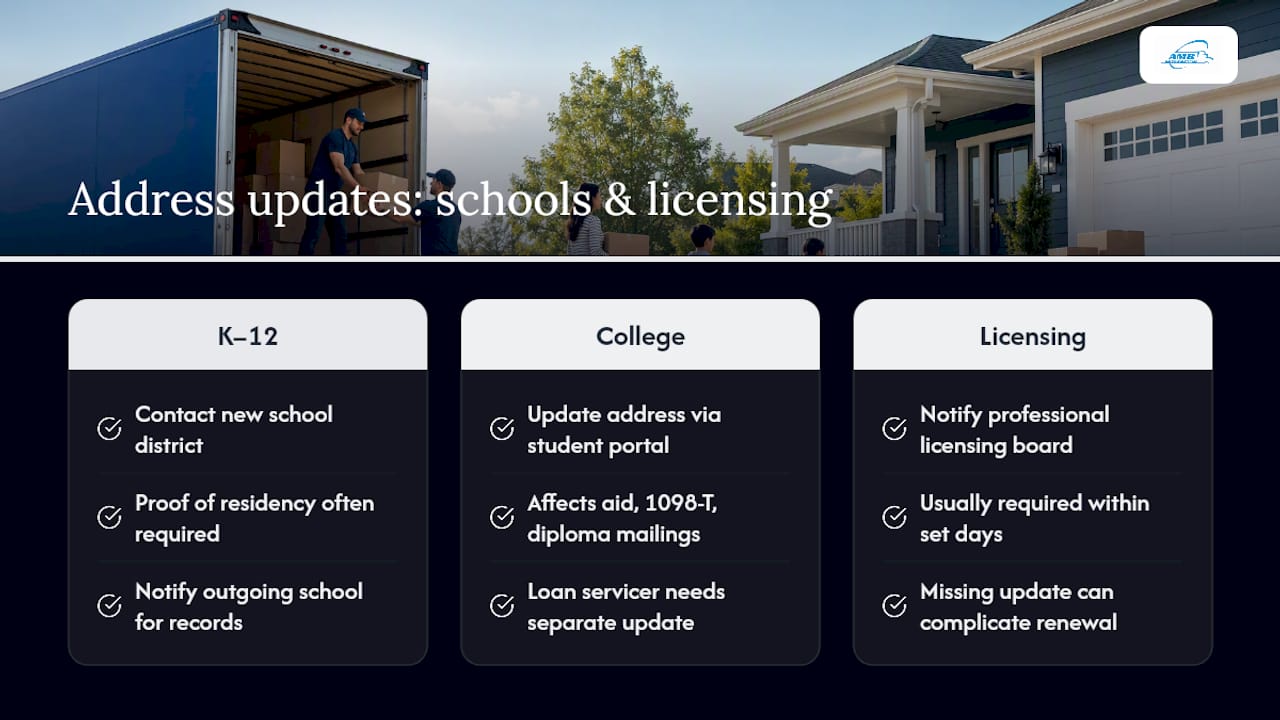
If you or your kids are enrolled anywhere, from K through 12 schools to colleges and trade programs, the address update process runs through the registrar or administrative office, not the mailroom.
For K through 12 students, contact the new school district first to confirm enrollment requirements, since many districts require proof of residency, like a lease or utility bill, before finalizing registration. The outgoing school also needs your new address on file so transcripts and final records route correctly.
College students and their families should update addresses directly through the school’s student portal. This affects far more than mail. Financial aid disbursements, 1098-T tax forms, and diploma mailings all depend on having a current address in the system. If you’re relying on federal student loans, the loan servicer needs a separate address update, since that record doesn’t automatically sync with your school’s registrar.
Professional licensing boards and certification bodies deserve their own mention here too. If you hold a state license tied to your profession, whether that’s nursing, teaching, real estate, or another regulated field, most boards require a separate address notification, often within a set number of days, and missing it can complicate license renewal later.
Updating Your Address on Digital Accounts and Online Shopping Platforms
Digital accounts are easy to forget because nothing physically arrives if you skip them, until a package ships to your old house or a fraud alert flags a mismatched address.
Start with the accounts you use most: your primary email provider’s account settings, any cloud storage service tied to billing, and password managers that store address data for autofill. Update these first since they often feed address information into other services automatically.
Online shopping platforms need individual attention. Update your default shipping address on every major retailer you order from regularly, and double check saved addresses on food delivery apps, since old defaults have a way of resurfacing on autopilot orders. Streaming services and app store accounts tied to a billing address matter too, especially if a mismatched address triggers a failed payment on a subscription renewal.
Digital wallets and payment apps deserve a careful pass. A billing address that doesn’t match your card’s actual mailing address is a common reason for declined transactions, and it can also trigger extra fraud verification steps that slow you down at exactly the wrong moment.
How to Confirm Every Address Change Actually Went Through
Filing an update isn’t the same as confirming it worked, and a lot of people assume the job is done the moment they hit submit.
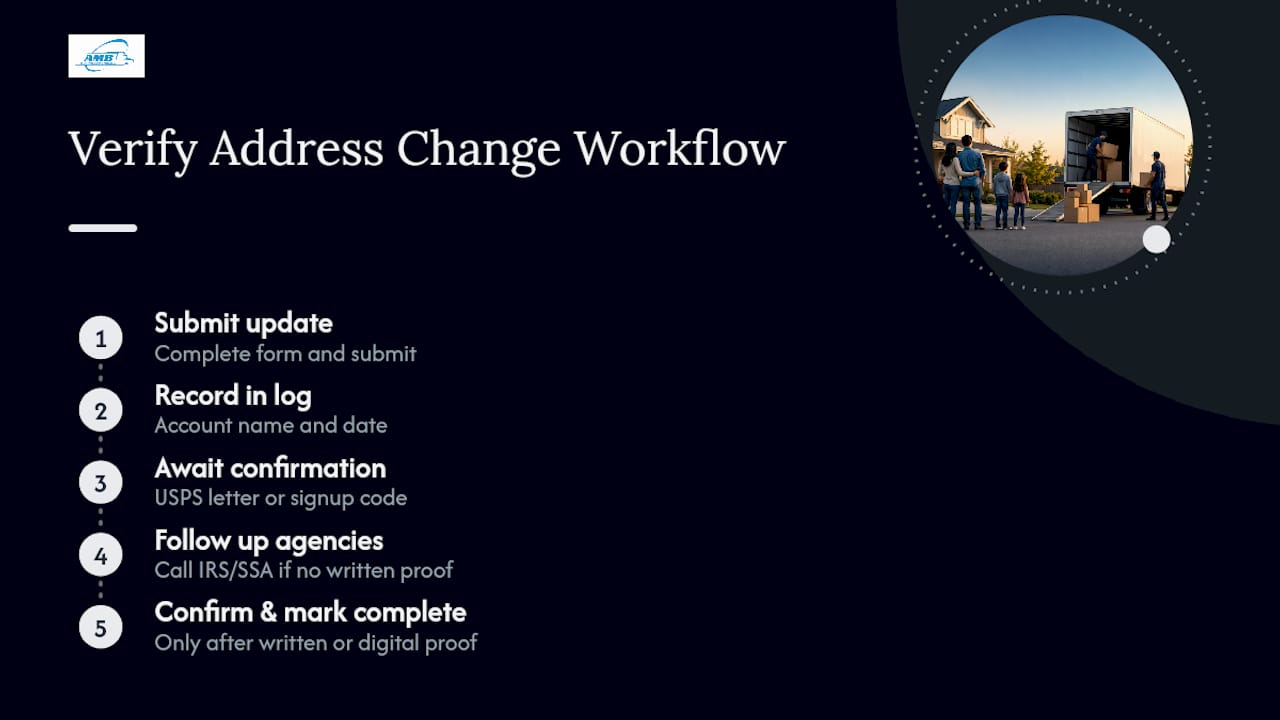
For USPS, watch for the confirmation letter mailed to your old address shortly after you file. That letter, along with the confirmation code you receive at signup, is your proof the order is active. For government agencies like the IRS or SSA, processing takes time, so follow up by phone if you haven’t seen a written confirmation within the timeframe each agency states.
Banks and credit card companies usually show the updated address immediately in your online account, so log in and check rather than assuming the change processed. For anything mailed to you, like a statement or a renewal notice, the real proof is when the next one arrives at the correct address.
Keep a simple log, even a basic spreadsheet, listing each account you updated and the date you did it. Cross off each one only after you’ve seen written or digital confirmation, not just after submitting the form. That single habit catches the handful of accounts that quietly failed to update, before they turn into a returned package, a bounced bill, or a lapsed insurance policy.
What AMB Sees Go Wrong Most Often
The biggest mistake we see is families treating USPS forwarding as the finish line instead of the starting point. It buys time, nothing more. Close behind that: skipping DMV and IRS updates for months, then scrambling when a renewal notice bounces back undeliverable. Utilities are the third repeat offender, families forget to schedule disconnect and connect dates until move week, and end up without power for the first night in a new state.
One client packet we’ve reviewed showed a family who delayed their SSA update by two months. Benefit correspondence went to an empty house for weeks. Start your checklist today, not after the truck is loaded.
— AMB
Get a Moving Quote That Covers the Whole Move, Not Just the Truck
AMB Moving & Storage is built for families who don’t want to juggle a cross-country move and a stack of address paperwork at the same time. Between long-distance moving, packing, and secure storage, AMB structures your move timeline so utility transfers, forwarding dates, and document coordination line up instead of colliding in the same chaotic week.
That coordination is the real difference for anyone managing a state-to-state relocation with kids, pets, or a tight closing date. Rather than tracking ten separate deadlines solo, you get a move plan built around them from day one, backed by AMB’s licensed and insured long distance moving service. Request a moving quote and include your move dates and any specialty items, so AMB can build a timeline around your actual address-change deadlines, not a generic one.
Sources
- Usa
- Change your address | USCIS
- Standard Forward Mail & Change of Address | USPS
- About Form 8822, Change of Address | IRS
- Update contact information | Social Security Administration
Stick to these official domains only. Anything charging a fee beyond USPS’s $1.25 verification is a third party, not a government requirement.


