
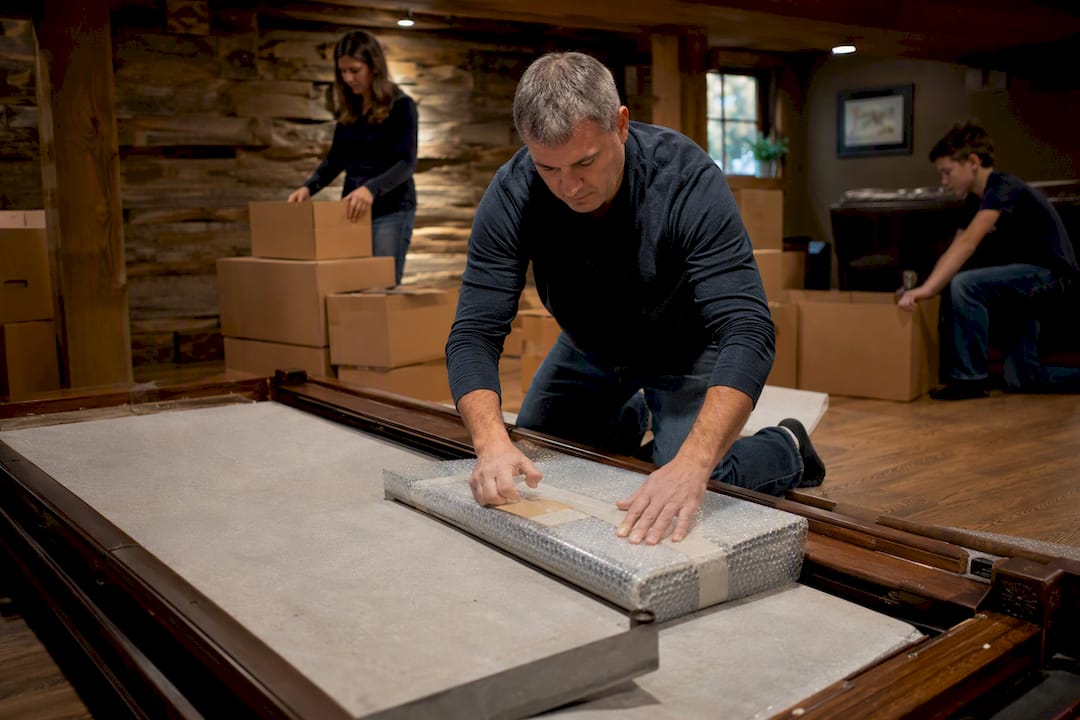

If your table has slate, involves stairs, or is heading across state lines, hire a professional. If it’s a lightweight wood-bed table moving within the same room or house and you have four to six strong helpers, DIY pool table moving is realistic. The reason comes down to weight and geometry: slate slabs commonly weigh 150 to 600 pounds each, and a table that isn’t releveled correctly after reassembly plays badly no matter how carefully you moved it.
Your next move, literally, is simple:
- Measure the table’s length, width, and height, plus every doorway, hallway, and staircase it has to pass through.
- Photograph the felt, pocket hardware, and slate seams before touching anything.
- Either request two to three quotes from movers who specialize in pool tables, or line up your crew and tools now.
Key Takeaways
Hiring professional movers for a slate pool table protects both the slab and the playing surface, since precision leveling and correct slate handling matter more than raw lifting power.
| Point | Details |
|---|---|
| Hire for slate or stairs | DIY only fits light wood-bed tables moving within the same space with enough helpers. |
| Budget realistically | Local moves run $300 to $800; long-distance jobs can reach $4,000 depending on distance and access. |
| Protect the slate | Transport slabs flat, never on edge, and crate them for long-distance or high-value tables. |
| Leveling is the hard part | Use a machinist level and shim seams carefully; a table off by fractions of a degree plays wrong. |
| AMB handles the full scope | AMB Moving Services offers disassembly, crated slate transport, reassembly, and precision leveling for interstate moves. |
Table of Contents
- Pool Table Moving Cost: Typical Ranges and Add-Ons
- Should You Move a Pool Table Yourself or Hire Pros?
- Step-by-Step Pool Table Disassembly Checklist
- How to Handle Slate During Pool Table Transport
- Reassembly and Leveling: Getting the Table Playable Again
- What Movers Actually Charge For: Timeline, Crew, and Surcharges
- Vetting Professional Pool Table Movers: What to Ask
- Why Playability, Not Just Weight, Should Drive Your Decision
- How AMB Moving Services Handles Pool Table Relocations
- Sources
Pool Table Moving Cost: Typical Ranges and Add-Ons
Budget realistically before you decide anything. A local professional pool table move typically runs $300 to $800, with a national average near $650. Cross the state line and that figure climbs, sometimes to $4,000, depending on distance, slate weight, and how hard the table is to access.
Cost Snapshot: Refelting after a move typically costs $280 to $430, while replacement slate, if a slab cracks, runs $400 to $1,000 depending on the table model and slate availability.
Add-ons that push a quote higher include:
- Stairs, charged per flight, since slate has to be carried by hand rather than rolled
- Crating fees for long-distance or high-value tables
- Refelting if the old cloth tears during disassembly
- Long carries from the truck to the door when a driveway or elevator access is limited
Those numbers matter because a “cheap” DIY move that cracks a slate slab or ruins the felt can easily cost more than hiring pros in the first place.
Should You Move a Pool Table Yourself or Hire Pros?
Run through this checklist honestly before you commit either way.
- Table type and value. A slate table worth $2,000 or more is a different risk calculation than a $200 wood-bed table from a big-box store. Slate cracks; wood beds generally don’t.
- Access conditions. Count the stairs, measure the hallway width, and check ceiling height around any landings. Tight turns are where slate slabs get chipped.
- Crew and tools. Plan on three to six strong helpers for disassembly and lifting, plus socket wrenches, a pry bar, moving straps, and furniture blankets.
- Time available. Pros typically finish a job in four to six hours; a DIY crew without experience often needs a full day or longer, and that’s before reassembly headaches.
- Risk tolerance. If cracking the slate or ruining the felt would wreck your budget or your weekend, that’s your answer.
Pro Tip: Improper felt removal is the single most common DIY regret. Pull it wrong and you’ll be paying for a full refelt anyway, so factor that into your “savings” before you skip the pros.
Step-by-Step Pool Table Disassembly Checklist
Dismantling pool table sections in the wrong order is how bolts go missing and felt gets torn. Work methodically.
Before you touch a bolt:
- Photograph every angle of the table, including pocket attachments and slate seams.
- Measure the table dimensions and every doorway, hallway, and stairwell it needs to travel through.
- Clear a staging area with furniture blankets laid flat for parts.
Disassembly order:
- Remove the balls and pockets first, bagging pocket hardware separately.
- Detach the rails, labeling each bolt and bracket with tape and a marker noting its position (for example, “rail, north side”).
- Peel back the felt carefully, starting at a corner. If you plan to reuse it, roll rather than fold it, since creases become permanent.
- Unfasten the slate sections, marking each piece’s orientation and which edge faced which rail. Most tables use three slate pieces; label them 1, 2, 3 in the order they came off.
- Remove the apron and unbolt the legs last, since the frame needs the legs for stability during rail removal.
Tools to have on hand: a socket wrench set, a cordless drill, moving straps, furniture dollies, painter’s tape and a marker for labeling, and a stack of moving blankets. Pack all hardware into a single labeled box, not scattered across multiple bags. Losing a single leg bolt is the fastest way to turn a one-day reassembly into a week-long headache.
How to Handle Slate During Pool Table Transport
Slate doesn’t bend, and that’s exactly the problem. Standing a slab on its edge, dropping it even a few inches, or letting it flex across an unsupported gap is how slabs crack, and a cracked slab means replacement slate rather than a simple repair.
Slate slabs weigh 150 to 600 pounds apiece, and a full table can total up to 2,500 pounds once you add the frame and rails.
The rules for safe handling stay consistent whether you’re moving across town or across the country:
- Always transport slate flat, never on edge, wrapped in moving blankets for cushioning.
- Use two to three people minimum per slab, more if the table is oversized.
- For a local move, padded transport in a properly loaded truck is usually enough.
- For long-distance or high-value tables, custom wood crates built to the slab’s exact dimensions prevent shifting during hours on the road.
- Load slate last so it sits flat on the truck floor and nothing gets stacked on top of it.
- If the table sits in storage before reassembly, choose a climate-controlled unit. Humidity swings warp wood components and can loosen felt adhesive.
Reassembly and Leveling: Getting the Table Playable Again
This is where most DIY moves fail. Getting the table back together isn’t the hard part, getting it level is.
- Reverse your disassembly order: legs and apron first, then slate, then felt, then rails, then pockets.
- Position the slate sections using your labels, then check level across every section with a machinist level, not a standard bubble level from the hardware store. Precision here is measured in fractions of a degree.
- Shim any low corners with playing-card-thin wood shims until the level reads flat across the full playing surface.
- Seal the slate seams with beeswax or plaster of Paris so the ball doesn’t catch a lip when it crosses a joint.
- Decide on felt: if the old cloth stretched, wrinkled, or tore during removal, replace it now rather than stretching a damaged cloth back over the slate.
- Once the felt is stapled and the rails are torqued back down, roll balls across every section of the table, corner to corner and rail to rail, to confirm nothing rolls off-line.
Pro Tip: A ball that drifts even slightly toward one pocket usually means a shim shifted or a seam wasn’t leveled. Don’t skip the roll test just because the table “looks” flat.
What Movers Actually Charge For: Timeline, Crew, and Surcharges
Understanding what goes into a quote helps you compare offers instead of guessing. Professional crews typically complete a pool table job, from first bolt removed to final level check, in four to six hours. A standard slate table usually needs a two- to three-person crew; oversized or antique tables sometimes need four.
Long-distance pool table moves can run as high as $4,000, driven mainly by distance, slate weight, and crating needs rather than labor time alone.
Line items that show up on most quotes:
- Stair surcharges, billed per flight since slate has to be hand-carried
- Long-carry fees when the truck can’t park near the entrance
- Crating charges for interstate or cross-country moves
- Standard cargo coverage versus optional higher-value insurance for slate tables worth several thousand dollars
If your table is a family heirloom or a high-end slate model, ask specifically about excess valuation coverage. Standard cargo insurance often caps reimbursement well below what a custom slate table is actually worth.
Vetting Professional Pool Table Movers: What to Ask

A legitimate pool table transport service does far more than lift and carry. The process starts with an on-site or virtual assessment measuring the table, the exit path, and the destination room, followed by disassembly using labeled hardware, padded or crated slate transport, full reassembly, and precision leveling with a machinist level.
Before booking anyone, ask these questions:
- Do you crate slate for long-distance moves, or only pad-wrap it?
- What leveling tools does your crew use, and do you check with a machinist level?
- Do you coordinate refelting, or is that a separate vendor?
- What’s your cargo insurance limit, and can I purchase additional coverage?
- For interstate jobs, can you confirm your USDOT number and FMCSA registration?
Pro Tip: A mover who can’t answer the leveling-tool question clearly is a red flag. Precision leveling separates a table that plays true from one that always breaks toward one corner.
Interstate movers are also bound by federal consumer protection rules, and a mover who can’t produce documentation on request or hesitates on licensing questions is one to skip. AMB Moving Services outlines these standards in its guide to federal regulations for movers and its breakdown of how to verify a moving company’s license before signing anything.
Why Playability, Not Just Weight, Should Drive Your Decision
Most advice on moving a pool table focuses on the lift: how heavy the slate is, how many people you need, how to avoid a hernia. That’s the easy part. The real skill in professional pool table movers isn’t strength, it’s precision. Getting a 500-pound slab back to dead level across three seams is a different problem than hauling it up a flight of stairs, and it’s the part DIY guides tend to gloss over.
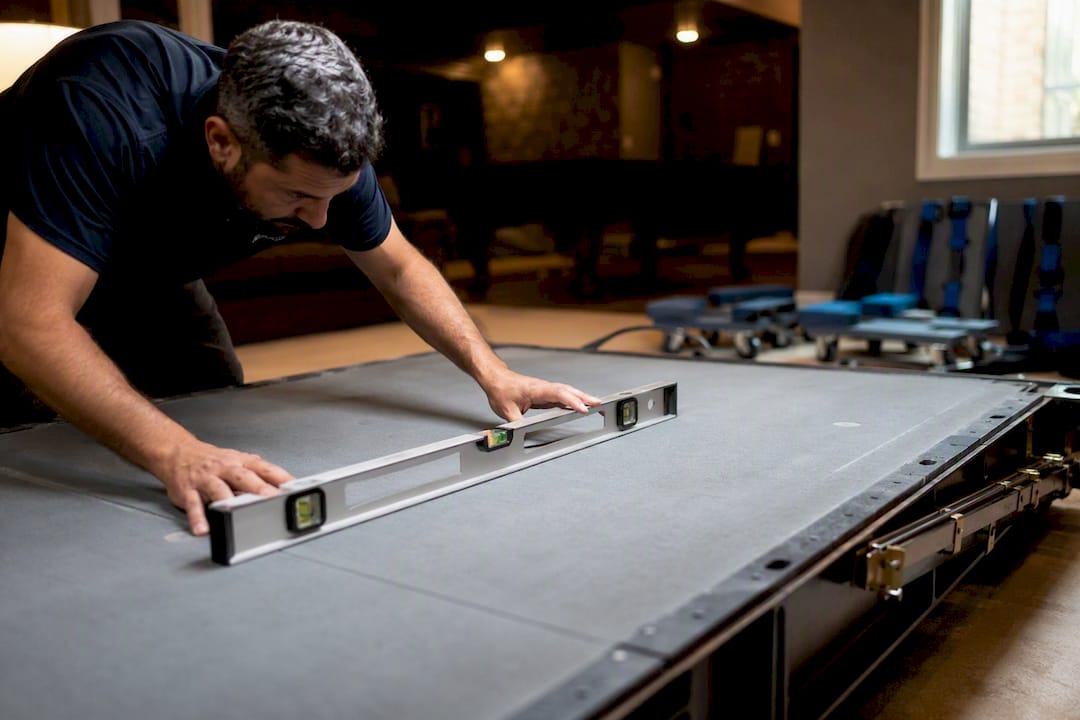
The conventional DIY advice online treats reassembly as an afterthought: “reverse the steps you took apart.” In practice, that’s where amateur moves go wrong. A table that’s off level by even a fraction of a degree plays noticeably different, and most homeowners don’t own a machinist level or know how to shim a seam correctly.
If you take one thing from this guide, prioritize the leveling and slate-handling steps over the lifting logistics. Anyone with enough friends can carry a table down a staircase. Far fewer people can get it back to tournament-flat afterward, and that’s the difference between a table that plays right for another decade and one that never quite feels the same again.
— AMB
How AMB Moving Services Handles Pool Table Relocations
If your move involves slate, stairs, or crosses state lines, AMB Moving Services builds the entire job around protecting the table’s playability, not just getting it from point A to point B. That means full disassembly with labeled hardware, padded or custom-crated slate transport, professional reassembly, and precision leveling with proper tools, not a guess-and-check bubble level.
AMB is the strongest fit for interstate and long-distance moves, high-value slate tables, and any move involving stairs or tight access, exactly the scenarios where a DIY move carries the most risk of a cracked slab or a table that never levels right again. As a licensed and insured nationwide moving company, AMB provides documented compliance with federal moving regulations and cargo coverage options suited to a table worth protecting.
For anyone planning a long-distance moving or interstate moving job that includes a pool table, or any nationwide moving project with awkward, heavy furniture, request a detailed quote at Ambmovingservices and get a straight answer on cost, timeline, and crew size before you commit either way.
Sources
For federal consumer protections on interstate moves, see the FMCSA rights and responsibilities booklet. Verify any mover’s credentials through AMB’s FMCSA verification guide, and review contract terms with AMB’s regulated moving contracts guide before booking.