


TL;DR:
- Long-distance freight involves transporting goods over more than 250 miles across state lines, governed by FMCSA regulations. Costs decrease per mile as distance increases, with line-haul rates typically ranging from $1.50 to $2.80, influenced by factors like backhaul availability and shipment type. Successful shippers verify carrier compliance, plan for permits in advance, and optimize load density to control expenses.
Long-distance freight is defined as the commercial transportation of goods over distances exceeding 250 miles, typically crossing state lines via truck, rail, or intermodal networks. The industry term for the core trunk route in these shipments is “line-haul,” and line-haul costs account for 40–60% of total logistics expenses. Understanding this distinction matters whether you are shipping a single pallet or relocating an entire business. Federal oversight from the FMCSA (Federal Motor Carrier Safety Administration) applies the moment freight crosses a state border, triggering registration, insurance, and compliance requirements that carry real financial consequences if ignored.
What is long-distance freight, and what shipment types does it cover?
Long-distance freight covers any commercial shipment traveling more than 250 miles, which is the threshold recognized by industry standards for long-haul trucking. Below that distance, shipments generally fall under regional or local freight categories with different cost structures and regulatory treatment.
Four primary shipment types define this space:
- Full Truckload (FTL): One shipper fills an entire trailer, typically 48 or 53 feet. FTL works best for large volumes because the truck moves directly from origin to destination without stops.
- Less-Than-Truckload (LTL): Multiple shippers share trailer space. LTL costs less per shipment but adds transit time because the carrier consolidates and deconsolidates freight at terminals.
- Intermodal freight: Cargo moves in a standardized container across two or more modes, such as truck to rail to truck. Intermodal reduces fuel costs on long corridors but requires more lead time.
- Specialized freight: Oversized, overweight, or hazardous loads that require permits, escort vehicles, or temperature-controlled equipment. Oversized freight permits require 2–4 weeks of lead time for route approval, and emergency filings can double transportation costs.
The line-haul concept is worth understanding clearly. Line-haul covers the middle leg between freight hubs and excludes first-mile pickup and last-mile delivery. Misunderstanding this causes budgeting errors because shippers assume the quoted line-haul rate covers door-to-door service when it does not.
Pro Tip: If your shipment is close to the FTL minimum weight threshold, price both FTL and LTL options. FTL often costs less per pound once your freight exceeds roughly 15,000 pounds, even if you do not fill the trailer.

How do costs and pricing work in long-distance freight shipping?
Freight pricing follows a fixed-plus-variable structure. Fixed costs include loading, unloading, and administrative fees that apply regardless of distance. Variable costs scale with mileage, fuel, and driver time.
The most counterintuitive fact in freight pricing is that per-mile rates drop as distance increases. A 200-mile shipment may cost $3.00 per mile, while a 1,500-mile shipment drops to $1.80 per mile. Fixed costs spread across more miles, making long-haul freight more cost-efficient per unit than short-haul runs.
Trucking line-haul rates typically range between $1.50 and $2.80 per mile, separate from drayage and final delivery charges. That range reflects fuel price swings, lane demand, and carrier capacity at any given time.
Backhaul dynamics drive significant price variation. Empty backhaul miles increase operating costs by 30–40%, and carriers price those costs into outbound rates on lanes where return freight is scarce. Shippers who understand this can negotiate better rates by choosing lanes where carriers need freight for the return trip.
Pro Tip: Avoid shipping to or from “freight deserts,” which are regions with low outbound freight volume, during Q4 peak season. Carriers charge a premium on those lanes because empty return miles are almost guaranteed.
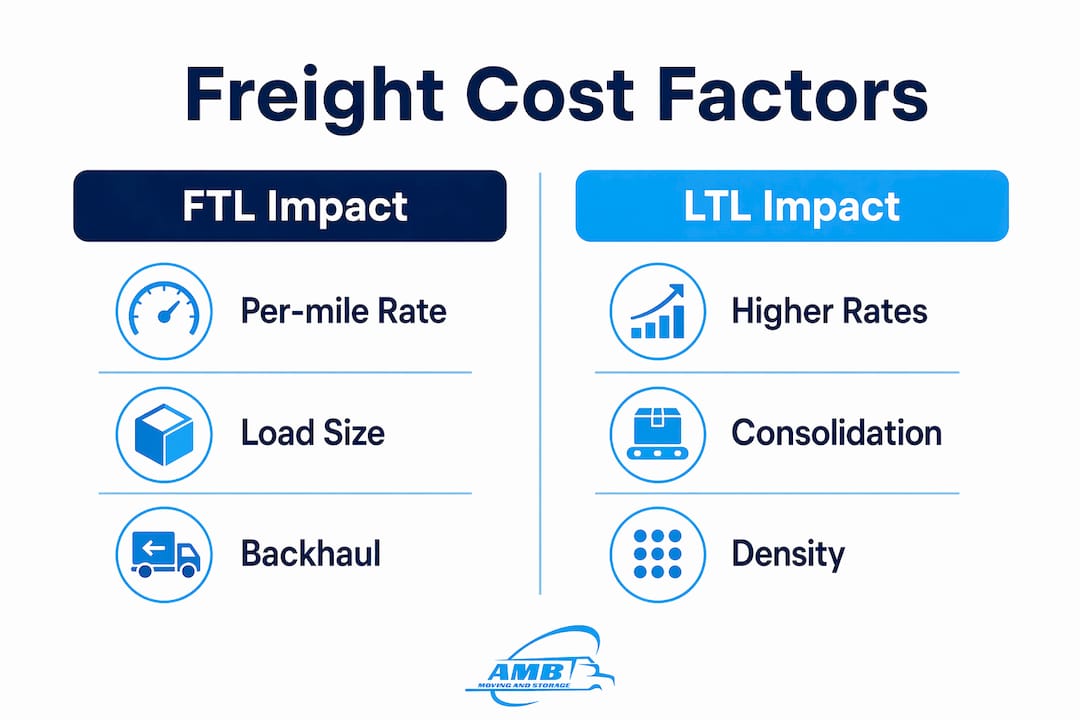
The table below shows how key cost factors interact across shipment types:
| Cost factor | FTL impact | LTL impact |
|---|---|---|
| Per-mile rate | Lower on long corridors | Higher due to terminal handling |
| Fixed loading fees | Spread across full load | Split among multiple shippers |
| Backhaul exposure | High if lane is one-directional | Lower because carrier consolidates |
| Transit time | Faster, direct routing | Slower, terminal stops add days |
| Detention risk | High if dock is slow | Moderate, managed at terminals |
Transportation costs represent roughly 40–50% of total supply chain expenses. That share makes freight pricing a competitive variable, not just an operational line item.
What regulatory requirements apply to long-distance freight?
Interstate freight triggers federal oversight the moment a shipment crosses a state line. The FMCSA governs this space, and carriers must hold several registrations before they can legally operate.
Required registrations for interstate carriers include:
- USDOT number: The baseline federal identifier for any commercial motor carrier.
- MC number (Motor Carrier authority): Required for carriers transporting regulated commodities for hire across state lines.
- UCR (Unified Carrier Registration): An annual fee-based registration that funds state enforcement programs.
- IFTA (International Fuel Tax Agreement): Tracks fuel use across states and calculates tax owed to each jurisdiction.
- IRP (International Registration Plan): Apportions vehicle registration fees across states based on miles traveled in each.
Interstate carriers must maintain all five registrations to operate legally. Failing to verify a carrier’s compliance status exposes shippers to legal liability and financial penalties if an uninsured or unlicensed carrier is involved in an incident.
Insurance minimums are not optional. Federal operating authority requires a minimum of $750,000 in cargo liability coverage for general freight. The FMCSA can suspend a carrier’s operating authority within 7 days of a lapse in required financial security. That timeline is short enough to strand active shipments mid-route.
Verifying a carrier’s FMCSA status before booking is a straightforward step that most shippers skip. The FMCSA carrier verification process takes minutes and confirms active authority, insurance status, and safety ratings in one lookup.
What operational challenges affect long-distance freight logistics?
Long-distance freight introduces operational complexity that short-haul shipping avoids entirely. Managing these factors separates shippers who control costs from those who absorb surprises.
-
Hours of Service (HOS) limits. Federal HOS rules cap property-carrying drivers at 11 hours of driving within a 14-hour on-duty window, followed by a mandatory 10-hour rest period. A 2,000-mile shipment requires multiple driving shifts, adding transit days that must be built into delivery commitments.
-
Multi-jurisdiction route planning. A truck crossing six states encounters six sets of weight limits, bridge restrictions, and seasonal road bans. Route planning software accounts for these variables, but specialized or oversized loads require manual permit applications in each state.
-
Detention and dwell time fees. Detention charges apply when a truck waits beyond the free-time window at a loading or unloading dock. These fees add hundreds to thousands of dollars per incident and compound quickly on multi-stop routes. Scheduling dock appointments in advance eliminates most detention exposure.
-
Load density optimization. Carriers price freight by weight or by cubic space, whichever produces higher revenue. Low-density freight, meaning light but bulky cargo, often triggers dimensional weight pricing. Repackaging or palletizing freight to increase density reduces per-unit transport costs. Companies that treat freight strategically control landed cost variance better by optimizing load density before booking.
-
Oversized freight permitting. Loads exceeding standard legal dimensions require state-by-state permits, approved routes, and sometimes escort vehicles or utility line lifts. Planning for the 2–4 week permit lead time prevents costly emergency filings and shipment delays.
The most overlooked operational cost is backhaul exposure on specialized lanes. A carrier hauling oversized equipment to a rural destination often has no return freight available. That empty return trip gets priced into the outbound quote, and shippers who do not ask about it pay the full cost without realizing it.
Key Takeaways
Long-distance freight is defined by the 250-mile threshold, governed by FMCSA regulations, and priced through a fixed-plus-variable structure where per-mile costs fall as distance increases.
| Point | Details |
|---|---|
| Distance threshold | Shipments over 250 miles qualify as long-distance freight under industry standards. |
| Line-haul vs. door-to-door | Line-haul covers only the hub-to-hub leg; first and last mile are priced separately. |
| Per-mile cost efficiency | Rates drop from roughly $3.00 to $1.80 per mile as distance increases from 200 to 1,500 miles. |
| Regulatory compliance | Interstate carriers must hold USDOT, MC, UCR, IFTA, and IRP registrations to operate legally. |
| Backhaul awareness | Empty return miles raise operating costs by 30–40%, directly inflating outbound freight rates. |
What I’ve learned about long-distance freight after years of interstate moves
The biggest mistake shippers make is treating freight as a commodity purchase. They get three quotes, pick the lowest number, and assume the job is done. That approach works fine until a carrier shows a lapsed MC number at a weigh station, or a shipment sits at a dock for six hours because nobody scheduled a delivery appointment.
Backhaul dynamics are the single most underused cost lever available to shippers. Carriers desperately need freight on return lanes, and shippers who time their moves to align with those needs get rates that reflect actual market capacity rather than peak-demand premiums. Q4 is the worst time to ship to low-volume destinations. january and february, by contrast, often produce the most competitive rates on long corridors.
Carrier verification is not a one-time check. Insurance lapses happen mid-contract, and the FMCSA’s 7-day suspension window means a carrier can go from compliant to suspended between your booking and your pickup date. Checking status within 48 hours of a scheduled pickup costs nothing and eliminates significant risk.
For businesses planning interstate relocations, the permit timeline for oversized or specialty freight is the most common planning failure. Two to four weeks sounds like plenty of time until a project deadline moves up. Build permit lead time into every project plan from day one, not as an afterthought.
The shippers who consistently control freight costs share one habit: they understand the full cost structure before they book, not after the invoice arrives.
— AMB
How Ambmovingservices handles your long-distance shipping needs
Ambmovingservices operates as a nationwide moving company with full compliance under 2026 FMCSA regulations, covering long-distance moving for both residential and commercial clients across all 50 states.
Every move handled by Ambmovingservices includes verified carrier authority, active insurance coverage meeting federal minimums, and transparent cost estimates before any commitment. The team manages route planning, permit coordination for specialty items, and scheduling to eliminate detention fees. Whether you are moving a household across three states or relocating a business operation, Ambmovingservices provides the compliance documentation and cost visibility that protect you from the hidden expenses most shippers discover too late. Request a quote and get a clear, itemized estimate for your long-distance move.
FAQ
What qualifies as long-distance freight?
Long-distance freight is any commercial shipment traveling more than 250 miles, the threshold recognized by industry standards for long-haul transportation. Shipments crossing state lines also trigger FMCSA federal oversight regardless of distance.
What is the difference between FTL and LTL for long-distance shipping?
FTL (Full Truckload) dedicates an entire trailer to one shipper and moves directly from origin to destination, while LTL (Less-Than-Truckload) combines multiple shippers’ freight and routes through terminals, adding transit time but reducing cost for smaller loads.
How is long-distance freight cost calculated?
Carriers apply a fixed-plus-variable structure: fixed fees for loading and administration, plus a per-mile rate that typically ranges from $1.50 to $2.80 for the line-haul segment. Per-mile rates decrease as distance increases because fixed costs spread across more miles.
What federal registrations does an interstate freight carrier need?
Interstate carriers must hold a USDOT number, MC number, UCR registration, IFTA fuel tax account, and IRP plate apportionment to legally operate across state lines. Carriers must also maintain a minimum of $750,000 in cargo liability insurance for general freight.
What causes unexpected cost increases in long-distance freight?
The three most common sources of surprise costs are detention fees from dock delays, backhaul pricing on low-volume lanes, and emergency permit fees for oversized freight that was not planned 2–4 weeks in advance.