


TL;DR:
- Commercial storage provides business-grade services like freight acceptance and extended access, ideal for long-distance relocations. Verifying features such as freight signature authority, climate control, and security measures prevents costly moving delays. Bundling storage with interstate moving offers efficiency, compliance, and reliable coordination for businesses and residents.
Commercial storage is rented space paired with business-grade services, including freight acceptance, extended access, and inventory handling, designed to support operations that standard self-storage units simply cannot accommodate. If you’re planning a long-distance or interstate move and need a facility that can receive truck deliveries, store palletized inventory, or allow light business activity on-site, commercial-grade storage is the right category to shop.
TL;DR
- Choose commercial storage (not residential self-storage) when you need freight acceptance, 24/7 access, or loading-dock capability.
- Standard self-storage prohibits most business activity; commercial facilities allow order staging, packing, and light assembly.
- For interstate and long-distance moves, book storage at the same time you book your movers.
- AMB Moving & Storage Inc. bundles licensed, insured moving with secure storage for cross-country relocations. Request a quote before your move date fills.
Table of Contents
- What commercial storage is and how it differs from self-storage
- Core features to expect from a commercial storage facility
- How businesses and residents use commercial storage during interstate moves
- Typical pricing models, fees, and contract terms
- Regulatory, insurance, and logistics checks before storing goods
- How to vet a commercial storage provider
- How to integrate commercial storage into your interstate moving plan
- When commercial storage is the right call
- Key Takeaways
- AMB’s perspective on commercial storage for interstate moves
- Get a quote for bundled moving and storage
- Useful sources and further reading
What commercial storage is and how it differs from self-storage
Commercial storage, also called business storage or warehouse storage, is a category of rented space built around operational needs rather than personal convenience. The practical gap between it and standard self-storage is wider than most people expect.
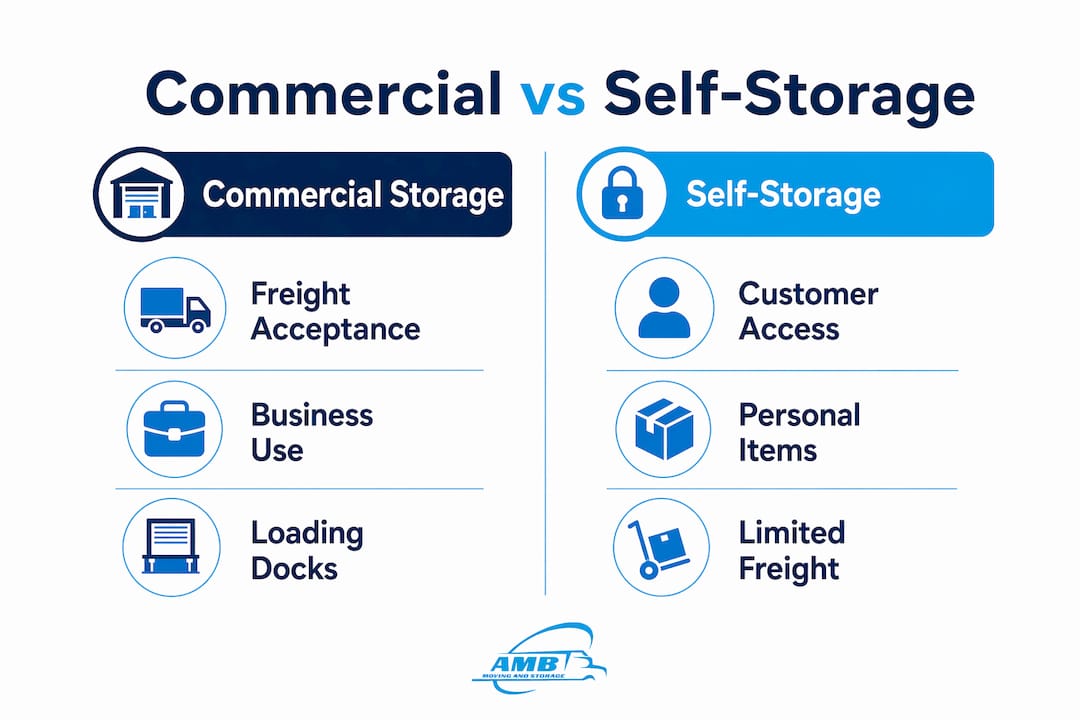
A typical self-storage unit gives you a locked room and a gate code. A commercial storage facility gives you a loading dock, freight acceptance with signature authority, pallet racking, large-vehicle access, and often the legal right to conduct light business activity inside the unit. Many self-storage operators prohibit conducting business in a unit entirely; commercial storage frequently allows order staging, packing, and assembly, which are activities that matter enormously during a business relocation.
Common types of commercial storage include:
- Warehouse bays for bulk inventory or equipment
- Pallet storage with forklift access and racking systems
- Climate-controlled units for electronics, documents, pharmaceuticals, or fine art
- Vehicle and yard storage for fleet trucks, trailers, or construction equipment
- Drive-up bays for frequent, high-volume access without dock scheduling
Pro Tip: Before booking any facility, ask two specific questions: “Can you accept freight deliveries that require a signature?” and “What is your policy on business activity within the unit?” The answers will immediately tell you whether you’re looking at true commercial storage or a self-storage unit with a business-friendly marketing label.
AMB Moving & Storage Inc. bundles moving and commercial storage services for interstate moves, which removes the coordination headache of managing two separate vendors across state lines.
Core features to expect from a commercial storage facility
The features that separate a capable commercial facility from a basic one come down to physical infrastructure, environmental controls, and operational support.
Physical infrastructure
- Loading docks and drive-up bays sized for 18-wheelers
- Forklift availability and pallet racking
- Large-vehicle and trailer access in the yard
- On-site packaging and shrink-wrapping services
Environmental and security controls
- Climate control (temperature and humidity regulation)
- Pest control programs
- Gated perimeter with keypad or app access
- 24/7 surveillance cameras and alarm systems
- Extended or 24/7 access for after-hours retrieval
Operational capabilities
- Freight acceptance and signing authority for incoming shipments
- Inventory tracking systems and itemized manifests
- Order staging and fulfillment permissions
- Cross-dock handling for multi-stop interstate shipments
Security checklist before you sign:
| Feature | Why It Matters |
|---|---|
| Freight acceptance with signature | Prevents delivery failures during interstate moves |
| 24/7 or extended access | Critical for time-sensitive business operations |
| Climate control | Protects electronics, documents, and sensitive inventory |
| Pallet racking and forklift | Required for bulk or heavy commercial goods |
| Gated access and cameras | Reduces theft and liability exposure |
| Pest control program | Protects inventory from damage during long-term storage |
Commercial storage options include warehouse rental space, climate-controlled units, and vehicle storage. The right type depends on your inventory size, handling requirements, and any regulatory limits on what you’re storing.
How businesses and residents use commercial storage during interstate moves
The scenarios where commercial storage earns its keep are specific, and recognizing yours early saves money and stress.
Business use cases:
- Staging inventory during a multi-state office or warehouse relocation
- Holding overflow seasonal stock when the new facility isn’t ready
- Running a temporary fulfillment hub between closing one location and opening another
- Storing equipment during a facility renovation or build-out
Resident use cases for interstate moves:
- Bridging the gap between your old home’s closing date and your new home’s move-in date
- Storing a vehicle during a cross-country relocation when you’re flying ahead
- Keeping climate-sensitive items (artwork, wine, instruments) safe during a long transit window
Business storage solutions can include full-service options that handle packing, pickup, and delivery to storage, which is valuable for long-distance moves where managing local regulations and pickup windows across multiple states gets complicated fast.
Businesses also choose commercial storage to avoid the capital expense of buying or leasing additional real estate, gaining flexible scaling during moves, seasonal demand spikes, or expansion phases. Where zoning restrictions and permit delays make on-site expansion costly, a commercial storage unit can be operational within days.
For interstate moving scenarios, the most time-sensitive cases involve freight acceptance and extended access. If your carrier arrives at 7 PM and the facility closes at 6 PM, your shipment sits on a truck overnight at your expense.
Typical pricing models, fees, and contract terms
Commercial storage pricing varies by market, facility type, and unit configuration. Understanding the structure prevents budget surprises.
Common pricing models:
- Per square foot per month (warehouse bays and large units)
- Per pallet position per month (racked storage)
- Flat monthly unit rate (drive-up and climate-controlled units)
- Tiered pricing: longer commitments typically reduce the monthly rate
Fees to anticipate:
- Access fees for after-hours or weekend entry
- Lift-gate fees on incoming deliveries
- Administrative fees for new accounts or contract changes
- Security deposits (often one to two months’ rent)
- Tenant insurance requirements (some facilities mandate a minimum coverage level)
Contract clauses to verify before signing:
- Minimum rental period and early-termination penalties
- Notice period required to vacate (commonly 30 days)
- Who has authority to sign for freight on your behalf
- Liability limits for damage or loss inside the facility
- Rules on business activity, subletting, and prohibited items
Pro Tip: Ask for a sample contract before your site visit. Reading it in advance lets you flag problem clauses before you’re standing in a leasing office under time pressure.
Local businesses prefer commercial storage because it offers a faster, more affordable path to growth than expanding property, especially where zoning or permit delays are barriers. For a business mid-relocation, that speed advantage is often the deciding factor.
Regulatory, insurance, and logistics checks before storing goods
Skipping compliance checks during an interstate move is where most storage problems originate.
Insurance and liability:
- Verify the facility’s insurance limits and what they actually cover.
- Confirm whether your mover’s transit insurance extends to goods held in storage.
- Purchase tenant insurance if the facility requires it or if your goods exceed the facility’s liability cap.
- Failure to disclose the nature of your inventory can void insurance or result in immediate removal.
Regulatory notes:
- Zoning rules may restrict certain business activities even in commercial facilities.
- Hazardous materials, flammables, and perishables are prohibited at most facilities. Disclose everything.
- Interstate transport of certain goods is subject to federal regulations; confirm your carrier and storage provider are aligned.
Logistics checks for interstate moves:
- Confirm freight acceptance policies and signature authority in writing.
- Verify transit lead times so storage is ready before your truck arrives.
- Coordinate the mover’s bill of lading and storage acceptance paperwork so the carrier, storage provider, and insurance carrier share consistent custody records. This single step reduces most damage and liability disputes during long-haul transitions.
Pro Tip: Always disclose the nature of your goods to the facility in writing before signing. Storing regulated materials without disclosure is the fastest way to lose both your lease and your insurance coverage simultaneously.
How to vet a commercial storage provider
Most facilities look fine on a website. The real evaluation happens on the phone and during a site visit.
Vetting checklist:
- Licensing and insurance certificates (ask for copies)
- Freight acceptance policy confirmed in writing
- Climate control specifications (temperature range, humidity control)
- Security features: cameras, alarms, gated access, lighting
- Vehicle access: can a loaded 18-wheeler reach your unit?
- Inventory tracking system and itemized manifest capability
- References from current business tenants
Questions to ask on the phone or during a site visit:
- Can you accept freight deliveries that require a signature, and who signs?
- What are your access hours, and what does after-hours access cost?
- What insurance does the facility carry, and what am I required to carry?
- What is your eviction or removal policy if there’s a dispute?
- Can I see a sample contract before committing?
Red flags:
- Inconsistent answers about freight acceptance from different staff members
- No documentation for insurance when asked
- No loading access for full-size trucks
- Poor lighting or visible camera gaps in the storage area
Many facilities advertise business storage but lack freight acceptance, loading-dock access, or inventory management systems. Verifying these specifics before signing is the step most businesses skip, and the one they regret most.
For bundled moving and storage on an interstate move, AMB Moving & Storage Inc. coordinates both sides. See the commercial move coordination guide for a full planning framework.
How to integrate commercial storage into your interstate moving plan
Timing is the variable that breaks most storage plans during cross-country moves.
Timeline steps:
- Reserve storage when you book your movers, not after.
- Confirm freight acceptance and signature authority at the storage facility before your move date.
- Coordinate pickup windows between your carrier and the storage facility.
- Schedule staged deliveries if your goods arrive in multiple shipments.
- Book your return delivery window from storage to your new location before you vacate the unit.
Planning checklist for movers and residents:
- Label every box and item with a destination code (storage vs. direct delivery).
- Create an itemized inventory list before loading; photograph high-value items.
- Palletize where possible to speed loading and reduce damage risk.
- Select climate control for electronics, documents, artwork, and instruments.
- Confirm your storage solutions for interstate moves are booked at least two to four weeks before peak-season move dates (May through August).
Full-service storage options that handle packing, pickup, and delivery remove the most complex coordination steps for long-distance moves. AMB’s long-distance moving services integrate storage booking into the move plan so pickup windows, freight acceptance, and delivery schedules align from the start. For a detailed scheduling framework, the business relocation timeline guide covers office move milestones step by step.
When commercial storage is the right call
Choose commercial storage when your interstate or long-distance move involves freight deliveries, extended access needs, business activity in the unit, or goods that require climate control. Standard self-storage covers none of those reliably.
Commercial storage advantages include affordable scaling, advanced security, and short-term flexibility for renovation or expansion phases. The limitation worth noting: very large fleets or highly specialized warehousing needs may require a dedicated logistics provider rather than a commercial storage unit.
AMB Moving & Storage Inc. is a licensed, insured nationwide mover that handles both the transit and storage sides of interstate relocations. For most businesses and residents planning a cross-country move, bundling both services with one provider is the most reliable path.
Pro Tip: If you’re unsure whether you need commercial or residential storage, describe your freight delivery requirements to the facility. That single question will clarify the category faster than any other.
Request a quote to get a storage and moving plan built around your specific interstate timeline.
Key Takeaways
Commercial storage is the right choice for any interstate or long-distance move that involves freight acceptance, extended access, or business activity, and verifying those capabilities before signing a lease is the step that prevents the most costly problems.
| Point | Details |
|---|---|
| Commercial vs. self-storage | Commercial facilities allow freight acceptance, business activity, and loading-dock access that standard self-storage prohibits. |
| Must-verify features | Confirm freight acceptance with signature authority, 24/7 or extended access, and climate control before committing. |
| Contract watch items | Check minimum rental period, early-termination penalties, and who signs for incoming freight deliveries. |
| Insurance is non-optional | Disclose all inventory types in writing; undisclosed goods can void your coverage and end your lease immediately. |
| AMB Moving & Storage Inc. | Bundles licensed interstate moving with secure storage, coordinating pickup windows and freight acceptance across state lines. |
AMB’s perspective on commercial storage for interstate moves
The part of commercial storage that catches most clients off guard isn’t the pricing or the contract length. It’s the freight acceptance gap. A business ships a pallet of equipment to its storage facility mid-move, and the facility can’t sign for it because no one with authority is on-site. The shipment bounces. The carrier charges a redelivery fee. The move schedule slips by two days.
What we’ve seen work consistently is treating storage as part of the move plan from day one, not as an afterthought once the truck is loaded. That means confirming freight policies before the contract is signed, aligning the bill of lading with the storage facility’s acceptance paperwork, and building the delivery window into the carrier’s schedule. When the moving company and the storage facility are coordinated, those friction points disappear.
AMB Moving & Storage Inc. is federally licensed and insured for interstate moves, and the storage coordination is built into the service, not bolted on. If you’re planning a long-distance or commercial relocation and want a single point of contact for both the move and the storage, that’s exactly what we’re set up to handle. Reach out for a coordinated storage and moving plan before your timeline gets tight.
Get a quote for bundled moving and storage
Coordinating a long-distance or interstate move with secure commercial storage doesn’t have to mean managing two separate vendors, two contracts, and two sets of access credentials.
AMB Moving & Storage Inc. offers bundled long-distance moving and secure storage for businesses and residents relocating across state lines. The service is licensed, insured, and federally compliant for interstate moves, with freight acceptance, inventory coordination, and climate-controlled options available. For clients booking a long-distance move, ask about a storage consultation as part of your move package. Get your quote now and lock in your move date before peak-season availability closes.
Useful sources and further reading
The following sources informed this guide and are worth reviewing for additional detail:
- Storage.com covers what commercial storage units are, how they differ from self-storage, and what features to verify before booking. Their commercial storage guide is the most thorough free resource on freight acceptance and activity allowances.
- Extra Space Storage provides a concise overview of commercial storage types, including climate-controlled units and vehicle storage.
- StoragePug explains why businesses choose storage over property expansion, with useful context on zoning and cost.
- Storage Post covers types of business storage solutions and the trade-offs between options.
- MoveBuddha addresses business and commercial storage in the context of long-distance moves, including full-service pickup and delivery options.
AMB Moving & Storage Inc. resources:
- Storage services overview
- Long-distance moving services
- Interstate moving services
- Commercial moving services
- Request a quote