


For most moves, plan on 2 movers for a studio or small apartment, 3 movers for a typical two- or three-bedroom home, and 4 or more for a large house or a tight one-day timeline. Stairs, long carries, and specialty items like pianos or gun safes typically increase the number needed. On interstate moves, the loading and unloading crews often differ in size, with loading crews generally larger and unloading crews smaller. Use the breakdown below to refine your number.
TL;DR:
- Moves involving specialty items like pianos, safes, or pool tables typically require an extra mover due to handling complexity.
- Staircases, long carries, or shared elevators at either address increase the crew size necessary for efficient moving.
- Long-distance loading crews tend to be larger, often 3 to 4 movers, while unloading crews are generally smaller, around 2 to 3 movers.
- If a move is estimated to take more than five hours with a two-mover crew, adding a third mover usually reduces total time without significantly increasing cost.
- Accurate crew recommendations rely on detailed information about heavy items, access constraints, and specific move logistics, not just home size or box count.
Table of Contents
- Number of Movers Needed by Home Size and Service Type
- What Changes the Number of Movers You Need
- How to Calculate Labor-Hours for Your Move
- Long-Distance Crews: Loading vs. Unloading
- When an Extra Mover Is Worth the Cost
- How to Get an Accurate Crew-Size Recommendation
- Crew Size for Commercial and Office Moves
- Seasonal and Regional Factors That Affect Crew Size
- Common Mistakes When Estimating Crew Size
- Why AMB Recommends Matching Crew Size to the Job, Not the Calendar
- Get a Crew-Size Review and Binding Quote
- Sources
- FAQ
Number of Movers Needed by Home Size and Service Type
The right crew size depends less on square footage and more on how much stuff has to move through how many bottlenecks in how many hours. Still, home size is the fastest starting point, and it’s the number most moving companies use when you call for a ballpark.
Here’s the baseline most interstate movers work from, based on industry staffing guides and labor-hours calculators:
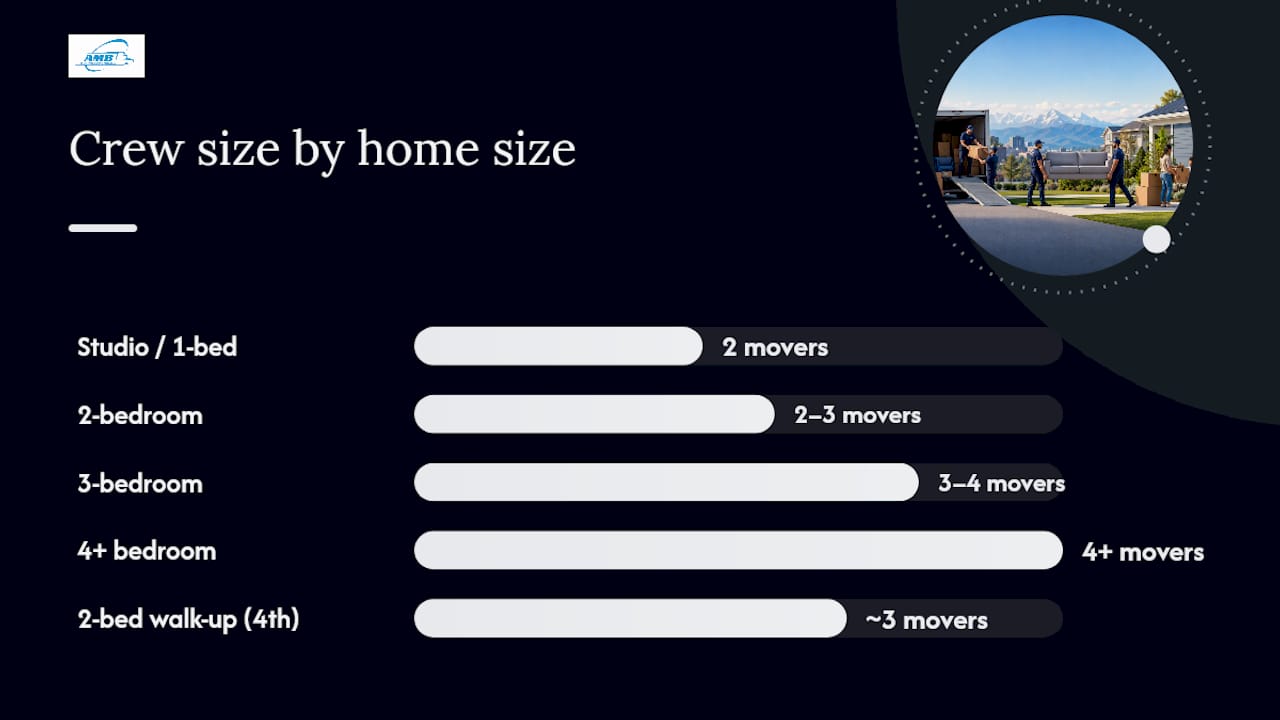
- Studio or 1-bedroom apartment: 2 movers, typically 3 to 5 hours for a load-only job.
- 2-bedroom home or apartment: 2 to 3 movers, typically 4 to 7 hours.
- 3-bedroom house: 3 to 4 movers, typically 6 to 9 hours.
- 4+ bedroom house: 4 or more movers, often split into two teams for larger jobs.
These ranges hold for a standard load, and home-size crew mapping from moving guides shows a similar pattern across the industry. Full-service moves that include packing shift those numbers upward, since packing consumes person-hours that would otherwise go toward loading. A 3-bedroom home with full packing often needs the same 4-mover crew you’d otherwise reserve for a 4-bedroom house.
A few adjustments matter more than the raw bedroom count. A ground-floor studio with a loading dock can often run with 2 movers even on a full-service job, while a 2-bedroom walk-up on the fourth floor might need the 3-mover crew you’d normally reserve for a bigger home. Elevators help, but a slow or shared elevator can eat almost as much time as a straight flight of stairs.
What Changes the Number of Movers You Need
Bedroom count sets the baseline. Everything else in your specific move either speeds up that crew or slows it down enough to justify adding a body.
- Access constraints. Stairs, narrow hallways, long carries from the door to the truck, and elevators that require a wait all reduce how much a given crew can move per hour. A third mover on a stair-heavy job often pays for itself by cutting the total time by more than one extra person’s cost.
- Inventory complexity. A high box count, oversized furniture, or specialty items like pianos, safes, or pool tables slow down a small crew disproportionately, since these items require careful handling that two movers simply can’t do as fast as three.
- Timing and weather. Same-day load-and-unload jobs, narrow delivery windows, and extreme heat or cold all reduce a crew’s effective output per hour, which is a strong argument for adding a mover rather than adding hours.
- Safety minimums. Many professional carriers won’t dispatch a truck-based job with fewer than two movers, since a single mover can’t safely handle a loaded truck ramp, heavy furniture, or an emergency alone.
Pro Tip: If your move involves more than one flight of stairs at either end, tell your estimator up front. Movers price stairs into the labor-hours estimate, and surprising the crew on move day is the fastest way to see your bill climb past the quote.
How to Calculate Labor-Hours for Your Move
Moving companies don’t really staff by bedroom count. They staff by person-hours, which is the total amount of labor a job requires regardless of how many people show up to do it. A 12-person-hour job can be done by 2 movers in 6 hours or 3 movers in 4 hours, and dispatchers choose the split that fits the truck size, driving window, and budget best.
Here’s how the math actually plays out for a mid-size move:
- 2 movers x 6 hours = 12 person-hours, typical for a straightforward 2-bedroom load.
- 3 movers x 4 hours = 12 person-hours, same total labor, finished two hours sooner.
- 4 movers x 3 hours = 12 person-hours, fastest option, useful when you’re racing a lease deadline or truck rental window.
The total labor cost is often similar across these splits, since you’re paying for the same 12 person-hours either way. What changes is elapsed time, and time matters when you’re paying for a truck rental by the day or trying to hand off keys by a deadline. A third mover often reduces idle time by creating a relay: one person stages items, one carries, and one loads, instead of everyone doing all three tasks in sequence.
Long-Distance Crews: Loading vs. Unloading
Interstate moves rarely use the same crew size at both ends. Loading crews tend to be larger because packing a truck efficiently for a multi-day transit takes more coordination and more hands than unloading it.
- Origin (loading) crew: Often 3 to 4 movers, since securing furniture and maximizing truck space for long-haul transit takes more care.
- Destination (unloading) crew: Often 2 to 3 movers, since unloading is generally faster than the original packing sequence.
- Matched crews: Some customers request the same crew or crew size at both ends for continuity, especially on complex moves with fragile or high-value items, though this usually costs more.
Transit distance and truck size also factor in. A move from Ohio to Arizona in a full 26-foot truck needs a different loading strategy than a partial-load shipment, and that changes how many hands you need to pack it correctly. Our interstate moving guide breaks down how these logistics typically unfold for cross-country moves.
When an Extra Mover Is Worth the Cost
Certain conditions almost always justify going up a crew size, even if your home size alone wouldn’t call for it.
- Pianos, gun safes, pool tables, or other 300+ pound items that need dedicated handling.
- More than one flight of stairs at either the pickup or drop-off address.
- A long carry distance from your door to where the truck can park.
- A same-day timeline where the truck must be loaded and driven before evening.
The clearest signal is what dispatchers sometimes call the crossover point: if a 2-mover crew is estimated to take more than 5 hours, a 3-mover crew usually finishes for close to the same total cost but frees up your day. Pro Tip: Ask your estimator to quote multiple crew size options side by side to compare costs and timing.
How to Get an Accurate Crew-Size Recommendation
A reliable crew recommendation depends on what you tell the estimator, not just what they can see in photos.
- Share the specifics. Square footage, standout heavy items, stair or elevator details at both addresses, driveway and parking constraints, and your target moving date all affect the recommendation.
- Ask the right questions. What’s the minimum crew size for a job this size? Do you charge travel time separately? Does the quote include packing, and is it a binding or non-binding estimate?
- Get it in writing. Compare binding estimates from more than one company, and look at total person-hours, not just the hourly rate, since a cheaper rate with a smaller crew can end up costing more in elapsed time. Our moving estimate guide explains the difference between binding and non-binding quotes in more detail.
Crew Size for Commercial and Office Moves
Office relocations follow different math than residential moves because the bottleneck usually isn’t bedrooms, it’s workstations, IT equipment, and business downtime. A 10-person office with standard desks and filing cabinets typically needs a 3 to 4 mover crew for a weekend move, while a 50-employee office with server racks, specialty furniture, and multiple floors can require 6 or more movers working in coordinated teams.
The real driver for commercial crew sizing is the window you have to complete the move. Most businesses want to be operational by Monday morning, which means the entire job, packing, disassembly, transport, and setup, has to fit into a compressed timeframe. That compression is exactly why commercial quotes tend to favor larger crews over longer timelines: doubling the crew on a Saturday-Sunday move can be the difference between reopening on time and losing a full business day.
Ask your commercial mover about disassembly and reassembly needs for cubicles, conference tables, and shared equipment, since these tasks often require dedicated crew members separate from the movers doing the actual carrying. Storage needs also come into play if your new office isn’t ready the same day the old lease ends; our commercial relocation guide covers how businesses typically sequence a multi-phase office move.
Seasonal and Regional Factors That Affect Crew Size
Summer is the busiest season for interstate moves, driven partly by families timing relocations around the school year, and that demand surge affects both pricing and crew availability. Interstate migration data from the Mercatus Center shows consistent cross-state movement patterns year over year, and moving companies staff up accordingly during peak months.
Booking a crew in June or July often means less flexibility on crew size since the largest teams get reserved weeks in advance. Booking in late fall or winter usually gives you more room to request an extra mover on short notice, since demand drops and crews have more open slots.
Region matters too. Dense urban moves, think walk-up apartments in older cities, tend to need larger crews relative to home size because of stairs, street parking restrictions, and building elevator rules that don’t apply to suburban or rural moves. A 2-bedroom apartment in a city with strict loading dock hours might need the same crew size as a 3-bedroom suburban home simply because of how much time access issues eat into the schedule. Climate plays a smaller but real role too: extreme summer heat in southern states can slow a crew’s pace enough that estimators pad in extra time or an additional mover to keep the job on schedule.
Common Mistakes When Estimating Crew Size
The most common mistake is underestimating based on box count alone. A homeowner might count 40 boxes and assume that’s a small job, without accounting for a sectional sofa, a treadmill, and a second-floor bedroom that requires careful stairwell navigation. Box count tells you almost nothing about person-hours if the furniture is what actually slows the crew down.

The opposite mistake, overestimating, happens when people assume more movers always means a faster, cheaper job. That’s not always true. A 4-mover crew in a small studio apartment can end up standing around waiting for space to work, which wastes person-hours without speeding up the job meaningfully. Matching crew size to the actual bottleneck, whether that’s stairs, inventory, or square footage, matters more than simply maximizing headcount.
Another frequent error is skipping the access conversation entirely. Homeowners often describe their home size accurately but forget to mention a steep driveway, a long walk from parking to the front door, or a shared elevator with a wait time. These details change the effective crew size needed even when the home itself is straightforward. The fix is simple: walk through your specific move scenario with your estimator, including anything unusual about either address, before locking in a crew size or accepting a quote.
Why AMB Recommends Matching Crew Size to the Job, Not the Calendar
Interstate moves punish guesswork. AMB Moving & Storage builds crew recommendations around licensing, insurance compliance, and federal regulations for long-distance carriers, not around filling a truck for the day. Our service pages on packing, storage, and specialty moves reflect that same principle: staffing follows the job’s real demands, not a one-size number.
— AMB
Get a Crew-Size Review and Binding Quote
Guessing at crew size from a home-size chart only gets you so far. AMB’s estimators walk through your specific inventory, access points, and timeline to recommend a crew size backed by a binding quote, not a rough guess that changes on move day.
Before you request a quote, have a few things ready: a rough inventory of heavy or specialty items, the number of stairs or elevators at both addresses, your target moving dates, and any parking or driveway restrictions movers should know about. Photos of tight hallways or narrow staircases help estimators size the crew accurately the first time. If you’re planning a cross-country move, our long-distance moving services page walks through what to expect from booking through delivery.
Ready to lock in a crew size that matches your actual move? Request your binding quote and get a straight answer on how many movers your job needs, with no surprise upcharges once the truck arrives.
Sources
FAQ
How Many Movers Do I Need for a 2-Bedroom Apartment?
Most 2-bedroom apartments need 2 to 3 movers, with 3 recommended if you have stairs, an elevator wait, or heavy furniture like a sectional sofa.
How Many Movers Do I Need for a Large House?
A 4-bedroom or larger house typically needs 4 or more movers, especially with a tight one-day timeline or a full-service packing request.
Does a Long-Distance Move Need More Movers Than a Local Move?
Interstate moves often use a larger loading crew, sometimes 3 to 4 movers, and a smaller unloading crew, since packing a truck for transit takes more coordination than unloading it.
How Do I Know If I Need an Extra Mover?
If your estimated job runs past 5 hours with your current crew size, adding a mover usually finishes the job for a similar total cost while saving you hours.
What Information Do Movers Need to Recommend a Crew Size?
Give your estimator your square footage, any stairs or elevators, heavy or specialty items, and your moving date. AMB uses these details to build a binding quote with the right crew size for your specific move.