


TL;DR:
- Understand FMCSA regulations and verify mover credentials to avoid fraud.
- Choose storage options based on move duration and access needs.
- Plan your move 8 to 12 weeks ahead to ensure a smooth, stress-free experience.
Picture this: your family is relocating from New Jersey to Texas. The truck is booked, the kids are anxious, and then you realize your new home won’t be ready for three weeks. Where do your belongings go? Long-distance moves involve far more moving parts than a local haul, and storage is often the piece families forget until it becomes a crisis. This guide walks you through federal regulations, storage options, step-by-step planning, and the most common mistakes people make, so your cross-country move goes smoothly from day one.
Table of Contents
- Understanding regulations and requirements for long-distance moves
- Choosing the right storage solution for your move
- Planning and organizing your move and storage step-by-step
- Common pitfalls and how to protect your belongings
- A fresh perspective: Why moving storage is about more than logistics
- Simplify your next move with expert help
- Frequently asked questions
Key Takeaways
| Point | Details |
|---|---|
| Know the rules | Federal regulations protect you and require movers to follow set legal standards. |
| Plan early | Start your preparations at least 8 to 12 weeks out for best results. |
| Choose storage wisely | Match your storage solution to your timeline, access needs, and budget to avoid costly mistakes. |
| Check credentials | Always verify movers using FMCSA and insist on documentation for a secure move. |
Understanding regulations and requirements for long-distance moves
Before you sign anything or hand over a deposit, you need to understand who governs long-distance moving and what protections you have. This isn’t just paperwork. It’s the foundation of a safe, legally protected move.
The Federal Motor Carrier Safety Administration (FMCSA) regulates all interstate and long-distance moves over 100 miles, requiring movers to carry valid USDOT and MC numbers, provide written estimates, issue a bill of lading, and give customers the “Your Rights and Responsibilities When You Move” booklet. If a mover can’t produce these, walk away.
Here’s a quick breakdown of the key documents every regulated mover must provide:
| Document | Purpose |
|---|---|
| Written estimate | Locks in pricing terms before the move |
| Bill of lading | Legal contract for your shipment |
| Rights booklet | Outlines your consumer protections |
| USDOT/MC numbers | Proof of federal registration |
You can verify any mover’s credentials directly at safer.fmcsa.dot.gov. It takes under two minutes and can save you thousands of dollars in fraud losses. Always check before you book.
Understanding federal interstate moving rules also means knowing what happens when things go wrong. Licensed movers are legally required to carry liability coverage. If your goods are damaged and the mover is unlicensed, you have almost no legal recourse.
Here are the core protections you should know:
- Written estimates must be honored within regulated limits
- Released value protection is free but minimal (60 cents per pound per item)
- Full value protection covers repair or replacement at current market value
- Dispute resolution programs are required for licensed movers
“Know your rights before moving day. The FMCSA requires licensed movers to provide specific documents and follow strict pricing rules. Customers who skip verification are the most common fraud victims.”
Review your rights and responsibilities before signing any contract. It’s the single most important step most families skip.
Choosing the right storage solution for your move
Not all storage is created equal, and the wrong choice can cost you time, money, and serious stress. The good news is that once you know your options, the right fit usually becomes obvious.
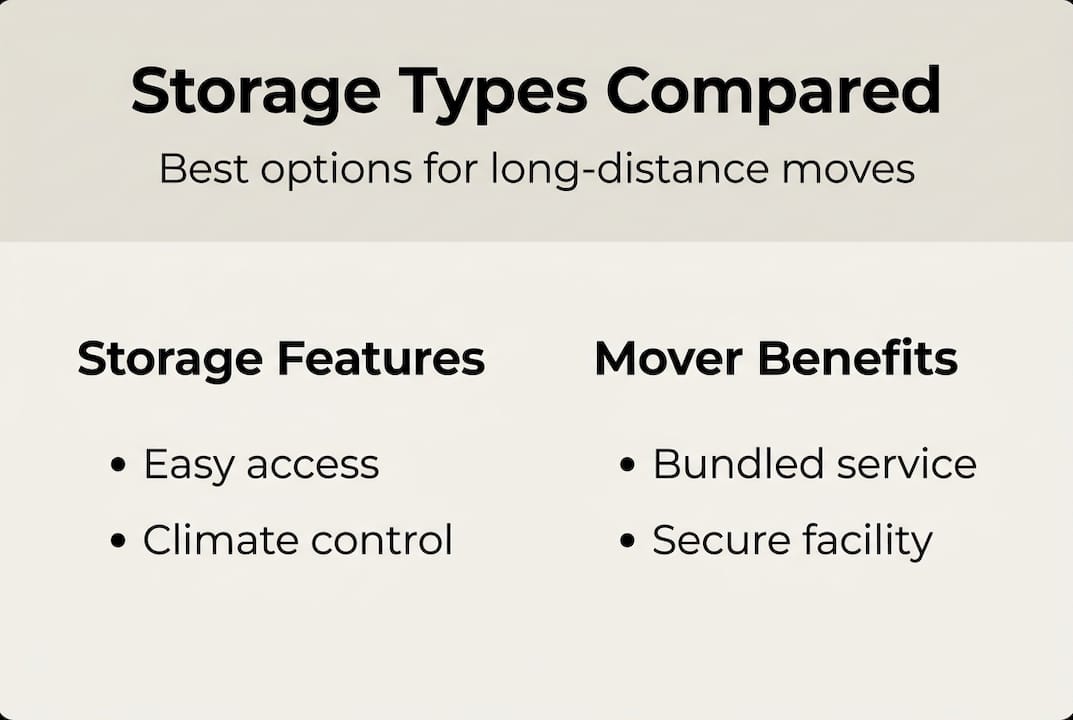
There are three main types of storage used in long-distance moves:
Self-storage units are rented independently from a local facility. You manage access, loading, and unloading yourself. These work well if you’re staying near the origin city temporarily and need frequent access to your belongings.
Moving company storage means your mover holds your goods in their warehouse between pickup and delivery. It’s seamless because the same crew handles everything. This is ideal when your new home isn’t ready yet and you don’t need access to your items during the gap.
Portable containers are delivered to your door, you load them, and the company transports and stores them. They offer flexibility but can be expensive for long distances.
| Storage type | Best for | Average cost | Access flexibility |
|---|---|---|---|
| Self-storage unit | Short gaps, frequent access | $80 to $200/month | High |
| Moving company storage | Seamless transitions | $150 to $400/month | Low to medium |
| Portable container | Flexible loading schedules | $200 to $500/month | Medium |
When exploring moving storage options, consider how long you’ll actually need storage. A family waiting on a home closing might need four to six weeks. A single professional between leases might only need ten days.
The FMCSA recommends you plan 8 to 12 weeks ahead and get at least three quotes before committing to any service. This applies to storage as much as it does to the move itself.
Pro Tip: If your mover offers in-house storage, ask whether your goods stay on the truck or transfer to a climate-controlled warehouse. Climate control matters for wood furniture, electronics, and artwork.
Also think through the types of moving services available to you. Some full-service movers bundle storage into the overall package, which simplifies billing and reduces the number of vendors you’re coordinating. For most families doing a long-distance moving relocation, bundled services reduce friction significantly.
Planning and organizing your move and storage step-by-step
A well-timed plan is what separates a smooth move from a chaotic one. Most people underestimate how much coordination is involved, especially when storage is part of the equation.
Here’s a realistic timeline to follow:
- 12 weeks out: Start researching movers. Verify mover registration, get at least three quotes, and confirm storage availability at your destination.
- 8 weeks out: Book your mover and storage. Confirm dates in writing. Begin decluttering and donate or sell items you won’t move.
- 4 weeks out: Create a detailed home inventory. Photograph high-value items. Confirm your mover’s USDOT and MC numbers one more time.
- 2 weeks out: Pack non-essentials. Label every box with room destination and contents. Arrange for utilities and address changes.
- Moving week: Confirm pickup and storage drop-off dates. Keep a personal bag with essentials separate from the main shipment.
Inventory is one of the most underrated steps in this process. A written inventory, signed by both you and the mover, is your best protection if anything goes missing or arrives damaged. Photograph everything before it goes on the truck.

Pro Tip: Use a color-coded labeling system. Assign each room a color and mark boxes accordingly. It speeds up unloading dramatically and reduces the chance of fragile items being stacked under heavy ones.
Synchronizing your storage drop-off and pickup with your move dates requires direct communication with your mover. Confirm the storage facility’s hours, access policies, and whether you’ll need to be present during delivery. These cross-country moving tips can save you from last-minute surprises.
The single biggest planning mistake families make is rushing the mover selection. Booking the first available company without verification is how people end up with unlicensed movers, surprise charges, and missing boxes.
Common pitfalls and how to protect your belongings
Even with a solid plan, there are specific mistakes that trip up families during long-distance moves. Knowing them in advance puts you ahead of most people.
Choosing unlicensed movers is the most dangerous mistake. Unlicensed movers operate without FMCSA oversight, meaning no required insurance, no dispute resolution, and no accountability if your belongings disappear. Always verify credentials before signing.
Here are the most common pitfalls and how to avoid them:
- Vague contracts: Never accept a verbal estimate. Every charge must be itemized in writing.
- Poor inventory practices: No inventory means no proof of what was loaded. Document everything.
- Underinsured goods: Released value protection (free) only pays 60 cents per pound. For a 50-pound TV, that’s $30. Choose full value protection for high-value items.
- Ignoring warning signs: Unusually low quotes, requests for large cash deposits, and no physical address are red flags.
- Skipping the FMCSA lookup: Takes two minutes and confirms whether your mover is legally operating.
“FMCSA resources exist specifically to help consumers verify movers and understand their protections. Using them before booking is the most effective fraud prevention step available.”
For fragile items, use double-wall boxes and clearly mark them “Fragile” and “This Side Up.” Don’t assume movers will handle unlabeled boxes with extra care.
Review your mover consumer rights carefully before moving day. You have the right to be present during weighing, to receive a written delivery receipt, and to file a claim for damaged goods within nine months of delivery. Most people don’t know these rights exist until it’s too late to use them.
A fresh perspective: Why moving storage is about more than logistics
Here’s something most moving guides won’t tell you: the stress of a long-distance move rarely comes from logistics alone. It comes from loss of control.
When your belongings are in a warehouse somewhere between states, there’s a psychological weight to that uncertainty. Families who report the smoothest moves aren’t always the ones with the best-packed boxes. They’re the ones who asked the right questions, communicated clearly with their movers, and gave themselves permission to prioritize family needs over pure efficiency.
We’ve seen customers try to save money by cramming too much into too short a timeline. The result is always the same: rushed decisions, skipped steps, and preventable problems. The families who do it well treat the move as a project with human stakes, not just a logistics puzzle.
Exploring family storage strategies that account for emotional needs, not just cubic footage, changes how the whole experience feels. Give yourself buffer time. Ask for help. The goal isn’t just to move your stuff. It’s to arrive feeling settled.
Simplify your next move with expert help
Every step in this guide points toward the same outcome: a move that protects your belongings, respects your timeline, and doesn’t leave you scrambling. That’s exactly what we built AMB Moving & Storage Inc. to deliver.

As trusted interstate movers registered with the FMCSA under U.S. DOT 3839636 and MC 1395855, we handle everything from packing and coordination to transport and warehousing. Whether you need short-term holding or extended secure storage options, our team works around your schedule, not the other way around. Reach out today for a transparent, no-pressure estimate and let us take the complexity off your plate.
Frequently asked questions
What documents are required for an interstate move?
You must receive a written estimate, a bill of lading, the “Your Rights and Responsibilities” booklet, and your mover’s USDOT and MC numbers, as required by the FMCSA. Without these, the mover is likely operating outside federal regulations.
How far in advance should I plan my long-distance move?
Start planning 8 to 12 weeks before your move date to secure quotes, verify mover credentials, and confirm storage availability. Rushing this process is the most common cause of preventable problems.
How can I check if my moving company is legitimate?
Visit safer.fmcsa.dot.gov and enter the company’s USDOT number to confirm their registration status, as recommended by the FMCSA. This verification step takes under two minutes and is your strongest protection against fraud.
What type of storage is best for long-distance moves?
Moving company storage or portable containers are usually the best fit because they coordinate directly with your transport schedule and reduce the number of vendors you’re managing. Self-storage works well only if you need frequent access during the gap period.