
October 18, 2026
8–12 Weeks to Move From Ohio to Florida: Taxes and FMCSA Rules
Plan your move from Ohio to Florida with an 8 to 12 week timeline, Florida tax and license deadlines, housing prices, and FMCSA steps for written estimates.
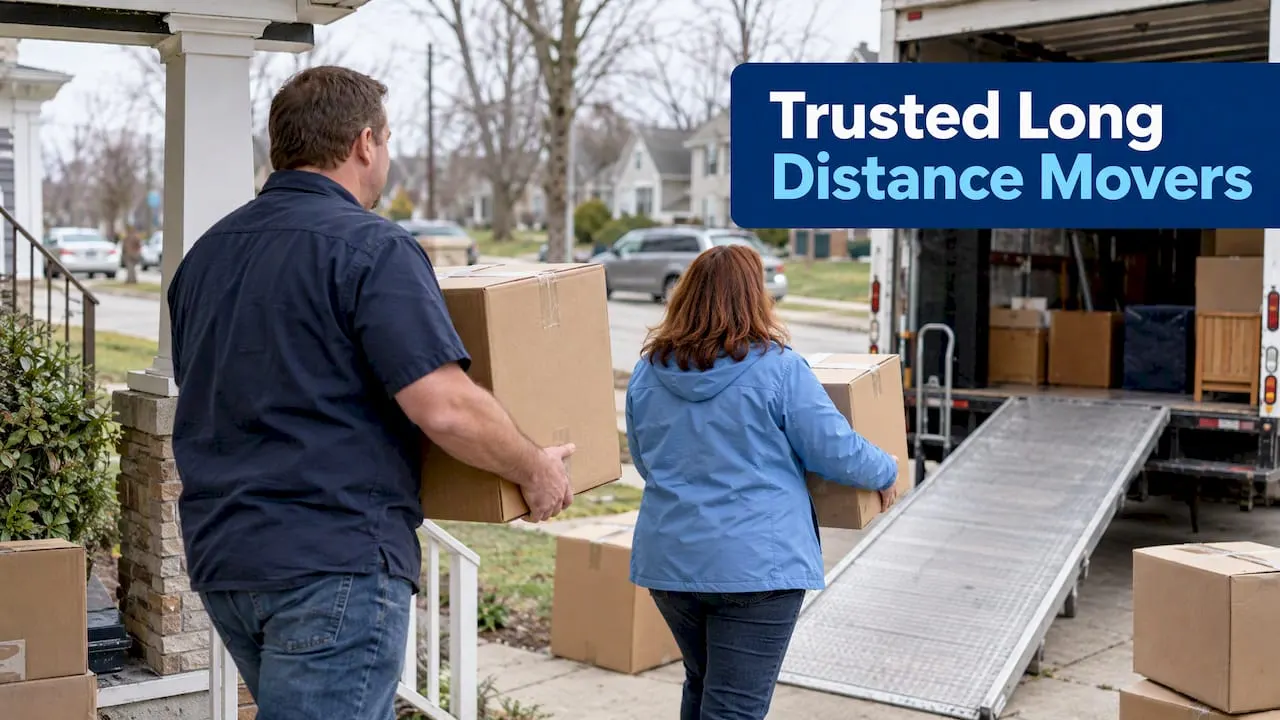
Moving from Ohio to Florida means no state personal income tax, a fast clock to get a Florida driver’s license and vehicle registration under new resident rules, and a need for a written, signed interstate estimate before any mover touches a box. Start there: collect two or three written estimates and review the FMCSA paperwork before you book.
TL;DR:
- Distance and shipment weight drive interstate quotes; stairs, long carries, season, packing, storage, and specialty items add charges, so compare identical service lists.
- A nonbinding estimate caps required payment at delivery at 110% of the estimate, while Released Value pays only 60 cents per pound per item.
- Permanent residents can apply for Florida’s homestead exemption if the home is their primary residence by January 1 and they file by March 1.
- Standard homeowners policies exclude flood damage, and flood coverage usually has a waiting period of 30 days, so check flood maps and arrange protection early.
- Begin planning eight to twelve weeks ahead; delivery windows may leave a gap requiring storage, while gated communities and condo elevators need advance coordination.
Table of Contents
- What changes first when you move to Florida
- An 8 to 12 week timeline for moving from Ohio to Florida
- What drives moving cost estimates for a cross-country move
- Taxes and residency steps after you arrive
- Florida housing market: what Ohio movers should expect
- How to hire interstate movers and protect your shipment
- Hurricane season and flood insurance for new Floridians
- First weeks in Florida: jobs, schools and local services
- Ohio to Florida moving checklist you can follow
- Logistics challenges on a long-distance Ohio to Florida route
- Rules that apply to movers working between Ohio and Florida
- Setting up Florida utilities after you arrive
- Transferring healthcare providers when you move to Florida
- Why a licensed nationwide mover matters for this move
- Request a written quote for your Ohio to Florida move
- FAQ
- Sources
What changes first when you move to Florida
- Taxes: Florida levies no personal income tax, so individuals file no state return. Businesses still have filing duties.
- Licenses: get a Florida driver’s license within 30 days of establishing residency.
- Vehicles: title and register within 10 days, with insurance from a Florida-licensed agent.
- Housing: Florida’s statewide median single-family price was about $413,990 at the end of 2025, with condos and townhouses near $310,000.
- Movers: gather written estimates and read the FMCSA rights booklet before you sign.
Your paycheck is the biggest difference: Florida’s constitution prohibits a personal income tax, so wages and individual capital gains are not taxed at the state level.
An 8 to 12 week timeline for moving from Ohio to Florida
Long distance moving rewards early planning. Peak season fills calendars fast, and a rushed booking is where most surprises start.
- Early in your planning: start your home sale or lease exit, build a room-by-room list (our guide to building a household inventory helps), and ask interstate movers for in-home or virtual estimates. Confirm each mover’s federal registration.
- As your move approaches: decide on professional packing, flag specialty items, and arrange storage if your closing dates do not line up.
- Before moving day: notify schools and employers, schedule Florida utilities, and lock in the date and written quote.
- 2 to 4 weeks out: confirm the delivery window, pack an essentials box, and gather vehicle documents for titling.
- Before moving day: defrost the fridge, do the walk-through, and make sure the estimate and bill of lading are signed at pickup.
If your timeline is tight, this planning article from a partner site shows how other movers sequence an interstate move.
What drives moving cost estimates for a cross-country move
Cross country movers price a shipment from a handful of variables, and knowing them lets you compare quotes fairly.
- Distance and weight: the two largest factors on any long-haul job.
- Accessorial services: stairs, elevators and long carries add line items. Our moving cost guide lists elevator or stair fees from $75 and long carry charges from $75.
- Season: summer and month-end dates cost more and book out.
- Specialty items: pianos and safes need extra crew and equipment, with handling from $200.
- Storage: from $0.50 per cubic foot if your dates gap.
- Packing: professional packing runs $1-2 per cubic foot.
A binding estimate means you pay no more than the quoted amount unless you add services. On a non-binding estimate, a mover cannot require more than 110% of the estimate at delivery.
Pro Tip: Declutter before the in-home survey. Every pound you remove comes off the weight your estimate is built on, and flexible dates can lower the rate further.
Taxes and residency steps after you arrive
Your take-home pay is the headline. With no state personal income tax, your Florida wages are not hit by a state levy the way they were in Ohio, and Florida also has no individual capital gains tax. Property and sales taxes still exist, so budget for them.
Homestead exemption is the next lever. Florida offers it to permanent residents, and you apply through the county property appraiser. In practice, you must live in the home as your permanent residence by January 1 and file by March 1, as county guidance explains. The state also publishes homestead exemption information.
Documents to gather:
- Proof of address and utility bills
- Vehicle title and your Ohio license
- Insurance from a Florida-licensed agent
The deadlines are short: a license within 30 days and vehicle titling within 10, according to Florida’s DHSMV.
Florida housing market: what Ohio movers should expect
Florida’s market cooled in 2025 and showed early signs of stabilizing, with domestic in-migration still above pre-pandemic levels. Affordability varies sharply by metro.
- Improving affordability: Jacksonville, Ocala and Orlando have seen conditions get easier for buyers.
- High-cost coastal markets: several remain among the state’s least affordable.
- Hidden costs: homeowners insurance and property taxes shift the real monthly cost from one county to the next, so compare total payments, not list prices.
Renting for the first few months is a common way to learn neighborhoods before you buy.
How to hire interstate movers and protect your shipment
Federal rules protect you, but only if you use them. Household goods movers must provide a bill of lading, a Your Rights and Responsibilities booklet, and written documentation of charges. The bill of lading is your binding contract and must be provided at or before loading.
Interstate movers must also offer two valuation levels under FMCSA liability rules: Full Value Protection, which covers replacement value, and Released Value, which pays only up to 60 cents per pound per article. Check your homeowner policy before buying outside insurance, and read FMCSA’s valuation guidance.
Compare every quote on:
- Exact pickup and delivery dates
- A full list of accessorial charges
- The weight or volume basis of the estimate
- Your signature before pickup
Our interstate moving page explains how that process works from quote to delivery.
Pro Tip: Treat a verbal quote as no quote. If it is not written and signed, it does not protect you.
Hurricane season and flood insurance for new Floridians
Hurricane season applies to inland residents too, so check your address against flood zone maps before you sign a lease or contract.
- Flood coverage is separate: standard homeowner policies do not cover flood damage, and flood policies typically carry a 30-day waiting period, so buy early.
- Document everything: photograph possessions and record serial numbers before you pack.
- Harden the home: NOAA’s guidance on strengthening your home covers building-code upgrades and garage protection. Renters should coordinate with landlords.
Never assume your current policy travels with you: NOAA stresses that standard homeowner policies exclude flood damage, so confirm flood coverage before hurricane season.
First weeks in Florida: jobs, schools and local services
Settle the essentials in this order and the rest gets easier.
- Work: start searching before you arrive. Tourism, healthcare, logistics and construction hire across Florida metros, and local recruiters can explain neighborhood commute patterns.
- Schools: contact the district for enrollment requirements and request records from your Ohio school in advance.
- Medical records: ask Ohio providers to transfer files before you leave.
- Utilities and internet: schedule installation dates early, since service windows can vary by provider and location.
Ohio to Florida moving checklist you can follow
- Collect two or three written estimates and verify federal registration.
- Book your mover and storage, and sign the written estimate.
- Notify employers, schools, banks and insurers of your new address.
- Photograph valuables and record serial numbers for insurance.
- Carry documents, medications, valuables and essentials yourself.
- Sign the bill of lading at pickup and keep your copy.
- Within 10 days, title and register vehicles; within 30, get your Florida license.
- File for homestead by March 1 once you qualify.
For more detail, use our interstate moving checklist and request binding estimates from AMB Moving & Storage, or another licensed mover, as early as possible.
Logistics challenges on a long-distance Ohio to Florida route
An Ohio-to-Florida job is a long haul south on the interstates, and most of the friction comes from scheduling rather than distance. Your pickup window in Ohio and your delivery window in Florida rarely line up perfectly, and a gap between pickup and delivery means somewhere to keep your belongings and somewhere to sleep.
Weather matters at both ends. Winter pickups can mean snow and ice in Ohio, and summer deliveries land in heat, afternoon storms and hurricane season. Planning around those windows protects both your furniture and your timeline.
Access is the other recurring issue. Many Florida communities have gated entrances, condo elevator reservations and association move-in rules. Ask your destination building or HOA what is required and book any elevator time before the truck is scheduled. A tall truck may also need a different approach on narrow streets.
Specialty items add steps. Pianos, safes and large appliances need additional crew and equipment, and we handle specialty items from $200 per our moving cost guide. If you need to bridge dates, our secure storage can store your goods until your Florida home is ready.
Finally, plan for the long-distance reality: your shipment may travel with a delivery window, not a single fixed hour. Keep essentials with you and share a reachable phone number with your dispatcher. Our long distance moving team can map the route and timing with you.
Rules that apply to movers working between Ohio and Florida
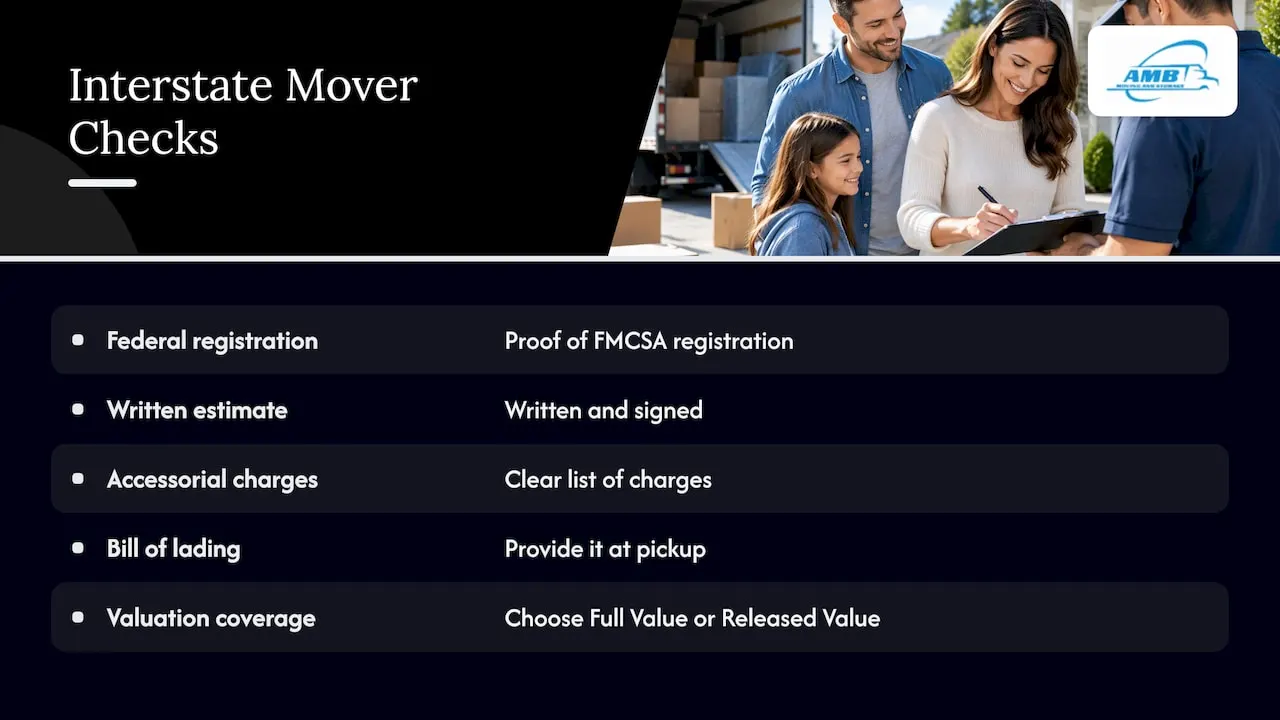
Because this move crosses a state line, it falls under federal rules for household goods movers. A reputable interstate mover must be registered with the Federal Motor Carrier Safety Administration, provide its consumer rights booklet, and give you written estimates and a bill of lading. The FMCSA rights and responsibilities booklet spells these out.
Several protections apply directly to your shipment. Estimates must be in writing. On a non-binding estimate, you cannot be required to pay more than 110% of the estimate at delivery. The mover must offer both Full Value Protection and Released Value, and you should choose one deliberately instead of defaulting to the free option.
State rules matter on your end too. Florida’s DHSMV governs your driver’s license and vehicle registration after arrival, and Florida’s county property appraisers handle homestead applications. Those are your responsibilities, not your mover’s.
What should you require from a company? Written, signed estimates, a clear list of accessorial charges, proof of federal registration, a bill of lading at pickup, and plain answers about valuation coverage. As a nationwide moving company, we can explain the documentation involved in an interstate move. Our nationwide moving overview describes how that works across state lines.
Setting up Florida utilities after you arrive
Start utilities before moving day, then confirm each one the week you land. Electricity and water are usually handled through your local provider or municipality, and many allow you to schedule a start date online. Ask your landlord, HOA or the seller which companies serve your address, because Florida service areas change from one county to the next.
A practical order works well:
- Electricity and water: schedule these first so the home is livable on delivery day. Have your closing or lease date and your Florida address ready.
- Internet and cable: book installation early, since technician appointments can fill up. Ask whether the provider offers self-install to speed things along.
- Trash and recycling: confirm pickup days and whether service is handled by the city, county or your HOA.
- Gas or propane: not every Florida home uses it, so check what your home needs.
Keep a folder with account numbers, confirmation emails and activation dates. If power or water is not on when the truck arrives, you may be unloading in the dark or without a working elevator, which can delay your delivery window.
Test everything the first day. Run the air conditioning, check water pressure, and confirm internet speed before you unpack in earnest. In Florida’s heat, working air conditioning is not optional, so address problems with the landlord or utility immediately.
Finally, update your address with the post office, banks, insurers and your employer. Doing it in one sitting, right after utilities are active, keeps important mail from landing in Ohio.
Transferring healthcare providers when you move to Florida
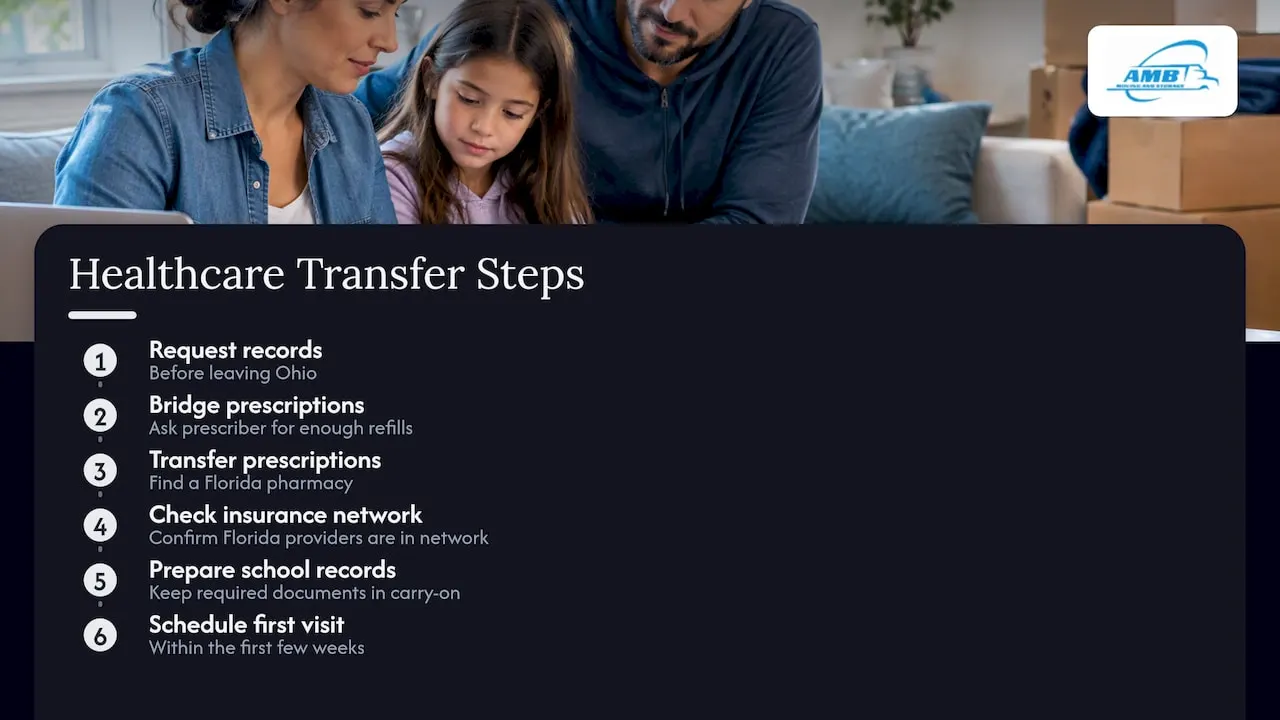
Healthcare is the task people postpone and then regret. Start before you leave Ohio: ask your current doctors, dentist and specialists for copies of your records or for a formal transfer to a new Florida practice. Many offices require a signed release, and processing can take several days.
Prescriptions need attention too. Ask your prescriber for enough refills to bridge the gap, then find a Florida pharmacy and transfer your prescriptions. If you take a controlled medication, confirm early what your new provider will require.
Check your insurance network before choosing doctors. A plan from Ohio may offer limited coverage in Florida, so confirm which Florida providers are in network and whether you need a plan change. If you are moving for a new job, ask HR about enrollment deadlines, since a life event like relocation often opens a special enrollment period.
For children, request immunization and school health records alongside your own. Check with your child’s Florida school about enrollment records, and keep any required documents in your carry-on folder instead of in the moving truck.
Once you arrive, schedule a first visit with a primary care provider within the first few weeks, even if you feel fine. Establishing care early means a clinician who knows your history when you need a referral or an urgent appointment. Keep a list of your medications, allergies and emergency contacts in your phone and on paper, and carry it with your valuables and documents on moving day.
Why a licensed nationwide mover matters for this move
An Ohio to Florida relocation has plenty of moving parts, and the paperwork is where people get hurt. A federally compliant mover gives you written estimates, a bill of lading and clear valuation options, so a dispute has a document behind it. Professional packing, storage and specialty handling cut damage and stress, which is why we encourage you to request a written estimate early, before dates tighten.
— AMB
Request a written quote for your Ohio to Florida move
We are a licensed, insured nationwide moving company handling long-distance and interstate moves, with professional packing, specialty item handling and secure storage for Ohio to Florida relocations. Packing starts at $1-2 per cubic foot. To get an accurate written estimate, have ready your inventory, move dates, destination address and any specialty items. Request your quote today.
FAQ
How does the cost of living in Ohio compare to Florida?
Florida has no state personal income tax, which can raise take-home pay compared with Ohio. Housing varies widely by metro, with the statewide median single-family price near $413,990. Insurance and property taxes also affect total monthly costs.
Who is the best out of state moving company?
The best choice is a licensed interstate mover that gives written, signed estimates, a bill of lading and clear valuation options. Compare two or three written quotes against FMCSA protections before you book. We offer long-distance and interstate moving.
What states are moving to Florida?
Florida’s housing market shows that domestic in-migration remains stronger than before the pandemic, though it has moderated since 2022. Specific origin-state rankings are not covered by the sources we reviewed.
Why are so many people moving out of Ohio?
Reasons vary by household, but common draws include Florida’s lack of a state personal income tax, a different climate, and job or family opportunities. We cannot cite a single verified cause, so weigh taxes, housing and work for your own situation.
What do I need to do within 30 days of moving to Florida?
Get a Florida driver’s license within 30 days of establishing residency, and title and register your vehicles within 10 days using insurance from a Florida-licensed agent, per DHSMV rules. Confirm the exact documents your county office requires.
Sources
- Hrblock
- New Resident – Welcome to Florida! – Florida Department of Highway Safety and Motor Vehicles
- Fla.’s 2025 Housing Market: Single-Family Sales Up; Inventory and Prices Stabilizing | Florida Realtors
- What is a binding move estimate? | FMCSA