
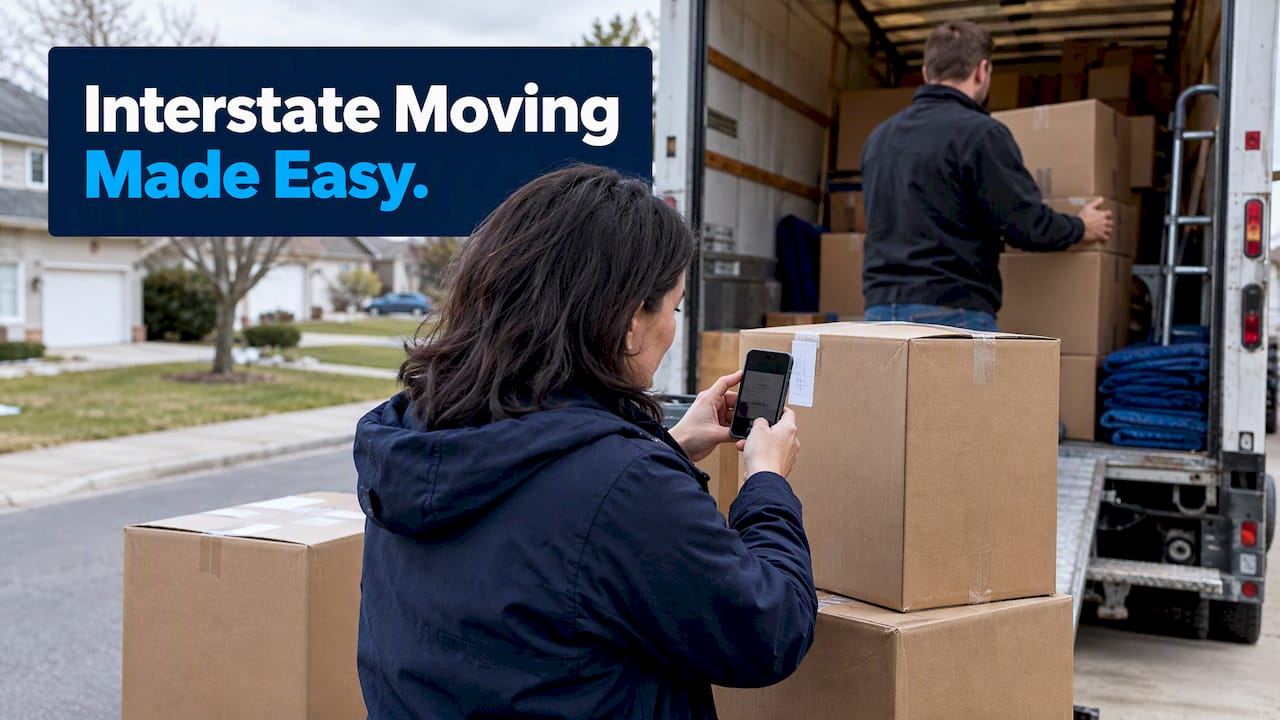

Movers track shipments through a combination of vehicle telematics and GPS for truck location, barcode or QR scans that log custody at key checkpoints, and paperwork such as the bill of lading, signed inventory, and weigh tickets that serve as the legal record of what shipped and when. Together, these show a delivery window and custody history, not live box-by-box tracking. Before you book, ask who owns your updates and get the documentation in writing.
TL;DR:
- GPS and telematics track vehicle location but do not provide live updates on individual boxes or precise arrival times.
- Scans at loading, transfer, and delivery confirm custody, while paperwork like the bill of lading and weight tickets serve as legal proof of shipment details.
- Delivery windows are usually several days wide, with federal rules requiring timely notifications of delays and responsible parties for updates.
- A stale map pin does not necessarily indicate a problem, as drivers rest, shipments pause, and transfers are normal during long-distance moves.
- Verify mover registration through FMCSA, review sample documentation beforehand, and clarify who manages your updates before booking.
Table of Contents
- How a shipment moves from pickup to delivery
- The technology behind tracking: GPS, ELDs, scans, and apps
- The paperwork that actually proves what happened
- What to expect for updates and delivery windows
- What the tracking data won’t tell you
- How to verify tracking claims before you sign
- How AMB tracks shipments and keeps customers informed
- Communication matters more than a live map
- Request a quote and talk to a real coordinator
- FAQ
- Sources
How a shipment moves from pickup to delivery
A long distance shipment generates a trail of records and scans long before it reaches your new address. Understanding that sequence helps you know what to expect and when to ask questions.
- Order for service: you sign an agreement outlining services, dates, and charges.
- Inventory and tagging at origin: crews list and number every item on a written inventory.
- Loading and on-truck custody: items are loaded and the bill of lading is signed, confirming what the carrier has in possession.
- Terminal or warehouse intake scans: for consolidated or stored shipments, items get scanned again on arrival at a terminal.
- Transfer events: if your shipment changes trucks or crews, that handoff is logged.
- Delivery attempt and final scan: the crew checks items against the inventory at your new address.
- Final weigh and paperwork close-out: weight tickets and signed delivery receipts complete the record.
Not every event reaches you as a customer-facing update. Pickup confirmation, major transfers, and the delivery window typically do, while routine driving hours usually don’t. Long distance moves commonly use a multi-day delivery spread rather than a fixed hour, since routing, weather, and hours-of-service rules affect exact arrival.
The technology behind tracking: GPS, ELDs, scans, and apps
Several distinct systems work together, and each one answers a different question.
- Fleet telematics and GPS give dispatchers a location window for the truck itself, useful for route visibility and estimated arrival, not for pinpointing a single box.
- Electronic logging devices (ELDs) are built for hours-of-service compliance. According to FMCSA’s ELD functions guidance, they automatically record date, time, location, engine hours, and vehicle miles at intervals, with driving-location accuracy generally within about a 1-mile radius and no street-address detail. They are not designed as continuous parcel trackers.
- Barcode, QR, or RFID scans mark custody checkpoints: items get scanned at loading, at any terminal, and again at delivery, which validates the inventory rather than tracking live movement.
- Mobile crew apps and customer portals relay status messages, photos of tagged items, and copies of documentation, filling the gap between scan events with human updates.
Pro Tip: Ask your coordinator which of these systems actually trigger a message to you, since some only feed internal dispatch software.
For movers handling consolidated freight, warehousing and fulfillment operations show how intake scanning and storage-in-transit handling work behind the scenes before a shipment resumes its route.
The paperwork that actually proves what happened
Technology shows location and custody events, but the documents created at pickup and delivery are what carry legal weight if something is disputed.
- Receiving procedures: numbered tags, a written inventory, and condition notes create a record of each item’s state before loading.
- Bill of lading and order for service: this is your contract. Under 49 CFR Part 375 Subpart E, movers must prepare an itemized inventory before or at loading and provide a bill of lading that spells out delivery dates and your rights as the customer.
- Weigh tickets: shipments are weighed at origin and destination, and the same federal rule requires signed weight tickets that you have the right to observe and, under certain conditions, request a re-weigh on.
These records matter because they outlast any app notification. If a dispute arises over what was loaded, when it shipped, or what it weighed, the signed inventory and bill of lading are what settle it, not a screenshot of a map.
What to expect for updates and delivery windows
Long distance delivery dates are typically given as a spread, not a single date, and federal rules set expectations for how and when you should be notified.
- Delivery spread: your bill of lading should state an agreed window, often several days wide for cross country moves.
- Notification requirements: movers are required to notify customers of delays and keep records of those notifications under 49 CFR Part 375.
- Ownership of updates: confirm whether your coordinator, the driver, or an automated system is responsible for proactive contact, since silence often means nobody owns that task.
If you go more than a day without a scheduled update near your delivery window, escalate to the dispatcher or coordinator named on your paperwork rather than waiting on the driver, who may be mid-route with limited signal or time to respond.
What the tracking data won’t tell you
A truck icon that hasn’t moved in hours doesn’t mean your shipment is stuck. Drivers take mandated rest breaks, shipments sometimes sit in storage-in-transit, and transfers between crews or terminals pause visible movement without anything going wrong.
One figure worth remembering: ELD location data is recorded at intervals with accuracy of roughly a 1-mile radius, without street addresses, so a stale-looking map pin often just reflects the compliance system’s own resolution limits rather than a real problem.
Between-scan periods are normal. The scans and signed paperwork, not a continuously refreshed map, are the checkpoints that count contractually.

How to verify tracking claims before you sign
A mover’s promises about tracking are only as good as its registration and documentation practices. Check both before committing.
- Confirm federal registration: use the FMCSA mover search to verify DOT number, registration status, and complaint history, a step our verification guide walks through in detail.
- Request the documents: ask to see a sample bill of lading, order for service, and itemized inventory format before you book.
- Ask about weigh tickets: confirm whether origin and destination weighing is standard practice and whether you can observe it.
- Clarify the notification policy: ask exactly who contacts you, how often, and what happens if your delivery spread slips.
Pro Tip: Request sample scan or tag photos from a past job. If a company can’t show you what a tracking update actually looks like, that’s a sign the process is informal.
How AMB tracks shipments and keeps customers informed
Crews tag and inventory items at origin with numbered tags, log custody through on-truck scans, and use fleet telematics for routing and estimated arrival windows. A named coordinator, not an app alone, typically manages updates, and signed weigh tickets and the bill of lading are retained to resolve discrepancies against a documented record. Customers are encouraged to photograph tag numbers at pickup, confirm the best contact method, and agree on the delivery spread in writing before the truck leaves. Those habits turn tracking from a guessing game into a paper trail both sides can rely on.

Communication matters more than a live map
The biggest misread in shipment tracking is treating a moving map pin as proof of progress. A 2025 GAO review of military household goods relocations found that inadequate communication and delays were common complaints, not a shortage of tracking technology. Pick a mover who commits to a named coordinator and clear delivery-spread updates, and treat the signed documentation as the record that settles any dispute.
— AMB
Request a quote and talk to a real coordinator
We built our process around documentation and direct communication, not just a map on your phone. Every move typically includes an itemized inventory with numbered tags, signed weigh tickets, and a coordinator who manages status updates from pickup through delivery.
- Long-Distance Moving: full-service cross country moves with documented custody at every step.
- Interstate & State-to-State Moving: compliant interstate service with a named coordinator for updates.
- Nationwide Moving Services: coverage for moves of any distance, backed by the same paperwork trail.
Ready to see real numbers for your route? Request a quote and ask your coordinator exactly how your shipment will be tracked and documented from the day the truck is loaded.
FAQ
Do movers arrive on time?
Long distance movers typically quote a delivery spread of several days rather than a single date, since routing, weather, and hours-of-service rules affect exact arrival. Under 49 CFR Part 375, movers must notify you of delays in writing, so ask your coordinator what triggers that notice.
How does shipment tracking work?
Tracking combines GPS or telematics for vehicle location, barcode or QR scans at loading, transfer, and delivery, and paperwork like the bill of lading and inventory that record custody. ELDs add compliance-focused location data at intervals, not continuous real-time tracking, according to FMCSA guidance.
Which app is best for packers and movers?
There is no single standard app across the industry, and reliable tracking depends more on documentation and coordinator communication than on any particular app. Ask a prospective mover what tool they use for updates and whether it generates a written record you can keep.
What to do when movers arrive?
Check your inventory tags against the crew’s list, review the bill of lading before signing, and confirm the agreed delivery window for the destination. Keep copies of every signed document, since they are the record used to resolve any later dispute.
How can I verify a mover’s tracking claims?
Use the FMCSA mover search to confirm registration status, DOT number, and complaint history before booking. Then ask to see a sample inventory, bill of lading, and notification policy so you know what documentation to expect.
Sources
- ELD functions | FMCSA
- GAO-25-107771 review (military household-goods relocations)
- eCFR 49 CFR part 375 subpart E