
DIY gun safe moving only makes sense for small, empty safes under roughly 300 pounds with a wide, level, obstacle-free path to the truck. Once a safe tops 500 pounds, involves stairs, tight turns, or still holds firearms and ammunition, hire professional movers rated for heavy safes. Measure the safe and the route today. If any red flag turns up, get a quote from a mover like Ambmovingservices before you touch a dolly.
TL;DR:
- Safes over 500 pounds, with stairs or firearms inside, require professional movers equipped with safe-rated rigging systems to prevent accidents.
- Proper equipment like two-dolly no-tilt rigs, stair climbers, and heavy-duty straps rated above the safe’s weight are essential for safe DIY moves.
- Accurate measurement of the safe and route clearance before moving day reduces the risk of damage or getting stuck, especially in narrow hallways or stairwells.
- Weight removal, such as emptying firearms, ammunition, and accessories, significantly improves safety and reduces the safe’s overall weight for moving.
- Professional movers provide site surveys, specialized equipment, insurance coverage, and proper planning for interstate and long-distance safe relocations.
Table of Contents
- Gun Safe Moving Equipment Checklist
- How Do You Plan the Route for a Gun Safe Move?
- Preparing the Safe Before You Move It
- Lifting and Dolly Techniques for Flat Ground and Stairs
- Loading and Securing a Gun Safe in the Truck
- Final Placement and Anchoring at the New Home
- When Should You Hire Professional Gun Safe Movers?
- How Ambmovingservices Handles Gun Safe Moves
- Gun Safe Moving Checklist and Final Verdict
- What We’ve Learned Moving Gun Safes for Clients
- Get a Quote for Your Gun Safe Move
- Sources
Gun Safe Moving Equipment Checklist
Moving a safe without the right gear is how hallways get gouged and backs get thrown out. The equipment matters more than muscle here.
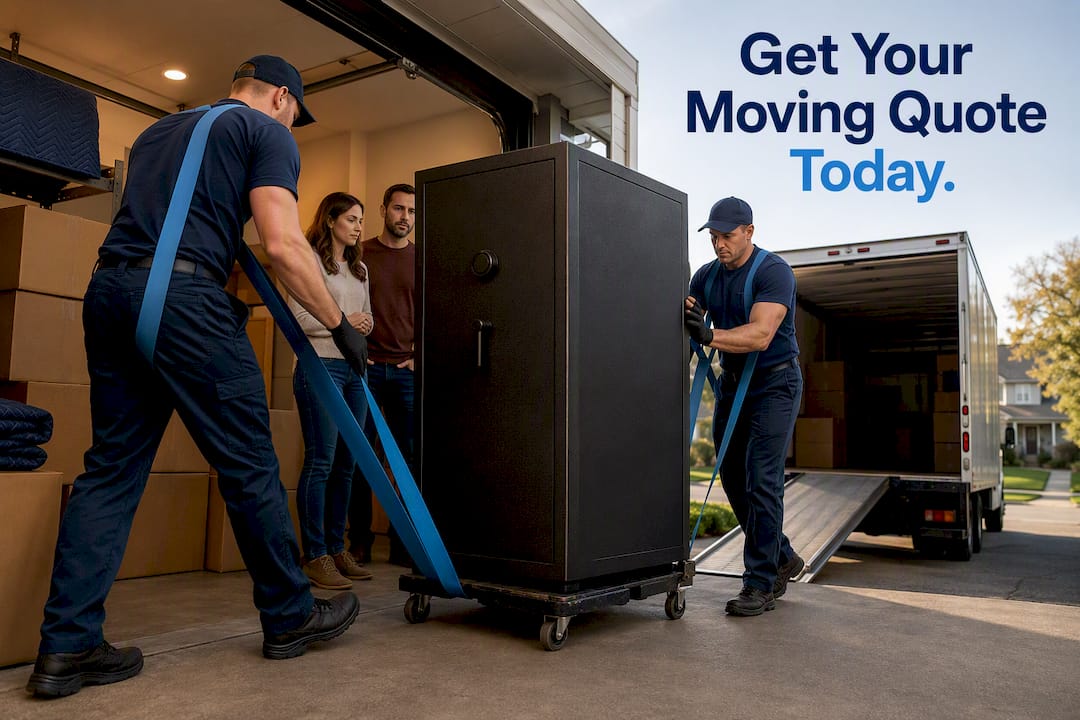
Appliance dollies work fine for lighter safes (under 300 pounds) on flat, short paths, but they tip easily once weight climbs. Safe-rated two-dolly no-tilt rigs solve that problem by cradling the safe from both ends, letting crews keep it upright through hallways and doorways instead of tilting it onto a single wheeled platform, a technique professional riggers rely on for anything heavy. Stair-climbing dollies with tracked wheels handle steps mechanically instead of relying on brute force.
- Two-dolly no-tilt rig rated for 1,000+ pounds
- Polyester webbing straps rated at 2,000 pounds minimum, with ratchet buckles rather than cam buckles
- Masonite or plywood floor runners to spread point loads
- Moving blankets to wrap corners and prevent scuffs
- Steel-toe boots, cut-resistant gloves, and eye protection for every crew member
Pro Tip: Check the strap’s rated capacity, not just its thickness. A worn 2,000-pound strap that’s been used to tow a truck is not a 2,000-pound strap anymore.
How Do You Plan the Route for a Gun Safe Move?
A safe that won’t fit through the doorway isn’t a moving problem, it’s a demolition problem. Measure before moving day, not during it.
- Measure the safe’s height, width, and depth, including any handle or dial that sticks out.
- Measure every doorway, hallway turn, and stairwell width along the path, plus ceiling clearance on stairs.
- Build a quick cardboard mockup of the safe’s footprint to test tight turns before the real thing shows up.
- Check the truck’s ramp angle, floor height, and interior door clearance.
- If the safe won’t clear a hallway or stairwell, consider an alternate route through a garage or window, or call a rigging crew rather than forcing it.
Interstate moves add a wrinkle here: a truck packed for a long-distance haul needs the safe positioned early, which means route planning at the origin has to account for loading order too. Our long-distance moving guide covers how crews sequence heavy items for cross-country hauls.
Preparing the Safe Before You Move It
Weight is the enemy here, and most of it is removable. A 600 pound empty safe loaded with ammunition, gold coins, and steel shelving can easily push past 700 pounds.
- Remove all firearms and ammunition first. Transport ammunition separately and follow your state’s transport laws, since some states restrict how firearms and ammo travel together in a vehicle.
- Pull out interior shelving, document trays, and any loose accessories.
- Unbolt floor anchors if the safe was bolted down; bag and label every bolt, washer, and anchor plate so reassembly isn’t a guessing game.
- Record the model number, serial number, and factory weight rating from the manufacturer’s data plate, usually on the back or inside the door.
- Wrap the exterior in moving blankets, focusing on corners and the dial, before it ever touches a dolly.
Many gun safes weigh well over 500 pounds even before contents are added, and that single number is why so many DIY moves go wrong. People plan for the safe they remember buying, not the safe sitting fully loaded in their bedroom closet.
Lifting and Dolly Techniques for Flat Ground and Stairs
Technique separates a controlled move from an expensive accident. The tilt-and-dolly method, where two people rock the safe onto a hand truck, works for lighter units but turns dangerous fast as weight increases; a tilted 600 pound safe that slips has nowhere good to go.
- For safes over 400 pounds, use a two-dolly no-tilt system that lifts from both the front and back simultaneously.
- Assign clear roles before lifting: one operator steering, one brakeman controlling speed on any slope, and at least one spotter watching corners and door frames.
- Move slowly through doorways, pausing to check clearance on each side rather than pushing through and hoping.
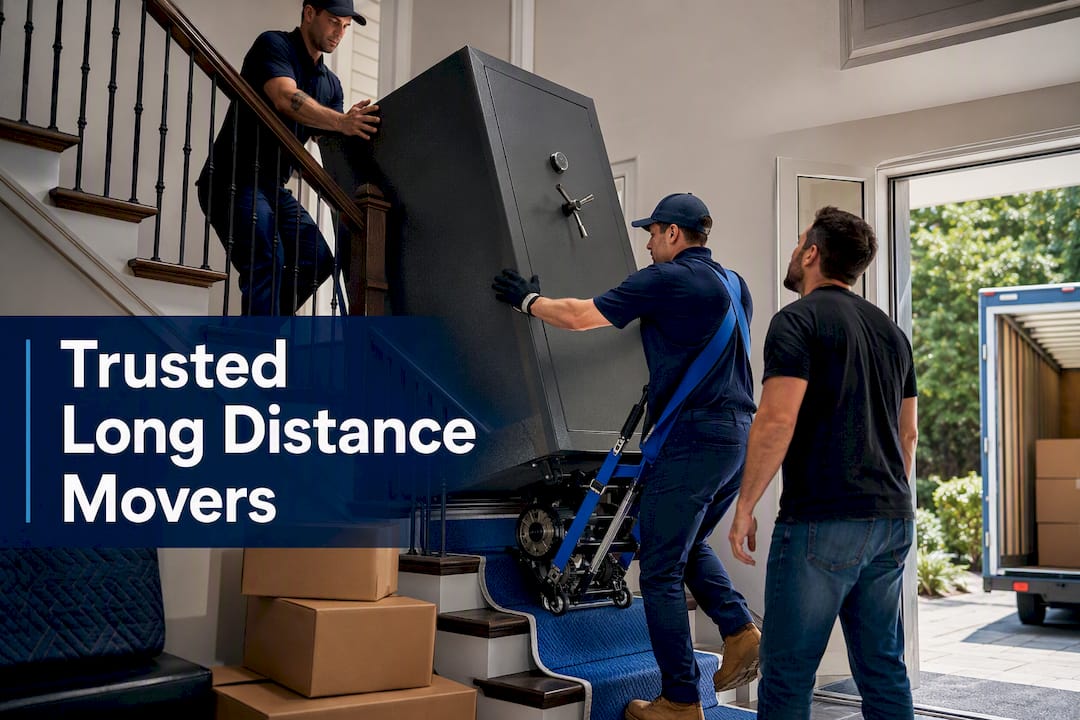
- On stairs, never free-roll a heavy safe. Use a mechanical stair-climbing dolly or a winch-assisted system that controls descent at a fixed rate.
Pro Tip: If your plan for stairs is “have four strong people carry it,” that’s not a plan, that’s a liability. Gravity does not negotiate.
Retailer guidance on DIY safe moves consistently stresses extra hands over speed. Rushing a heavy, awkward load with an uneven center of gravity is the single most common way these moves go sideways.
Loading and Securing a Gun Safe in the Truck
Where the safe sits in the truck matters almost as much as how it got there. Place it low and centered over the axle whenever the floor plan allows, which keeps the vehicle’s weight distribution stable during highway driving.
- Position the safe against the truck’s front wall for a head-to-tail block, then brace it with other stable, heavy items rather than leaving a gap it can shift into.
- Strap it down with ratchet straps rated well above the safe’s actual weight, running straps at multiple angles rather than just one direction.
- Slide masonite or non-marring wheels under any casters or feet touching the truck floor to prevent gouging.
- Photograph the final placement and strap configuration before closing the truck door. That photo matters if you ever need to file an insurance claim.
Interstate moves come with their own paperwork trail. The FMCSA’s consumer guidance on preparing goods for transport outlines what movers are responsible for once your safe is loaded and the truck crosses state lines.
Final Placement and Anchoring at the New Home
Getting the safe into the house is only half the job. Re-measure the intended spot before the crew commits to a final position, and use furniture sliders or floor protectors for that last few feet of positioning so you’re not gouging brand-new flooring on the last step.
- Anchor to a concrete slab with rated floor bolts if the safe sits on grade.
- For upper floors, have a contractor confirm subfloor reinforcement before anchoring, since standard joists weren’t built for a 600 pound point load.
- Test the lock and any electronic keypad immediately after placement, before you forget the override code is still in a drawer somewhere.
- Do a quick inventory check and photograph the safe’s condition for your records.
Pro Tip: Anchor bolts feel like an optional step until an earthquake, a break-in attempt, or a curious toddler proves otherwise.
When Should You Hire Professional Gun Safe Movers?
There’s a point where DIY stops being frugal and starts being risky. Hire professionals once the safe exceeds 500 pounds, involves any staircase, requires a multi-floor carry, or has a tight, awkward exit like a narrow hallway or a sharp turn near the front door. Safes above 1,000 pounds almost always need mechanical assistance like winches or forklift attachments to manage safely, a threshold professional rigging guides treat as a hard line rather than a suggestion.
Professional gun safe movers bring more than muscle:
- An on-site survey that measures doorways and stairs before quoting a price
- Safe-rated rigging equipment, not repurposed appliance dollies
- Floor and wall protection built into the standard process
- Insurance coverage and a documented claims process if something goes wrong
Cost typically scales with weight, stair count, travel distance, and crew size. A ground-floor move with wide doorways costs far less than a third-floor walkup requiring four movers and rigging equipment. Before booking, ask about insurance limits, request an equipment list, and get a written estimate rather than a verbal ballpark. Our guide to licensed vs. unlicensed movers explains why that paperwork matters more than the quote itself, and our breakdown of insured moving companies covers what coverage limits actually mean for a high-value item like a loaded gun safe.
How Ambmovingservices Handles Gun Safe Moves
Ambmovingservices treats a gun safe the way any professional rigging crew would: as a job that starts before the truck ever shows up. That means a pre-move survey of the safe’s weight, the route, and any structural obstacles, followed by a plan built around the right equipment rather than whatever happens to be on the truck.
What that process includes:
- Site survey confirming doorway, stair, and hallway clearances in advance
- Safe-rated dollies and rigging appropriate to the safe’s actual weight
- Full protective wrapping and floor runners at both the origin and destination
- Licensed, insured crews experienced with interstate and long-distance logistics
- Documentation of condition and placement for insurance purposes
Long-distance safe moves add coordination most local movers rarely handle, since state lines can complicate ammunition and firearm transport rules. Our services overview details how that fits into a broader relocation plan.
Gun Safe Moving Checklist and Final Verdict
DIY works only for small, empty safes with clear, level access. Everything heavier, taller, or blocked by stairs belongs to a professional crew.
| Step | Action |
|---|---|
| Measure | Safe dimensions vs. doorways, stairs, turns |
| Empty | Remove firearms, ammo, shelving, loose items |
| Protect | Wrap safe, lay floor runners, rate your straps |
| Decide | DIY only if under 300 lb, no stairs, wide clear path |
| Call | Request a quote if any red flag applies |
What We’ve Learned Moving Gun Safes for Clients
Homeowners consistently underestimate two things: how much a fully loaded safe actually weighs, and how narrow a hallway looks once you’re trying to walk a 600 pound box through it. The moves that go smoothly are the ones where someone measured twice before committing to a route.
Reputable movers carry insurance precisely because heavy, awkward loads occasionally go wrong even with good equipment and experienced hands. That coverage is the difference between a bad afternoon and a bad year.
— AMB
Get a Quote for Your Gun Safe Move
Ambmovingservices gives you what a rental truck and a rented dolly never will: a crew that has already rigged safes through stairwells, narrow hallways, and cross-country hauls, backed by insurance that covers the load the whole way. That’s the real difference between hoping the move goes fine and knowing it will.
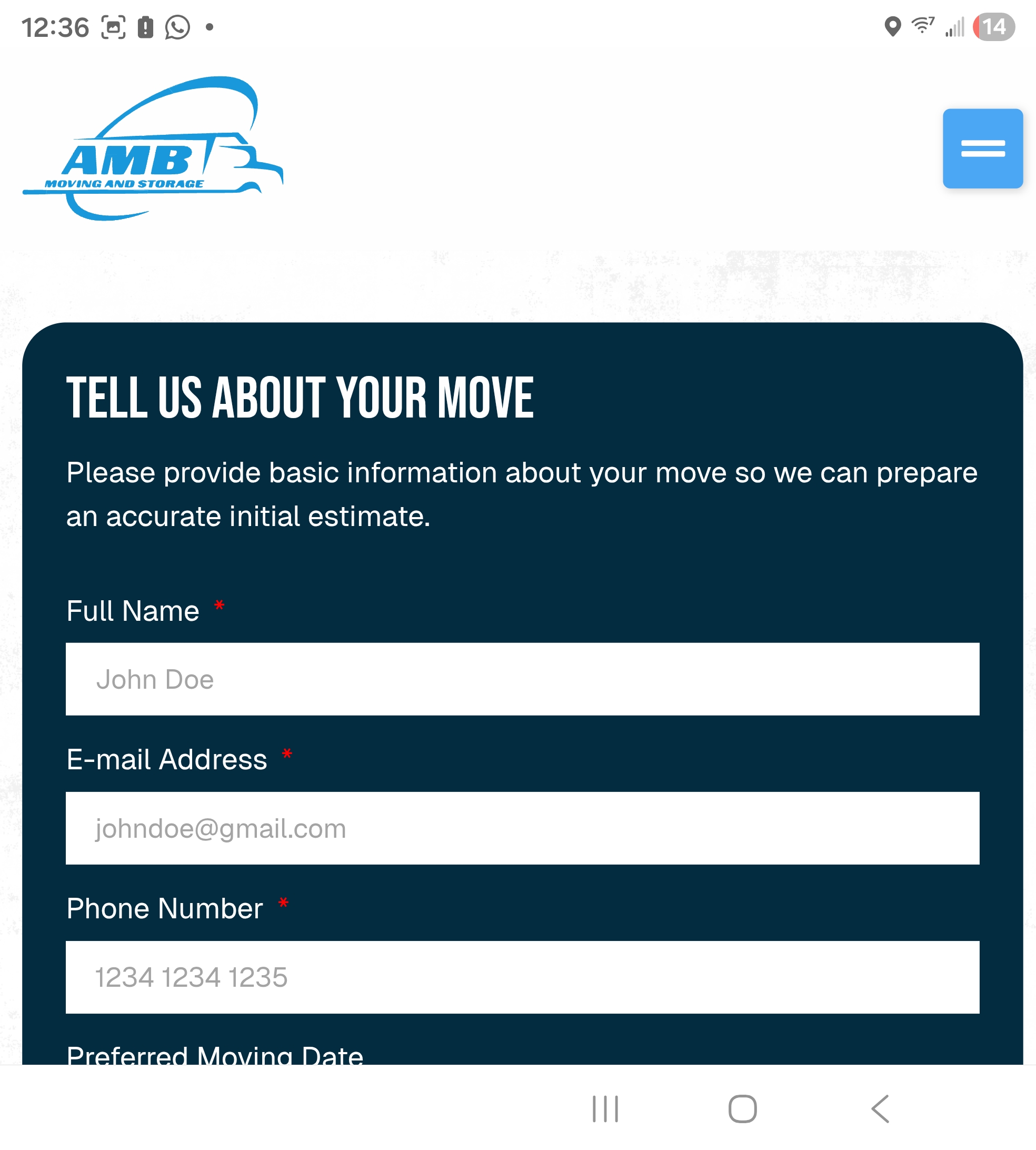
When you request a quote, include the safe’s weight from its data plate, a few photos of the path from the safe to the door, and any stairs or tight turns along the route. That’s enough for an accurate estimate rather than a guess. Ambmovingservices handles this as part of broader interstate moving and nationwide relocation work, so your safe travels under the same insured, licensed process as the rest of your household. Get your free quote today and find out what a properly rigged move actually costs.
Sources
- Ready to Move brochure (FMCSA) — 2022 update
- The Professionals’ guide to moving heavy safes (Anderson Dolly) — 2026 edition
- DIY or Disaster? What to know before moving a gun safe yourself (IslandSafe) — 2025
- Tips for moving a gun safe on your own (Liberty Safe) — 2020