


TL;DR:
- Expedited moving services use dedicated trucks and crews to deliver belongings within 48 hours to 8 days, significantly faster than standard moves.
- Choosing a trustworthy provider requires verifying active FMCSA registration, obtaining binding estimates, and ensuring transparency before loading begins.
Expedited moving services are specialized relocation solutions that transport your belongings faster than standard moves by assigning dedicated trucks, crews, and direct routing to guarantee delivery within a defined window. Unlike consolidated long-distance moves that can take 7 to 14 days, expedited interstate moves compress that timeline to as little as 48 hours or up to 8 days. If you are facing a job transfer, a lease deadline, or a medical relocation, understanding how these fast moving services work, what they cost, and how to choose a trustworthy provider is the difference between a controlled move and a costly scramble.
What is expedited moving services and how does it work?
Expedited moving services are defined by one core operational difference from standard moves: your belongings travel on a dedicated truck with a crew assigned exclusively to your shipment. Standard long-distance carriers use consolidated loads, meaning your furniture shares space with other customers’ items and makes multiple stops along the route. That model is cost-efficient but slow. Expedited movers eliminate those stops entirely.

Dedicated vehicle routing reduces transit time by up to 50% compared to consolidated loads. That figure reflects the compounding delays that come from shared trucks: additional pickups, detours, and waiting periods at distribution hubs. A dedicated truck drives directly from your origin to your destination, which is why the timeline shrinks so dramatically.
The operational model also includes priority scheduling. Your move coordinator locks in a guaranteed departure date and an arrival window before the truck leaves your driveway. GPS tracking gives you real-time visibility during transit, so you are never guessing where your belongings are. Professional packing, direct transport, and unloading by the same crew are standard features of most expedited packages, which reduces the handoff errors common in multi-crew standard moves.
Pro Tip: If your timeline has even a small buffer, tell your move coordinator. Scheduling flexibility allows carriers to slot your shipment into existing routing gaps, which can meaningfully reduce the cost of an expedited move without sacrificing speed.
The packing and loading procedures in expedited moves are also calibrated for speed. Crews arrive with pre-staged materials, work in parallel rather than sequentially, and use inventory systems that track every item from load to delivery. This is not the same as a rushed move. It is a structured process designed to be fast and precise.
What types of expedited moving options are available?
Not every urgent move looks the same, and the industry offers distinct service tiers to match different timelines and distances. Understanding which category fits your situation prevents you from overpaying for speed you do not need or underestimating the complexity of your move.
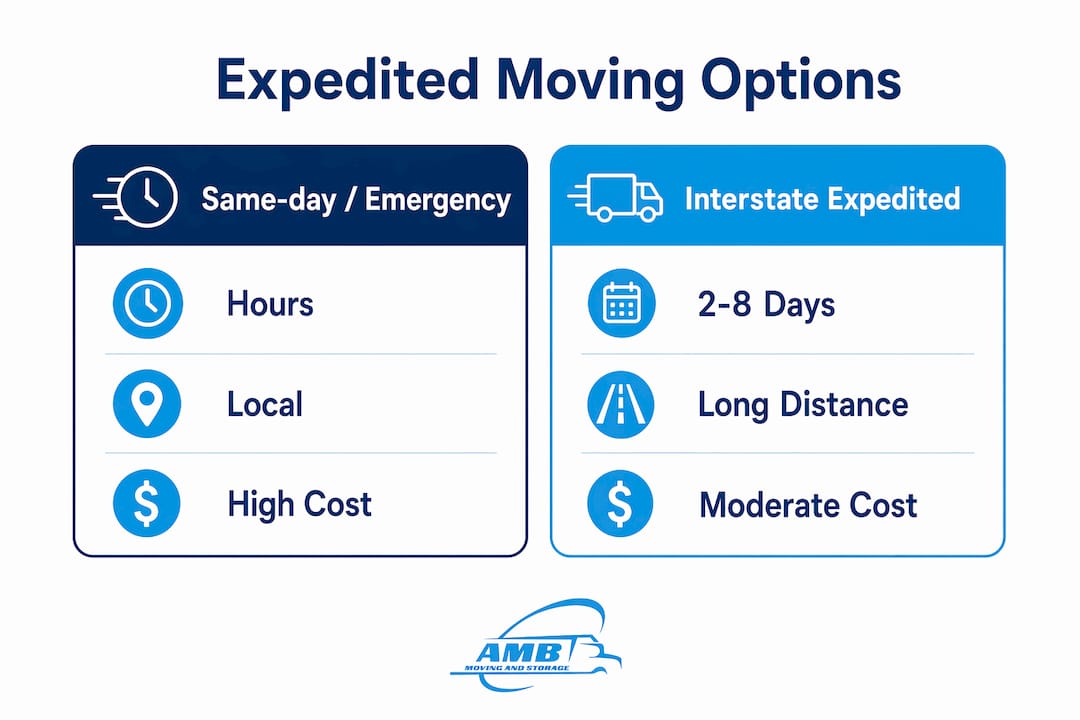
Same-day and emergency moves are typically local or short-distance relocations completed within hours to 24 hours. These serve renters facing sudden lease terminations, families dealing with medical emergencies, or anyone who needs to vacate a property with almost no notice. They are operationally different from interstate expedited moves because the distances are short and the logistics are simpler.
The table below compares the primary expedited moving options available for urgent relocations:
| Move type | Typical timeline | Primary use case | Cost factors |
|---|---|---|---|
| Same-day / emergency | Within 24 hours | Local lease deadlines, medical emergencies | Hourly labor, short distance |
| Last-minute (1 to 3 days) | 24 to 72 hours | Sudden job transfers, short-notice closings | Premium scheduling, crew availability |
| Expedited interstate | 2 to 8 days | Cross-country or state-to-state urgent moves | Dedicated truck, direct routing, distance |
| Standard long-distance | 7 to 14 days | Planned moves with flexible timelines | Consolidated load, multi-stop routing |
Interstate expedited moves are the most logistically complex category. A nationwide moving company handling these moves must coordinate FMCSA-compliant carriers, dedicated equipment, and guaranteed arrival windows across state lines. The scope is fundamentally different from a same-day local move, and the pricing reflects that difference.
For families relocating due to corporate transfers or military orders, the 2 to 8 day interstate window is often the most practical quick move solution. It provides speed without the premium of a true same-day service, and it covers the full range of long-distance moving needs including packing, vehicle transport, and storage if the destination is not ready on arrival.
How to choose a reliable expedited moving service
Urgency is the condition that scammers exploit most aggressively in the moving industry. When you are under pressure to move fast, the temptation to skip verification steps is real. That is exactly when those steps matter most.
The Federal Motor Carrier Safety Administration (FMCSA) requires all interstate movers to hold an active USDOT number and valid carrier authority. You can verify any mover’s registration and safety rating through the FMCSA verification process before signing anything. A legitimate expedited mover will provide this information without hesitation.
Follow these steps when vetting any fast moving service:
- Confirm the mover’s active USDOT number and FMCSA registration status
- Request at least three written estimates from separate FMCSA-registered carriers
- Insist on a binding estimate in writing before any belongings are loaded
- Ask for proof of cargo insurance and liability coverage
- Request an in-home or virtual walkthrough estimate rather than a phone quote
Federal law requires a binding estimate to be honored unless you request additional services after signing. Without a binding estimate in writing, you are exposed to “hostage load” practices, where a mover inflates charges after your belongings are on the truck and refuses delivery until you pay. This practice is illegal, but it happens, and expedited moves are a common target because customers feel they cannot afford delays.
Red flags to avoid include movers who demand large cash deposits upfront, refuse to provide a written estimate, or decline to conduct a walkthrough of your home before quoting. Transparency and open communication are the baseline standard for any trustworthy provider.
Pro Tip: Use the interstate moving verification resources available through FMCSA and reputable moving guides to cross-check any carrier before committing. Spending 20 minutes on verification can prevent weeks of legal disputes.
What are the benefits and limitations of expedited moving?
Expedited moving services deliver clear advantages for the right situations, but they also carry trade-offs that every customer should understand before booking.
| Factor | Benefit | Limitation |
|---|---|---|
| Speed | Delivery in 2 to 8 days versus 7 to 14 days | Higher cost than standard consolidated moves |
| Handling | Same dedicated crew from load to delivery | Limited availability during peak summer months |
| Scheduling | Guaranteed departure and arrival windows | Less flexibility for last-minute date changes |
| Insurance | Priority cargo coverage options available | Full-value protection adds to total cost |
| Routing | Direct transport with GPS tracking | Fewer carriers offer true expedited interstate service |
The most significant benefit is reduced transit risk. Every handoff between crews or trucks is a point where items can be damaged or lost. A dedicated crew that loads and unloads your belongings eliminates most of those handoffs. For high-value items, antiques, or fragile furniture, this single factor often justifies the cost difference.
The primary limitation is price. Expedited moves cost more than standard moves because you are paying for exclusive use of a truck and crew. During peak moving season, typically May through August, availability tightens and prices rise further. If your timeline allows any flexibility, booking outside peak periods and disclosing a small scheduling buffer are the two most effective ways to manage costs without sacrificing the speed you need.
For families navigating a sudden corporate relocation or a medical transfer, the benefits of expedited moving typically outweigh the cost premium. The certainty of a guaranteed delivery date has real financial value when you are coordinating hotel stays, school enrollment, or a new job start date.
What practical steps should you take to prepare for an expedited move?
Preparation directly determines how smoothly an expedited move executes. The faster the timeline, the more your advance work matters.
- Sort and downsize before the crew arrives. Every item removed from your inventory reduces weight, volume, and cost. Donate, sell, or discard anything you would not pay to ship at expedited rates.
- Build an accurate inventory list. Provide your move coordinator with a detailed room-by-room inventory before the estimate. Surprises on moving day cause delays and cost overruns.
- Decide on packing services early. If professional packing is included in your package, confirm the timeline. If you are self-packing, complete it before the crew arrives. Partially packed homes slow expedited moves significantly.
- Disclose any scheduling flexibility. Even a one or two day buffer can reduce your cost by fitting your shipment into an existing route gap rather than requiring a dedicated dispatch.
- Prepare your documents and payment method. Have your binding estimate, inventory list, and payment confirmation ready before the truck arrives. Disputes over paperwork on moving day create delays that defeat the purpose of an expedited service.
- Confirm arrival window and tracking access. Ask your coordinator for the GPS tracking link and the confirmed delivery window at least 24 hours before your scheduled pickup.
Pro Tip: Confirm your arrival window and tracking access the day before pickup, not the morning of. If there is a routing change or crew adjustment, you want time to adapt your plans at the destination rather than scrambling on arrival.
For interstate relocations, also confirm that your mover has the correct destination address, access instructions, and any building elevator or parking restrictions at your new location. These details are easy to overlook under time pressure and can delay unloading by hours.
Key takeaways
Expedited moving services are the most reliable solution for urgent relocations because dedicated trucks, direct routing, and binding estimates combine to deliver speed without sacrificing accountability.
| Point | Details |
|---|---|
| Dedicated transport is the core difference | Expedited moves use exclusive trucks and crews, cutting transit time by up to 50%. |
| Delivery windows range from 48 hours to 8 days | Interstate expedited moves are far faster than standard 7 to 14 day consolidated timelines. |
| Binding estimates are non-negotiable | Federal law protects consumers, but only when a written binding estimate is signed before loading. |
| Verify FMCSA registration before booking | Confirm active USDOT numbers and insurance to avoid scams and hostage load practices. |
| Scheduling flexibility reduces cost | Disclosing a small date buffer allows carriers to reduce pricing without compromising speed. |
Why urgency should not shortcut your due diligence
The most common mistake I see in urgent relocations is treating speed as a reason to skip verification. It is the opposite of what the situation requires. When a move must happen fast, the consequences of choosing a bad mover are amplified. You have less time to recover, less leverage to negotiate, and more financial exposure if something goes wrong.
From working with clients across hundreds of interstate moves, the pattern is consistent: the customers who have the worst experiences are not the ones who moved slowly. They are the ones who moved fast without confirming the basics. A mover without an active USDOT number is not a fast option. It is a liability.
There is also a widespread misconception that expedited automatically means expensive beyond reach. That is not accurate. Scheduling flexibility, accurate inventory, and early booking all reduce costs substantially. Customers who treat expedited moving as a premium-only product often overpay because they do not negotiate or compare estimates. Three binding written estimates from FMCSA-registered carriers will give you a realistic market price and real leverage.
My practical recommendation: treat the verification process as a 30-minute investment, not an obstacle. Confirm FMCSA registration, get three written estimates, and insist on a binding quote. Those three steps protect you regardless of how fast the move needs to happen.
— AMB
Move fast and move right with Ambmovingservices
Ambmovingservices specializes in long-distance and interstate moves across the United States, including expedited options for clients who need guaranteed delivery windows and dedicated transport. Every move is handled by FMCSA-registered carriers with active USDOT numbers, valid insurance, and full binding estimate transparency before a single item is loaded. Whether you are relocating for a job transfer, a family emergency, or a lease deadline, Ambmovingservices provides the speed and accountability that urgent relocations demand. Packing services and secure storage are available to cover situations where your destination is not ready on arrival. Request a free moving quote today and get a binding estimate with no obligation.
FAQ
What is the delivery window for expedited moving services?
Expedited moving services typically deliver interstate shipments within 48 hours to 8 days, compared to 7 to 14 days for standard consolidated long-distance moves. The exact window depends on distance, routing, and carrier availability.
How much do expedited moving services cost compared to standard moves?
Expedited moves cost more than standard moves because you pay for exclusive use of a dedicated truck and crew. Disclosing scheduling flexibility and booking outside peak season (May through August) are the most effective ways to reduce the premium.
What is the difference between same-day moving and expedited interstate moving?
Same-day moving covers local or short-distance relocations completed within 24 hours, typically for emergency situations like sudden lease terminations. Expedited interstate moving handles cross-country or state-to-state relocations over 2 to 8 days using dedicated trucks and direct routing.
How do I verify that an expedited mover is legitimate?
Confirm the mover’s active USDOT number through the FMCSA database, request at least three written binding estimates, and avoid any carrier that demands large upfront cash deposits or refuses a walkthrough estimate. Federal law requires binding estimates to be honored, protecting you from inflated post-loading charges.
Can I get expedited moving services for a last-minute interstate move?
Yes. Most FMCSA-registered expedited carriers can accommodate last-minute interstate moves with 1 to 3 days of notice, though availability tightens during peak summer months. Providing even a small scheduling buffer improves both availability and pricing.