


The best time to move is an off-peak, mid-month weekday, typically between November and February, with April and October as the strongest shoulder-season alternatives when winter weather is a concern. Booking during these windows gets you two things peak-season movers rarely see: lower rates and open availability. Interstate and long-distance carriers cut prices when demand drops, and dropping demand means more trucks and crews to choose from instead of a scramble for whatever’s left.
Here’s the quick breakdown:
- Best for cost: November through February, when industry pricing data shows rates run well below the annual average.
- Best for balance: April or October, when demand has eased but weather is still manageable in most regions.
- When you have no choice: June through August, the window most families are locked into by the school calendar, even though it’s also the most expensive stretch of the year.
If you’re planning a move now, check mid-month Tuesday or Wednesday availability with a few carriers and start requesting quotes 8 to 12 weeks out if you’re moving long-distance. That lead time matters more than people expect, especially heading into summer.
Pro Tip: Stack all three levers at once: off-season, mid-week, and mid-month, and you’ll typically see the deepest discount a mover can offer. Each one only helps a little on its own; together they compound.
Key Takeaways
Booking an off-peak, mid-month weekday move, ideally in late fall through winter, saves the most money, while April and October offer the best balance of cost and weather.
| Point | Details |
|---|---|
| Off-peak wins on price | Off-peak pricing runs well below the annual average. |
| Peak season costs more | Peak season moves can run significantly higher for the same route and home size. |
| Timing within the month matters | Mid-month, Tuesday or Wednesday dates avoid the price spikes tied to lease turnovers and weekends. |
| Book early for interstate moves | Plan 8 to 12 weeks out normally, or 12 to 16 weeks during peak season. |
| Ambmovingservices adapts to your timeline | Ambmovingservices offers binding estimates, flexible delivery, and storage add-ons to fit your ideal booking window. |
Table of Contents
- Best Time of Year to Move: A Season-by-Season Breakdown
- Cheapest Times to Move and What You Can Expect to Save
- Timing Your Move Within the Month and Week
- How Region and Weather Should Shift Your Plan
- How Far Ahead to Book, by Move Type and Season
- Matching Timing to Your Situation
- The Numbers Behind These Recommendations
- Get Your Move Scheduled Before Peak-Season Rates Kick In
- Frequently Asked Questions
- Sources
Best Time of Year to Move: A Season-by-Season Breakdown
Moving costs follow a predictable curve tied to demand, not to the calendar itself. Roughly 60% to 70% of all annual moves happen between mid-May and mid-September, which is exactly why that stretch is also the most expensive one to book.
Peak season: This is when families move around the end of the school year, leases turn over en masse, and carriers can charge a premium because they don’t need to compete for your business.
Shoulder season: Demand has cooled but weather is still workable almost everywhere. This is the closest thing to a sweet spot for households that don’t have a hard deadline.
Off-peak season: November through February. Demand drops sharply after the holidays, and monthly pricing data pegs January and February well below the annual average, often 18% to 20% cheaper.
If you’re optimizing purely for cost, target the winter months and November. If you want a reasonable trade-off between price and weather risk, April and October both work well.
The months to avoid, and why:
- July and August: the highest demand of the year, with prices running well above average in some markets.
- Hurricane season (June through November) for anyone relocating to or from the Gulf Coast or Southeast, with August and September carrying the highest storm risk.
- Deep winter (January in northern climates) if you’re sensitive to snow and ice delays, even though it’s the cheapest month on paper.
Families with school-age kids face a real constraint here: most can’t move mid-semester, which pushes them straight into the most expensive months. If that’s your situation, the goal shifts from “when” to “how to save within June through August,” which the sections below cover.
Cheapest Times to Move and What You Can Expect to Save
Peak season can cost you 15% to 35% more for an identical move, according to cost comparisons across common long-distance routes. That’s not a rounding error. On a typical two- or three-bedroom interstate move running $4,000 to $6,000 in the off-season, a summer booking can push the same job past $7,000, sometimes higher depending on the route and how far out you book.
The FreightWaves seasonal pricing analysis puts the peak-season premium at roughly 20% to 30% versus the rest of the year, driven almost entirely by carrier capacity. Trucks and crews are finite. When everyone wants the same two months, price is how carriers ration the calendar.
A few habits compound the savings:
- Book in the off-season instead of peak season.
- Choose a Tuesday or Wednesday move date instead of a weekend.
- Aim for the middle of the month rather than the first or last few days.
Each one shaves a little off the price on its own. Stacked together, they’re usually the difference between a mediocre quote and a genuinely good one.
Timing Your Move Within the Month and Week
Moving costs shift by the day, not just the season. The first and last three days of any month spike hard because that’s when most leases turn over and most closings happen, which means every mover in the area is booked solid. Shifting your date to the middle of the month, roughly the 10th through the 20th, avoids that entire bottleneck.
Day of the week matters just as much. Tuesday and Wednesday are consistently the cheapest, since weekend and Friday slots get claimed first by people who don’t want to take time off work. Any weekday beats a weekend if price is your priority.
Time of day is a smaller lever, but a real one: early starts avoid afternoon heat and traffic, while some carriers discount later slots on days when the morning crew already finished a smaller local job.
Before locking in a date, confirm:
- Your current and new lease dates actually leave enough buffer.
- Building access rules, including elevator reservations if you’re in an apartment or condo.
- Parking or loading zone permits, especially in dense urban areas.
Pro Tip: Call ahead about loading zone permits in cities with strict parking enforcement. A move that starts 45 minutes late because the truck couldn’t find legal parking can cost you real money in hourly labor.
How Region and Weather Should Shift Your Plan
The national “best time” advice bends depending on where you live. Regional weather risk should factor into your date almost as much as price does.
- Northeast: avoid December through February in snow-heavy areas; late spring and early fall are safer bets.
- Southeast and Gulf Coast: hurricane season runs June through November, with August and September carrying the highest storm activity. Watch NOAA advisories closely if you’re booking during this window.
- Midwest: late-winter and early-spring snow and ice can delay trucks well into March in some years.
- Mountain and high-altitude areas: late-spring snow is a real risk into May at higher elevations.
- Southwest: extreme heat from June through August can affect both crew safety and how belongings hold up in a hot truck.
Carrier availability also varies regionally. Coastal and hurricane-prone markets tend to book up fast right before storm season as people move ahead of it, so booking windows there should skew earlier than the national average.
How Far Ahead to Book, by Move Type and Season
Booking too late is the single most common reason people end up paying peak-season rates even when they didn’t have to. Lead time depends on both distance and season.
| Move Type | Off-Peak Lead Time | Peak-Season Lead Time |
|---|---|---|
| Local move | 2 to 4 weeks | 4 to 6 weeks |
| Long-distance / interstate | 8 to 12 weeks | 12 to 16 weeks |
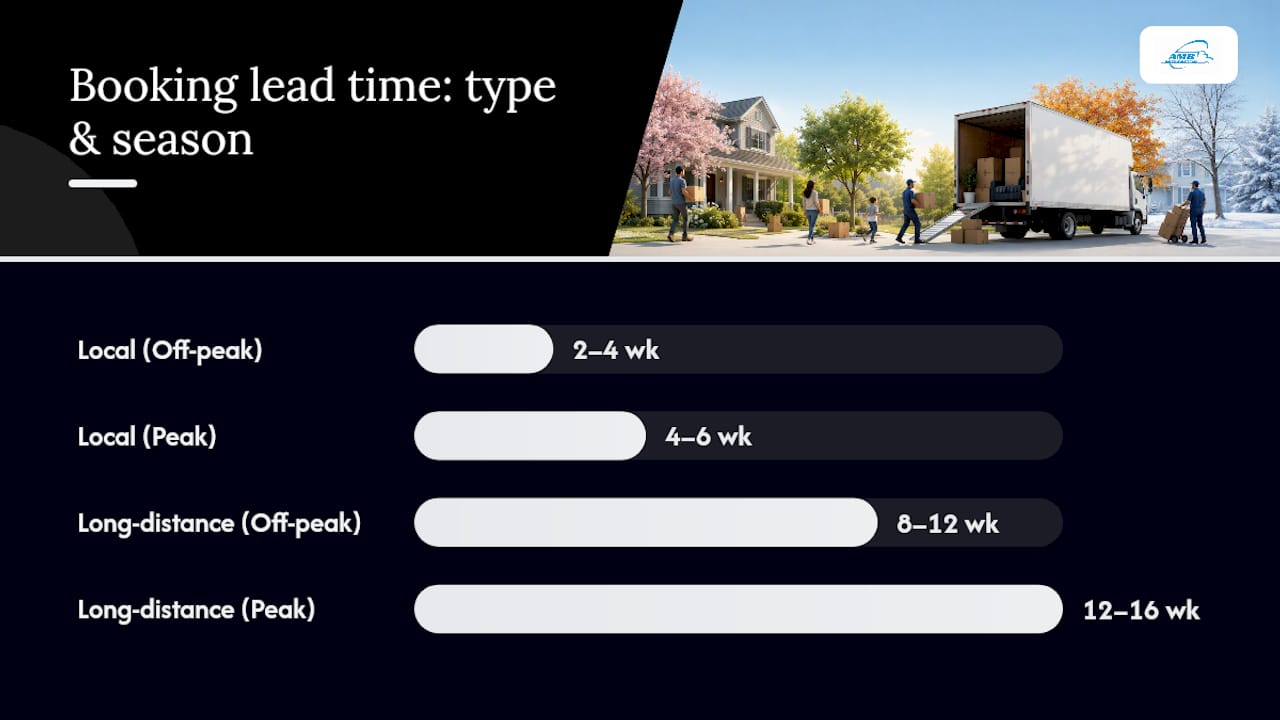
That guidance for interstate moves comes from industry scheduling recommendations, and it holds up whether you’re moving with long-distance movers or handling a shorter interstate relocation.
A rough checklist by stage:
- 8 to 12 weeks out: get three quotes, confirm binding vs. non-binding estimates, verify carrier credentials.
- 6 to 8 weeks out: lock your date and deposit.
- 3 to 4 weeks out: finalize packing plan and any storage needs.
- 1 to 2 weeks out: confirm building access, parking, and delivery windows.
Pro Tip: Earlier isn’t always cheaper. Booking six months out for a peak-season date can trigger a “safety surcharge” on some binding estimates, while booking too late means paying a panic premium for whatever’s left. The 8 to 12 week window is the sweet spot for most interstate moves.
Matching Timing to Your Situation
Your ideal window depends on what’s actually constraining you, cost, calendar, or flexibility.
- Families with school-age kids: aim for June through early August, but book 12+ weeks out since this is peak season.
- Students: mid-August move-in windows are busy; consider moving a week earlier or after Labor Day if your program allows it.
- Renters with lease deadlines: target the middle of your move-out month, not the last few days when everyone else is scrambling too.
- Military and government moves: these often run on fixed orders, so the priority shifts to booking as early as your orders allow.
- Corporate relocations: if your employer sets the date, focus on requesting mid-week service and asking about flexible delivery to soften the peak-season hit.
When timing genuinely isn’t your call, book early, request a Tuesday or Wednesday slot if the carrier offers any flexibility at all, and ask about staged or flexible delivery options.
The Numbers Behind These Recommendations
The savings estimates in this guide aren’t a guess. They come from combining a few different data sources: U.S. Census mobility research on why and when Americans relocate, seasonal pricing indexes from moving-industry analysts, and sample carrier pricing reports across common interstate routes.
Three figures anchor the whole picture: 60% to 70% of annual moves happen between mid-May and mid-September, peak-season pricing runs 15% to 35% higher than off-peak on comparable routes, and January/February sit roughly 18% to 20% below the annual average in month-by-month price indexes.
A caveat worth stating plainly: these are national averages. Your actual quote depends on your specific route, home size, and the carrier’s local capacity that month. A move from a low-demand market to a high-demand one can behave differently than the national curve suggests, so treat these ranges as a planning baseline, not a guaranteed quote.
- Census data explains the underlying mobility patterns behind seasonal demand.
- Industry pricing indexes translate that demand into the percent swings shown above.
- Carrier booking guidance shapes the lead-time recommendations throughout this guide.
Why timing shapes almost everything else in an interstate move
Peak season doesn’t just raise prices, it tightens the entire schedule: fewer trucks, less flexible pickup windows, and less room to negotiate delivery dates. AMB Moving Services has seen how much more predictable a long-distance move becomes when it’s booked in a wider planning window rather than crammed into the same six weeks everyone else is fighting over. Getting the timing right upfront is one of the most effective ways to control both cost and risk on an interstate move.

Get Your Move Scheduled Before Peak-Season Rates Kick In
Ambmovingservices gives you something the calendar math above can’t: a real quote based on your actual route, home size, and date, not just a national average. Whether you’re planning a cross-country relocation for June or trying to squeeze into a cheaper November window, our team specializes in long-distance moving and interstate moving with binding estimates, secure storage add-ons, and guaranteed-delivery options that protect you from the panic premium of booking too late.
As a nationwide moving company, we recommend locking in your date 8 to 12 weeks ahead for most interstate moves, and closer to 12 to 16 weeks if you’re moving between May and September. If you’re relocating an RV or specialty vehicle alongside your household goods, transport guidance for recreational vehicles is worth reviewing before your move date. Ready to see what your move actually costs? Request a free quote and get a date that works for your budget, not just your calendar.
Frequently Asked Questions
What is the single best time to move to save money?
November through February, ideally mid-month on a Tuesday or Wednesday, typically offers the lowest rates because carrier demand drops sharply after the summer peak.
Is it cheaper to move on a weekday or weekend?
Weekdays are almost always cheaper, with Tuesday and Wednesday usually the least expensive since weekend slots fill first.
How much more does it cost to move during peak season?
Identical moves can cost 15% to 35% more between May and September compared to off-peak months, depending on the route and home size.
How far in advance should I book an interstate move?
Book 8 to 12 weeks out for most interstate moves, and 12 to 16 weeks out if you’re moving during peak season between May and September.
What if I have to move during summer because of school or a lease?
Book as early as possible, request a mid-week date, and ask about flexible delivery or storage options to offset some of the peak-season premium.
Sources
- Why people move (U.S. Census Story)
- When is peak moving season? (FreightWaves)
- The Complete 2026 Moving Cost Database: Real Rates, Regional Variations & Hidden Multipliers | MoveSmart Blog
- Cost of Moving Interstate in 2026: Average Prices by Distance, Home Size & State | UseCalcPro
- How to Move Across the Country: Long-Distance Guide (Majestic Moving Companies)