


Inventory and documented valuation, paired with the right transport method and mover valuation coverage, are what actually keep a wine collection intact during an interstate move. Skip either one and you’re gambling with bottles that can’t be replaced. The rest comes down to execution: verify state alcohol rules before you book, pack for vibration and temperature swings, and get every promise from your mover in writing.
TL;DR:
- Using a professional white-glove wine mover and obtaining Full Value Protection minimizes the risk of loss or damage for high-value bottles during interstate transport.
- Thorough documentation, including appraisal, photos, and provenance, is essential to ensure proper valuation and claim handling in case of damages or loss.
- Confirm with your mover in writing that they accept wine shipments, provide temperature control, and comply with state-specific alcohol transport laws to avoid legal issues.
- Packing should address temperature swings, vibration, and impact by using rigid containers, insulated boxes, and careful stacking, especially for large-format and rare bottles.
- Before moving, verify state alcohol laws and HOA or landlord rules to prevent legal or logistical obstacles that could delay or complicate your wine relocation.
Table of Contents
- Choosing How to Move Wine Collection Assets: DIY vs. Mover vs. Specialist
- What Documentation Do You Need Before a Wine Move?
- Is It Legal to Transport Wine Across State Lines?
- Packing Wine for an Interstate Move Without Breaking a Bottle
- What Should You Require From a Mover for Temperature Control?
- How Do You Protect Wine Legally in a Mover’s Contract?
- Do You Need a Permit to Move Wine Across State Lines?
- Should You Notify Your HOA or Landlord Before Moving Wine?
- How Do You Protect Rare or High-Value Bottles During a Move?
- An Editorial Take on What Separates Careful Movers From Careless Ones
- Get a Quote for Professional Wine Collection Packing and Interstate Moving
- Sources
- FAQ
Choosing How to Move Wine Collection Assets: DIY vs. Mover vs. Specialist
Not every collection needs the same plan. A dozen everyday bottles can ride in your own car with a blanket and some common sense. A 200-bottle cellar with a few first-growth Bordeaux mixed in is a different problem entirely.
Use these decision rules to sort your situation fast:
- Carry it yourself if you have fewer than 20 to 30 bottles and can control the climate in your vehicle the whole trip.
- Use a household-goods mover when wine is part of a larger residential move and the collection has no bottles worth more than a few hundred dollars each.
- Hire a wine-specific white-glove service when you have rare vintages, large-format bottles, or any bottle you’d genuinely grieve over if it broke.
- Call your state alcohol-control authority first if you’re unsure whether your destination state restricts personal alcohol transport.
Before you touch a single bottle, build an inventory, snap photos, pull your highest-value bottles aside, and rough out how long they’ll sit in a truck or garage at the wrong temperature.
What Documentation Do You Need Before a Wine Move?
Insurers and movers won’t take your word for what a bottle is worth. You need a paper trail before the first box gets taped shut.
For every bottle, or at minimum every case, log the producer, vintage, format (standard, magnum, double magnum), condition of the label and cork, original purchase price, and provenance if you have it. Photograph each bottle’s label and fill level, and date every image.
- Get a professional appraisal for any bottle valued at several hundred dollars or more, and attach that document to your mover’s contract.
- Review FMCSA’s valuation rules: movers must offer Full Value Protection and Released Value, and Released Value caps liability at 60 cents per pound per article, which is nowhere near enough for a rare bottle.
- Choose Full Value Protection, or line up separate third-party insurance, for any collection with meaningful dollar value at stake.
- Keep a signed copy of your inventory, dated photos, and purchase receipts somewhere other than the moving truck, in case you need to file a claim.
Skipping the appraisal step is the single most common mistake collectors make. A 60-cent-per-pound payout on a bottle that cost $400 is not a real remedy.
Is It Legal to Transport Wine Across State Lines?
State alcohol laws are not uniform, and that catches collectors off guard constantly. Some states cap how much personal alcohol you can bring in without a permit, and a few restrict direct shipment altogether.
Before booking anything, run these checks:
- Contact the alcohol-control authority in both your origin and destination states, since TTB guidance and state-level resources confirm there’s no single nationwide rule for personal wine relocation.
- Know that USPS generally prohibits mailing alcoholic beverages, so mailing a case to yourself at your new address isn’t an option in most cases.
- If you’re moving internationally, consult U.S. Customs and Border Protection alongside TTB’s personal importation guidance, since personal importation rules differ from commercial import permits.
- Get written confirmation from your mover that they accept wine shipments and will comply with the destination state’s rules.
That last point matters more than most collectors realize. A mover that hasn’t confirmed acceptance in writing can legally refuse the shipment at pickup, leaving you scrambling.
Packing Wine for an Interstate Move Without Breaking a Bottle
Packing wine well means addressing every stage of the trip, not just the drive itself. USDA transportation research on shipping hazards flags temperature swings, humidity, shock, vibration, impact, and compression as the failure points, and those same forces apply whether you’re shipping produce or a case of Cabernet.
At the bottle level, use rigid foam dividers or molded inserts that immobilize both the neck and the base. Wrap foil capsules for extra cushioning, and never let a box exceed about 40 pounds, since heavier boxes get stacked carelessly and crushed at the bottom.

At the carton level, use rigid, double-walled cartons or wooden crates, and brace the interior so bottles can’t shift during loading or a hard stop on the highway. If you’re moving a large cellar, palletizing with load locks keeps the whole stack from sliding.
Temperature matters as much as impact. Use insulated boxes for anything spending more than a day in transit, and if the value or the season warrants it, request a climate-controlled van. Keep boxes away from refrigeration discharge points and away from doors that open repeatedly at delivery stops, since those spots see the widest temperature swings.
Label every box on three sides with “fragile,” an orientation arrow, and a contents note, similar to the three-layer labeling method used for other breakables. Load high-value bottles last, so they ride on top and centered in the truck.
Pro Tip: Tape a printed inventory sheet inside the lid of every wine box before sealing it. If a claim comes up later, you’ll have proof of contents without digging through photos on your phone.
What Should You Require From a Mover for Temperature Control?
Ordinary household-goods transport, climate-controlled carriers, and wine-specific white-glove movers sit on a spectrum of cost versus control. Ordinary transport is cheapest but offers no temperature guarantees. Climate-controlled carriers add cost but give you a documented range. White-glove wine movers charge the most and typically provide continuous monitoring.
Refrigerated trucks aren’t automatically safe for wine. Airflow near the discharge point can create localized freezing, even when the rest of the trailer sits at a reasonable temperature. Ask your mover to:
- Provide a written temperature plan covering the entire route, not just pickup and delivery.
- Confirm where your boxes will sit relative to refrigeration discharge and cargo doors.
- Use data loggers for shipments crossing more than one climate zone, and share the readings at delivery.
- Explain their storage-in-transit (SIT) protocol and what happens if weather delays the route.
If a mover can’t answer these questions specifically, treat that as a red flag, not a formality.
How Do You Protect Wine Legally in a Mover’s Contract?
Verbal promises don’t survive a claims dispute. Everything that matters needs to be on paper before the truck leaves your driveway.
- Get written confirmation that the mover accepts alcohol shipments and how those bottles are covered under your chosen valuation option.
- Select Full Value Protection or arrange separate insurance, since FMCSA notes that mover liability and outside insurance carry different exclusions and claims procedures, and the two shouldn’t be confused.
- List any bottle with extraordinary value separately on the bill of lading, because Released Value’s 60-cents-per-pound cap won’t come close to covering a rare vintage.
- Get the temperature and handling commitments, plus SIT procedures, written into the contract itself, not just discussed on a phone call.
Pro Tip: If a bottle arrives damaged, photograph it before you touch it, keep the broken glass and label if possible, and file your claim immediately. Movers operate under specific FMCSA claim timelines, and delay can weaken your case.
Do You Need a Permit to Move Wine Across State Lines?
For most collectors moving personal wine between states as part of a household relocation, no special federal permit is required, since this counts as personal property transport rather than commercial sale or distribution. The distinction that matters is transport versus commerce: you’re relocating bottles you already own, not shipping alcohol for sale, and that keeps you outside the commercial importer and wholesaler licensing rules that apply to businesses.
Where permits do come into play is at the state level, and the rules aren’t consistent. A handful of states cap how many bottles a resident can bring in without registering with the state alcohol authority, and a few require a permit for any quantity above a small personal threshold. This is exactly why calling the destination state’s alcohol-control agency before your move date matters more than guessing based on what a neighboring state allows.
If your collection is large enough that it could be mistaken for a commercial shipment, or if you’re moving wine as part of settling an estate or dissolving a business-owned cellar, that’s a different regulatory category entirely, and it’s worth a direct conversation with your state’s alcohol authority rather than assuming personal-use rules apply. International moves complicate this further, since crossing a U.S. border invokes CBP and TTB personal importation rules on top of whatever the destination state requires.
The safest approach: document your collection’s size and intended use as personal property, keep that documentation with your moving paperwork, and get the destination state’s answer in writing or by email before the truck loads.
Should You Notify Your HOA or Landlord Before Moving Wine?
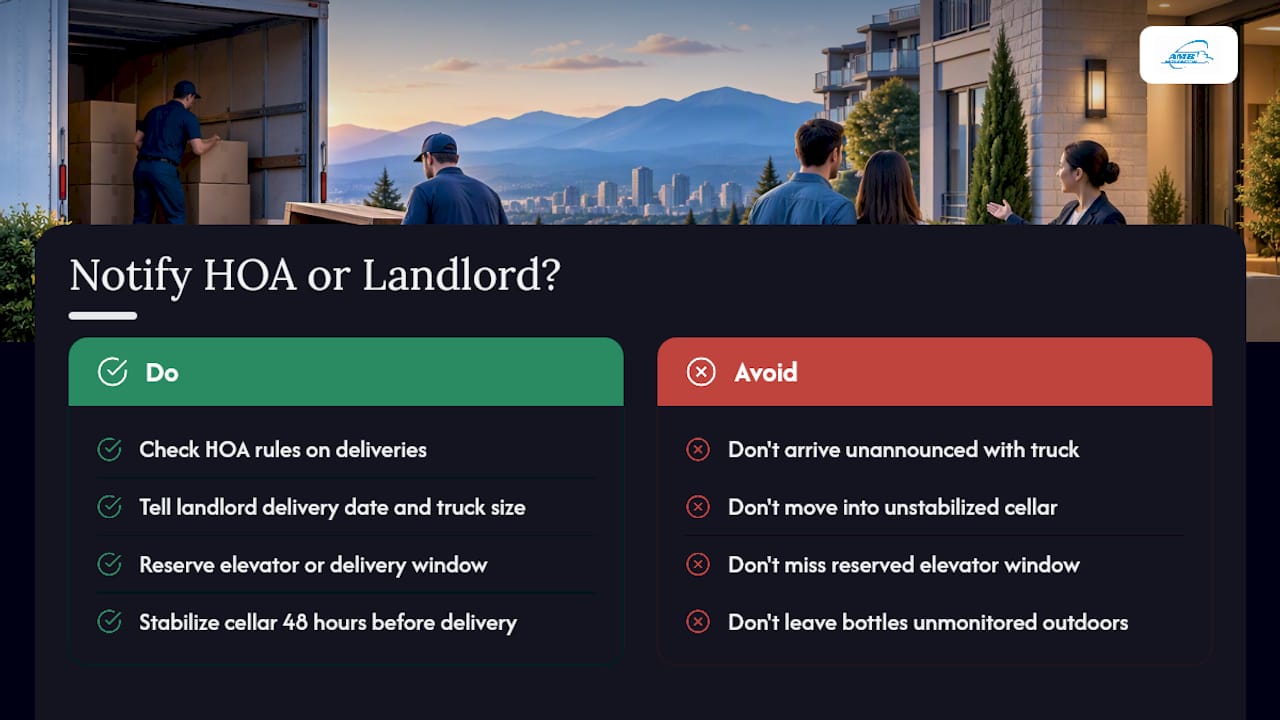
Most collectors don’t think about their homeowners association or landlord until a delivery truck shows up unannounced, and that’s when problems start. If you’re moving into a property governed by an HOA, check the community’s rules on large delivery vehicles, loading dock access, and any restrictions on storing alcohol in shared spaces like a communal wine locker or basement storage area.
Renters have a narrower but equally important set of notifications to handle. Tell your landlord or property manager the delivery date and approximate truck size, especially if the building has a narrow driveway, a shared elevator, or a limited delivery window. Some buildings require advance notice for elevator reservations, and missing that window can mean carrying cases up multiple flights of stairs by hand, which is exactly the kind of jostling that damages bottles.
If your new home includes a dedicated wine cellar or cooling unit, confirm it’s running and stabilized at least 48 hours before delivery. Moving bottles into a cellar that hasn’t reached temperature yet defeats the purpose of careful climate-controlled transport. It’s also worth checking with your homeowners insurance provider or renters policy about coverage for high-value collections at the new address, since coverage limits and named-item riders vary by policy and by state.
Finally, if your collection includes bottles stored under a bond or held in a commercial wine storage facility, notify that facility of the move date directly. Coordinating pickup and delivery windows between two parties, your storage facility and your mover, avoids the gap where bottles sit unmonitored in temperature-uncontrolled conditions.
How Do You Protect Rare or High-Value Bottles During a Move?
Rare bottles need a different level of attention than the rest of your cellar, and treating them the same as your everyday drinking wine is how six-figure collections lose value in a single move. Start by physically separating anything appraised above a few hundred dollars from your general inventory boxes, and pack those bottles in individually foam-fitted cases rather than shared cartons.
Large-format bottles, magnums, double magnums, and anything larger, need custom bracing because their weight distribution differs from a standard 750ml bottle. A crate built for standard bottles will let a magnum shift and crack against its neighbors. If you own bottles in wooden cases with original branding, keep them in that case where possible; provenance packaging can matter to future buyers or appraisers as much as the wine itself.
Consider hand-carrying your single most valuable bottles rather than trusting them to the same truck as your furniture, particularly for irreplaceable single bottles rather than full cases. For bottles too large or numerous to carry personally, request that the mover load them last so they sit on top of the stack, centered in the truck, and away from cargo doors and refrigeration discharge points where temperature swings are worst.
Get a second, more detailed appraisal specifically for auction-grade or investment-grade bottles, separate from your general collection appraisal, and make sure that documentation travels with you, not in the moving truck.
An Editorial Take on What Separates Careful Movers From Careless Ones
The gap isn’t packing material, it’s process. Movers who treat wine like ordinary cargo skip the documentation and temperature commitments that actually prevent claims disputes. AMB Moving & Storage Inc. builds its approach around inventory, valuation, packing standards, and monitoring, integrating specialty packing and secure storage into the same interstate move plan.
— AMB
Get a Quote for Professional Wine Collection Packing and Interstate Moving
If you’d rather not gamble a wine collection on generic moving boxes and hope, Ambmovingservices offers a more direct path: professional packing services built around fragile, high-value items, paired with nationwide interstate moving capacity built for exactly this kind of complex, multi-state relocation.
For a wine collection move, request a quote that specifically covers a documented temperature plan for the route, your choice between Full Value Protection or third-party insurance, and written handling instructions for high-value bottles. AMB’s long-distance moving and interstate and state-to-state relocation services combine with secure storage options for collectors who need a bridge period between homes, and nationwide moving coverage means your cellar isn’t limited to a regional carrier with inconsistent equipment. Specialty-item handling extends the same crating and bracing standards used for pianos and safes to wine crates that need the same level of care.
Start the process at the AMB quote page and specify that you’re moving a wine collection so the team can scope the right packing materials and valuation coverage from the first conversation.
Sources
- Importing bottled alcohol beverages into the United States | TTB
- Liability & Protection | FMCSA
- Transportation analysis and guidance | USDA AMS
- Shipping restrictions & HAZMAT – USPS
FAQ
Who Will Buy My Wine Collection If I Don’t Want to Move It?
Licensed wine retailers, auction houses, and specialty wine brokers are the typical buyers for a collection you’d rather sell than relocate. Get a professional appraisal first, since that same documentation you’d use for a mover’s valuation coverage also strengthens your position in a sale negotiation.
What Is the 75-85-95 Rule for Wine Storage?
The 75% humidity limit is a common rough guideline some collectors use to avoid mold and label damage, but definitions vary among collectors and retailers. Treat it as a general reference point rather than a fixed industry standard, and prioritize documented temperature and humidity commitments from your mover instead.
What States Restrict Wine Shipment or Personal Transport?
State rules on alcohol shipment and personal transport vary significantly, and there is no single nationwide standard, according to TTB guidance. Contact the alcohol-control authority in both your origin and destination states before your move date to confirm current limits, since rules change and enforcement differs by state.
What Is the 20-Minute Rule for Wine?
The 20-minute rule generally refers to letting a chilled red wine sit at room temperature for about 20 minutes before serving, or chilling a room-temperature white for roughly 20 minutes before pouring. It’s a serving guideline, not a moving or storage rule, so it has no bearing on how you pack or transport bottles during a relocation.
Does Ambmovingservices Handle Wine Collections During Interstate Moves?
Yes, Ambmovingservices provides professional packing services suited to fragile, high-value items like wine, combined with interstate and nationwide moving capacity. Current pricing for packing and specialty handling is available directly through a quote request rather than a fixed published rate for wine-specific service.