


Yes, wardrobe boxes are worth it for anyone moving suits, dresses, coats, or a closet full of hanging clothes, especially on a long-distance move. Start by measuring your longest garment from shoulder seam to hem, then reserve one tall box per appropriate amount of closet space based on your garment sizes. The sections below cover exact sizes, how many boxes to buy, step-by-step packing, and what to do differently when your clothes are riding in a truck for several days.
TL;DR:
- Ensure wardrobe boxes have a high edge crush test rating and strong double-wall construction for long-distance moves to prevent bottom failures during transit.
- Measure your longest garment from shoulder to hem and compare it to the box’s hanging clearance to choose the appropriate size, especially for full-length gowns or coats.
- Pack clothes in small batches of 4 to 8 hangers, and avoid overpacking the bar to prevent damage and wrinkles during the move.
- Treat wardrobe boxes as heavy and awkward to lift, limiting weight to about 60 pounds and using two-person lifts for heavier loads.
- Consider professional packing and loading services for valuable or delicate clothing to ensure proper handling in multi-day interstate moves.
Table of Contents
- What Are Wardrobe Boxes and When Do You Need Them?
- Wardrobe Box Sizes, Measurements, and Strength for Long-Distance Moves
- How Many Wardrobe Boxes Do You Actually Need?
- How to Pack a Wardrobe Box Step by Step
- Loading and Transport Tips for Long-Distance Moves
- Where to Buy or Rent Wardrobe Boxes, and What They Cost
- What AMB Moving & Storage Recommends for Wardrobe Packing
- Our Take on Packing Wardrobe Boxes for a Long-Distance Move
- Get Professional Help Packing Wardrobe Boxes for Your Move
- Sources
- FAQ
What Are Wardrobe Boxes and When Do You Need Them?
A wardrobe box is a tall cardboard or plastic carton with a metal hanging bar near the top and a front access flap, built so clothes travel on their hangers instead of folded into a duffel bag. The bar clips into slots on either side of the box, the flap lets you slide garments in and out without lifting the whole box, and cutout handholds make it liftable by two people even when it’s stuffed with wool coats. That’s the entire design, and it solves one specific problem: preventing wrinkles and saving hours of steaming and ironing after you arrive, according to ThisOldHouse’s wardrobe box guide.
Not every closet needs one. A studio apartment with ten t-shirts and two blazers can get by with a suitcase and a couple of garment bags. But wardrobe boxes earn their cost fast in a few specific situations:
- Suits, gowns, and tailored jackets that lose their shape when folded, especially anything with structured shoulders or a lining.
- Delicate fabrics like silk, chiffon, or beaded formalwear that crease permanently under pressure.
- Tight move timelines, where you don’t have a spare evening to re-press half your closet before a Monday meeting or a corporate transfer.
- Long-distance or interstate moves, where clothes sit in a truck for days rather than hours, giving wrinkles and creases time to set in.
For everything else, garment bags folded flat into a suitcase, or a laydown wardrobe box, cover the gap without the extra bulk. The real decision point is volume and fabric type, not just how many hangers you own.
Wardrobe Box Sizes, Measurements, and Strength for Long-Distance Moves
Wardrobe boxes come in three main heights, and picking the wrong one is the single most common mistake movers see on packing day. Short or half boxes are designed for kids’ clothes or closets with limited ceiling clearance. Standard boxes cover most shirts, pants, and mid-length dresses. Tall or extra tall boxes suit full-length gowns or long overcoats and prevent folding over the bar, per ThisOldHouse.
Here’s the measurement most people skip: the usable hanging height is shorter than the box itself, because the metal bar sits several inches below the top edge and the hanger hook adds another inch or two above the garment. Measure your longest item from the top of the hanger hook to the hem, then compare that to the box’s listed hanging clearance, not its outer height.
- Measure your three longest garments, not the average, since one evening gown or full-length coat dictates the box size for the whole batch.
- Check doorway and stairwell width before ordering tall boxes. A 60 inch box turns awkward fast in a narrow hallway or a walk-up apartment, a point ThisOldHouse flags for exactly this reason.
- Confirm truck door clearance if you’re loading boxes yourself. Most residential moving trucks handle tall wardrobes fine, but rental vans with lower rear openings sometimes don’t.
- If your closet is mostly short garments with one or two long pieces, buy one tall box for the outliers and standard boxes for the rest instead of upgrading everything.
Pro Tip: When a garment is borderline too long for a standard box, don’t force it onto the bar at an angle. A laydown wardrobe box, which lets you keep clothes flat instead of hanging, protects beaded or structured formalwear better than a cramped standard box ever will.
Board strength matters more on a cross-country move than a local one. Double-wall construction with a higher edge crush test (ECT) rating holds up better under truck vibration and stacking pressure than single-wall retail boxes, according to Discount Moving’s packing guide. If you’re moving across three or four states, that extra board strength is what keeps the bottom from blowing out under a coat closet’s worth of weight.
How Many Wardrobe Boxes Do You Actually Need?
Two rules of thumb cover most closets. For a mixed closet of everyday clothes, shirts, pants, and light dresses, plan on one wardrobe box per several linear feet of hanging rod. For a closet dominated by coats, suits, or bulky winter wear, plan fewer boxes per linear foot, since heavy garments take up more bar space per hanger, a ratio backed by Discount Moving.
- Measure your hanging rod length. Walk your closet with a tape measure and note the total linear footage of rod actually holding clothes.
- Sort mentally into light versus bulky. A standard box typically holds a moderate number of light garments like shirts and blouses, or fewer bulky items like coats and suits, per the same Discount Moving data.
- Apply the ratio. Divide your linear footage by 2 for mixed closets, or by 1 to 1.5 for coat and suit heavy closets, and round up.
- Adjust for what’s leaving the closet another way. Subtract anything going into a garment bag inside a suitcase, or into long-term storage instead of the truck.
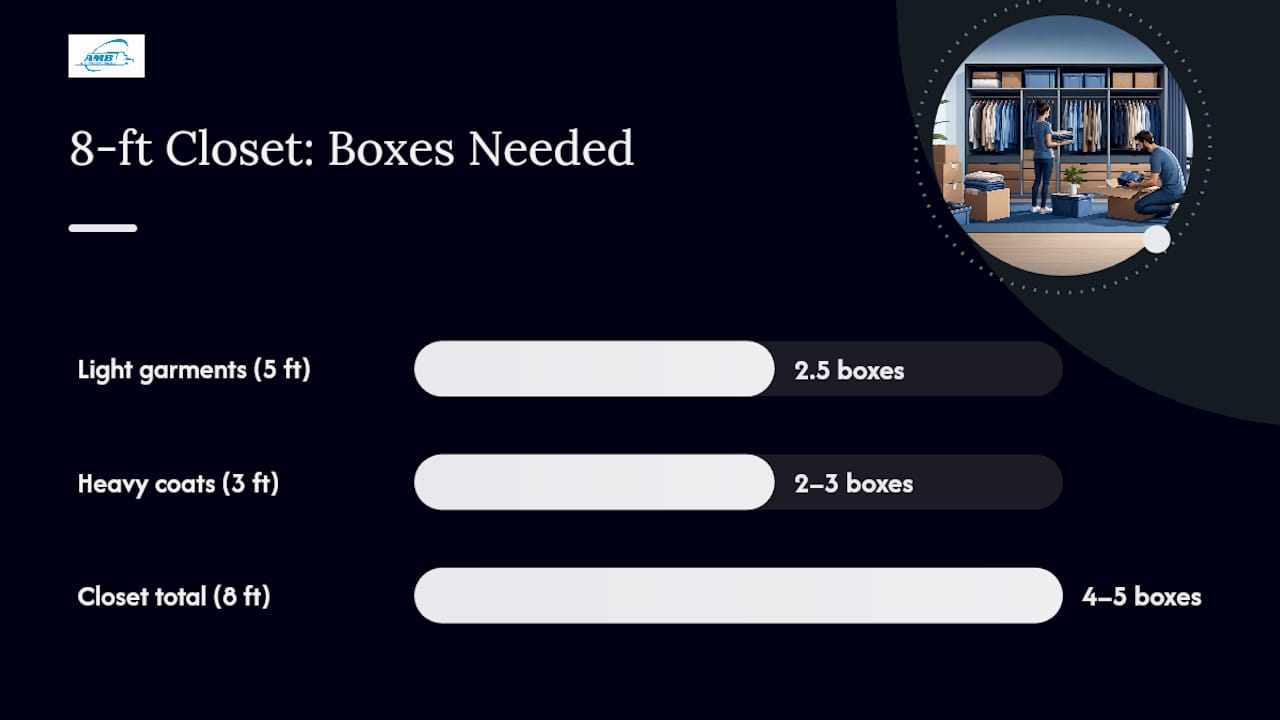
Here’s how that plays out in practice: a couple with an 8-foot closet rod split evenly between everyday clothes and a shared coat rack might measure 5 feet of light garments and 3 feet of heavy coats. That’s roughly 2.5 boxes for the light side and 2 to 3 for the coats, landing at 4 to 5 wardrobe boxes total for that one closet. A second bedroom closet or a mudroom coat rack gets counted separately using the same math.
Round up rather than down. An extra empty box costs far less than realizing on packing day that four shirts have nowhere to go and end up crushed into a suitcase corner.
How to Pack a Wardrobe Box Step by Step
Packing wardrobe boxes well is less about muscle and more about sequence. Skip a step and you either waste box space or risk a bottom blowout halfway through loading the truck.
- Declutter before you pack a single hanger. Pull anything you haven’t worn in a year, anything that doesn’t fit, and anything already destined for storage or donation. Every item you remove now is one you don’t pay to move.
- Sort by length and fabric type. Group long dresses and coats together, short items together, and set aside anything delicate enough to warrant a garment bag layer before it goes on the bar.
- Assemble the box with H-tape on the bottom. Fold the bottom flaps and run packing tape in an H pattern across the seams, not just a single strip down the center. This is the single most common failure point on heavy loads, according to Discount Moving’s packing walkthrough.
- Seat the metal bar and test it before loading anything. Clip the bar into both side slots, then push down on it with your hand. If it flexes or pops loose, reseat it. Finding this out with ten pounds of coats already hanging is a bad time to find it out.
- Transfer clothes in small batches. Carry 4 to 8 hangers at a time from the closet rod straight onto the box bar, keeping garments in the same order they hung in the closet. This avoids the wrinkling you’re trying to prevent in the first place and keeps outfits together for easier unpacking.
- Orient garments to use the full width. Alternate hanger hook directions slightly so shoulders don’t all pile against one side, which lets you fit more without crushing anything.
- Don’t overpack the bar. If you have to force the last few hangers on, that box is full. Start a second box rather than compressing the load, which defeats the entire purpose of using a wardrobe box.
- Use bottom space for light items only. Shoes, folded scarves, or a rolled belt can go beneath the hanging clothes, but nothing heavy or sharp, since it’s now supporting weight from above.
- Close and label clearly. Fold the top flaps, tape the top seam, and mark the box with the room and a short contents note. A three-layer labeling system that flags fragile or priority boxes saves real time on the unpacking end, especially across a multi-room house.
Pro Tip: Tape the front access flap closed with a single light strip rather than sealing it fully. That way, if you need to grab a jacket for the drive or check on a garment mid-move, you can peel back one strip instead of cutting into the box.
Once boxes are packed and sealed, treat them the same way you’d treat any high-value cargo for the rest of the move. For a fuller rundown on box strength and reinforcement across your whole shipment, AMB’s guide to best packing practices for long-distance moves covers the same principles for dishware, electronics, and furniture.
Loading and Transport Tips for Long-Distance Moves
A packed wardrobe box is heavier and more awkward than it looks, and that combination causes more truck-loading injuries and box failures than almost anything else in a residential move. A standard wardrobe box loaded with winter coats and boots can hit 60 to 70 pounds, which is right at the edge of what one person should lift alone.
By the numbers: Double-wall wardrobe boxes with a 44 to 48 ECT rating hold up significantly better under multi-day transit stress than standard single-wall retail boxes, per Discount Moving’s packing data, which matters most on moves crossing several states.
Keep these guidelines in mind once boxes are ready to load:
- Treat 60 to 70 pounds as your practical ceiling per box, and use a two-person lift above that weight rather than risking a dropped or torn box.
- Load wardrobe boxes upright against the truck’s side walls, never on their side or upside down, since the metal bar and hanger weight are designed to hang, not shift horizontally.
- Strap wardrobes in place rather than relying on other boxes to hold them upright. A shifted wardrobe box mid-transit can crush its own contents against the bar.
- Never stack heavy furniture or other boxes on top of a wardrobe box. The top isn’t built to bear weight, unlike a standard moving carton.
- Add a second strip of tape along the bottom seam and one around the middle for interstate hauls of more than a day, since vibration over hundreds of miles works tape loose that would hold fine on a short local move.
For storage stretches before or after the move, keep wardrobe boxes off concrete floors, ideally on a pallet or shelf, and skip airtight plastic wrapping, which traps humidity against fabric. A breathable cover and a dry, climate-controlled space prevent the mildew smell that ruins an otherwise perfect packing job. If your move includes a storage gap between homes, AMB’s guide on protecting belongings during a move covers humidity control and general cargo protection in more depth.
Where to Buy or Rent Wardrobe Boxes, and What They Cost
Cardboard wardrobe boxes generally vary in price depending on size and strength. Reusable plastic wardrobe rentals are available for weekly rates, often preferable if you plan to return them quickly. Prices vary by vendor and location per Discount Moving’s pricing breakdown.
- Moving supply stores and hardware chains carry wardrobe boxes individually, useful if you only need one or two and want to see the box before buying.
- Online moving kits bundle wardrobe boxes with a mix of small, medium, and large cartons, often at a lower per-box cost than buying each size separately, as with uBoxes’ wardrobe kit options.
Two practical notes worth acting on early. First, call ahead if you need tall or extra-tall boxes, since retailers frequently run short on the larger sizes right before peak moving weekends. Second, check the bar fit and handhold cutouts when you pick up or receive boxes; a bar that doesn’t seat firmly or handholds that tear under light pressure are signs of a low-quality box regardless of what the listing promised. Buying in a multipack, or borrowing a few from a friend who moved recently, is often the cheapest route if your closet needs are modest.
What AMB Moving & Storage Recommends for Wardrobe Packing
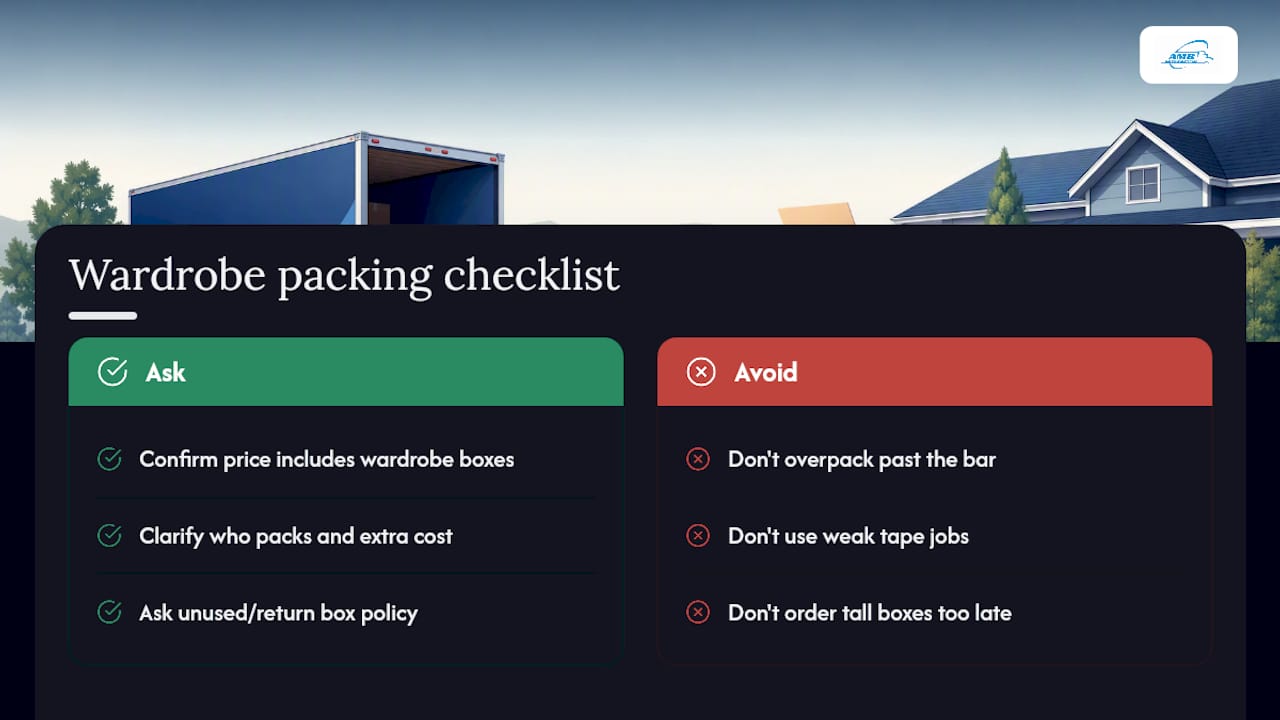
As a licensed and insured nationwide mover handling interstate relocations, AMB Moving & Storage sees the same wardrobe box mistakes on repeat: boxes overpacked past the bar’s capacity, tape jobs that fail somewhere in Ohio, and tall boxes ordered too late to arrive before the move date. Professional packing earns its cost most clearly on three kinds of moves: a wardrobe full of valuable or formal clothing, a timeline too tight to pack carefully yourself, or any move crossing multiple states where boxes sit loaded for several days.
Before hiring anyone to help with wardrobe boxes specifically, ask three questions. Does the price include wardrobe box supply, or do you need to buy your own? Who packs the boxes, the movers or you, and does that change the cost? And what happens to unused or returned boxes, since some movers charge for boxes not used and others don’t. A straight answer to all three tells you more about a company’s transparency than anything on its marketing page.
Our Take on Packing Wardrobe Boxes for a Long-Distance Move
Most packing advice treats wardrobe boxes as an afterthought, a nice-to-have you grab if the budget allows. That gets the priority backward for anyone with more than a handful of dress clothes. The math on wrinkles and re-ironing time makes wardrobe boxes one of the better dollar-for-dollar purchases in a move, right behind good tape and a dolly.
Where conventional advice actually falls short is board strength. Plenty of guides list sizes and stop there, without mentioning that a single-wall box holding 65 pounds of winter coats for three days in a truck behaves nothing like the same box sitting in a closet for an afternoon. Interstate moves punish weak cardboard in ways a local move never reveals until the box arrives with a blown-out bottom.
If you take one thing from this article, prioritize the ECT rating and the bar test over the size chart. Getting the height right matters, but a properly reinforced box that survives the trip matters more.
— AMB
Get Professional Help Packing Wardrobe Boxes for Your Move
Buying and packing your own wardrobe boxes works fine for a local move down the street. It gets riskier once your clothes are riding in a truck for two, three, or five days across state lines, where a weak seam or an overpacked bar has real time to fail. AMB Moving & Storage supplies wardrobe boxes as part of its professional packing services, and our crews load them the same way every time: upright, strapped, and never stacked under anything heavier.
That consistency matters most on the moves where wardrobe boxes matter most, corporate relocations, multi-state family moves, and anyone with formalwear or delicate fabrics that can’t afford a re-press on arrival. If your move includes long-distance moving, interstate transport, or full nationwide relocation logistics, our crews can supply, pack, and load your wardrobe boxes as part of the full job, so you’re not sourcing boxes and hoping the tall sizes are still in stock the week before your move. Get a free quote today, and if you’d rather handle packing yourself, just ask about ordering wardrobe boxes directly through your mover instead of a separate supply run.
Sources
- Everything You Need To Know About Wardrobe Boxes
- Wardrobe Boxes For Moving In 2025: Sizes, Costs, And Pro Tips – Discount Moving
- Wardrobe Moving Boxes Kit #4
FAQ
Are Wardrobe Moving Boxes Worth It?
Yes, especially for suits, dresses, coats, or any closet with more than a handful of hanging garments, since they prevent the wrinkling that costs hours of steaming after a move. They matter most on long-distance moves, where clothes sit packed for multiple days rather than hours.
How Do You Pack a Wardrobe Box?
Assemble the box with H-tape on the bottom, seat and test the metal hanging bar, then transfer clothes from the closet in batches of 4 to 8 hangers at a time. Fill the bottom with light items only, avoid overpacking the bar, and seal the top with a clear label noting the room and contents.
What Are the Best Wardrobe Box Sizes for Moving?
Standard boxes, roughly 40 to 48 inches tall, cover most shirts, pants, and mid-length dresses, while tall boxes at 50 to 60 inches handle gowns and full-length coats, according to ThisOldHouse. Measure your longest garment against the box’s hanging clearance, not its outer height, before choosing.
Does Home Depot Sell Wardrobe Boxes for Moving?
Cardboard wardrobe boxes in standard sizes are commonly available at hardware and home improvement retailers, though tall and extra-tall options may be limited near peak moving weekends. Calling ahead to confirm size and stock is worth the two minutes, particularly if your move date is set.
How Many Wardrobe Boxes Do I Need for My Move?
Plan on one box per two linear feet of hanging rod for a mixed closet, or one per one to one and a half linear feet for a closet heavy on coats and suits, based on Discount Moving’s practitioner ratios. Measure your rod length first, then round up rather than down to avoid running short on packing day.
Can AMB Moving & Storage Supply Wardrobe Boxes for My Move?
Yes, wardrobe boxes are supplied as part of AMB’s professional packing services for long-distance and interstate moves. Request a free quote to get exact pricing and confirm box supply for your specific move.