


Office moving cost typically runs from under $1,000 for a small local relocation to more than $30,000 for a large or interstate move, with $5,000 as a commonly cited average for a mid-size office. Where your move lands in that range depends on square footage, distance, building access, and how much IT equipment has to travel intact. The one rule that protects every budget is to set aside a contingency reserve to cover unexpected costs, because hidden costs almost always show up.
TL;DR:
- Office move costs vary greatly, from under $1,000 for small local moves to over $30,000 for large interstate relocations, depending on size and distance.
- Hidden expenses such as downtime, lease overlap, and IT infrastructure often add 30% to 50% to the initial estimate, outweighing trucking costs.
- Accurate quotes require detailed scope definitions, including inventory, access constraints, IT requirements, and insurance, to prevent costly change orders.
- Urban moves tend to cost more per square foot due to logistical challenges like elevator scheduling and building permits.
- Starting planning 60 to 90 days ahead for local moves and up to 18 months for interstate moves helps mitigate delays, costs, and service disruptions.
Table of Contents
- What Does an Office Move Cost by Size and Distance?
- What Line Items Make Up an Office Relocation Budget?
- What Hidden Costs Catch Businesses Off Guard?
- How Do You Get Accurate, Comparable Moving Quotes?
- When Should You Schedule Your Office Move?
- An Editorial Take: Where Office Moving Budgets Actually Go Wrong
- Get a Tailored Commercial Moving Quote
- Sources
What Does an Office Move Cost by Size and Distance?
Size and distance drive the two biggest swings in any office relocation budget, and once you know your category, the rest of the estimate gets much easier to pin down.
A small office, roughly 1,000 to 3,000 square feet or 10 to 25 workstations, generally runs $1,000 to $5,000 for a local move under 100 miles. A medium office, 3,000 to 10,000 square feet or 25 to 75 workstations, falls into the $5,000 to $15,000 range locally, climbing toward $20,000 once you add distance or complexity. Large offices above 10,000 square feet, or any move crossing state lines, regularly land at $15,000 to $30,000 or more, especially when server rooms, specialty equipment, or multiple floors enter the picture.
Distance matters as much as size. A move confined to one metro area avoids long-haul trucking, overnight crews, and multi-day scheduling. Cross the state line and you’re paying for mileage, potential overnight lodging for the crew, and a longer window where your equipment sits in transit. One industry pricing guide shows baseline local moves averaging $2,000 to $6,000, while premium relocations with added services push past $15,000.
Three scenarios show how this plays out:
- Small local move: 15-person marketing agency, 1,800 square feet, moving eight miles across town. Estimated total: $2,200 to $3,800, including basic packing.
- Medium interstate move: 60-person law firm relocating from Chicago to Indianapolis, including server room and file storage. Estimated total: $14,000 to $19,000.
- Large premium move: 200-person corporate headquarters moving within the same city but across three floors with a full IT overhaul. Estimated total: $22,000 to $28,000.
Urban moves often cost more per square foot than suburban ones. Downtown high-rises mean elevator scheduling, tighter loading dock windows, and sometimes street permits, all of which add labor hours even when the mileage is short.
What Line Items Make Up an Office Relocation Budget?
A commercial move budget isn’t one number. It’s a stack of line items, and missing one is the fastest way to blow past your estimate.
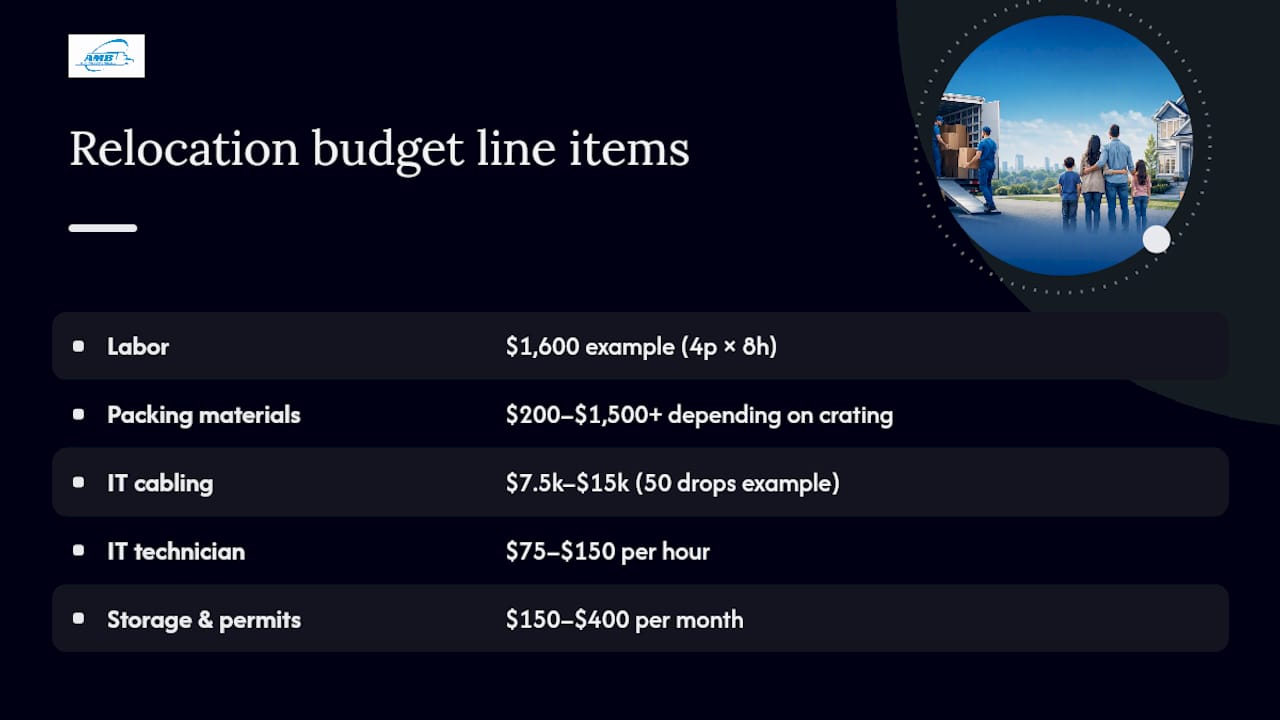
Labor is usually priced by the hour per crew member, with rates commonly falling between $40 and $75 per person per hour depending on your market and crew size. A four-person crew working eight hours at $50 per hour runs $1,600 before travel time or equipment rental. Add a second truck for a larger office and that figure roughly doubles.
Packing materials and specialty packing add another layer. Standard boxes and basic supplies might run $200 to $600 for a small office, but electronics, monitors, and glass-top furniture need custom crating that can push materials costs to $1,500 or more for a medium-size relocation.
IT and data infrastructure frequently outsizes the physical move itself. Network cabling alone runs roughly $150 to $300 per drop, meaning a 50-workstation office can face $7,500 to $15,000 in cabling costs before a single desk gets moved. Server relocations often require a dedicated IT technician, adding $75 to $150 per hour on top of the moving crew.
Insurance and valuation coverage varies by protection level. Released value coverage (the industry default) costs little but reimburses at a fraction of replacement cost.
Permits, elevator reservations, and storage round out the list. Building management often charges for reserved elevator time or after-hours loading dock access, and short-term storage typically runs $150 to $400 per month for a modest unit.
IT and cabling costs can rival or exceed the physical move cost itself when server rooms and new network drops are involved, according to one relocation cost analysis — treat it as its own budget line, not an afterthought.
Packing your own smaller items before the crew arrives can trim hours off the labor bill. Our office packing guide walks through what to box yourself versus what to leave for professionals.
What Hidden Costs Catch Businesses Off Guard?
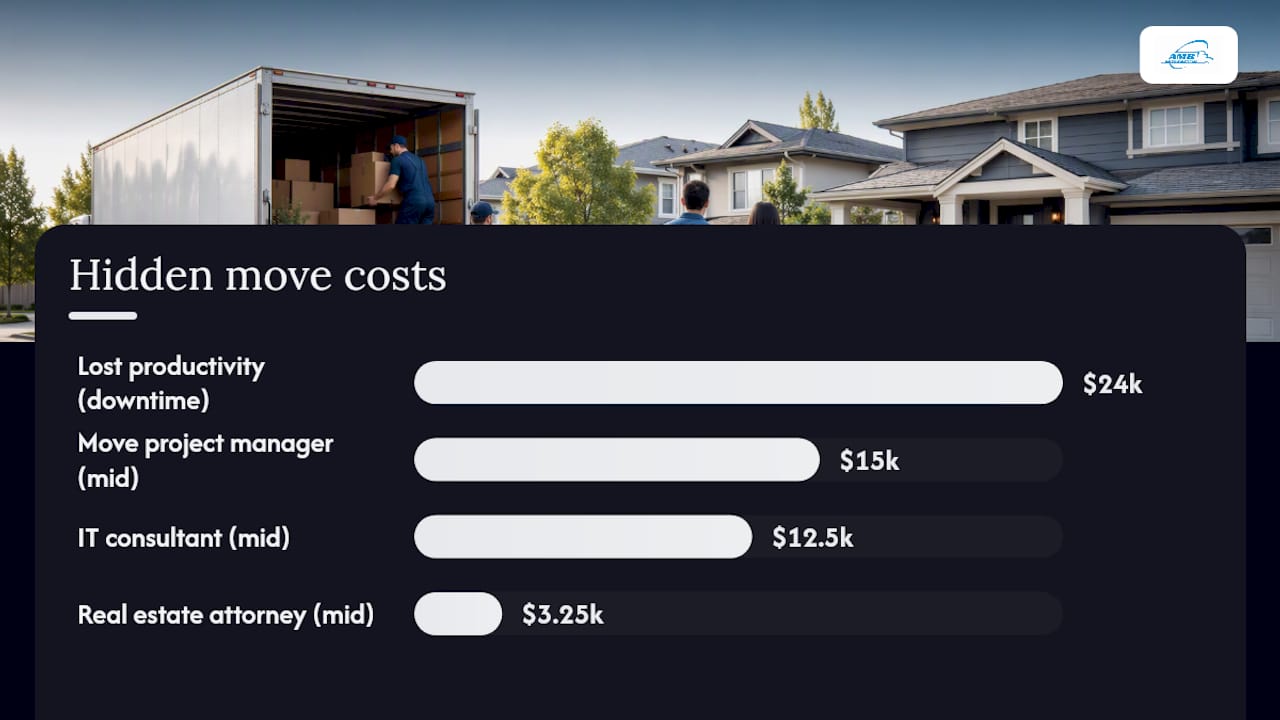
The invoice from your moving company is rarely the full cost of relocating. Hidden costs often add 30% to 50% on top of the initial estimate, and most of them come from disruption rather than the physical move.
Downtime is the biggest one. If your average employee generates $300 in daily revenue and the move causes two lost productive days across 40 staff, that’s $24,000 in lost output, often more than the move itself cost.
- Lease overlap between old and new space can result in paying rent on both locations simultaneously for a period of time.
- Make-good or restoration clauses may require patching walls, replacing carpet tiles, or removing cabling, sometimes costing several thousand dollars.
- Professional fees add up fast: a real estate attorney runs $1,500 to $5,000, an IT consultant $5,000 to $20,000, and a dedicated move project manager $5,000 to $25,000 for a complex relocation.
- Disposal and recycling fees for old furniture or e-waste can run several hundred dollars per truckload.
American Family Insurance points out that marketing updates, signage changes, and stationery reprints also chip away at the budget, and these rarely show up in a moving quote at all.
How Do You Get Accurate, Comparable Moving Quotes?
Bids only compare fairly when every vendor is pricing the exact same scope. Build a request for proposal (RFP) with these elements:
- Detailed inventory listing furniture, equipment, and specialty items by department.
- Access constraints, including elevator size, loading dock hours, and parking restrictions at both locations.
- IT scope, specifying whether the mover or a separate technician handles server disconnection and cabling.
- Move window, including whether it’s a weekend, overnight, or staged multi-day project.
- Insurance expectations, stating the valuation coverage level you require and asking for a certificate of insurance.
- Disposal needs for furniture or equipment you won’t be taking to the new space.
Ask every bidder the same questions about pricing model (hourly versus flat rate), surge charges for after-hours work, and what’s explicitly excluded from the quote. Score each bid on price, scope completeness, insurance terms, and references, not price alone.
Pro Tip: A quote that comes in well below the others usually means something got left out, not that you found a bargain. Ask what’s excluded before you sign anything.
Requiring identical scope information from each bidder is the only reliable way to catch these gaps before they become change orders.
When Should You Schedule Your Office Move?
Timing changes both your cost and how much your business feels the disruption. Start planning at least 60 to 90 days out for a small local move, and 12 to 18 months ahead for a complex interstate relocation, a lead time several relocation guides recommend for coordinating leases, IT, and vendors.
- Weekend and off-hours moves cost more in labor rates but preserve weekday productivity.
- Staged moves, relocating departments in phases, spread cost over time and reduce the days operations are fully offline.
- Pre-wiring the new space before moving day lets IT teams bring systems online faster.
- Confirm elevator reservations and loading dock windows with building management early. Delays here cascade into overtime labor charges.
Our business relocation timeline guide breaks down week-by-week planning for offices of any size.
An Editorial Take: Where Office Moving Budgets Actually Go Wrong
Most office moving budgets fail not because the mover’s quote was wrong, but because the quote was treated as the whole budget. IT, downtime, and lease overlap consistently outweigh the trucking bill, yet they’re the line items businesses estimate last, if at all.
AMB Moving & Storage Inc. operates as nationwide moving company, built around interstate and long-distance relocations, and that scale matters here: a company that routinely coordinates multi-state logistics tends to flag hidden scope, like elevator access or cabling timelines, before it becomes a surprise invoice. The site’s emphasis on licensing, insurance, and federal compliance reflects the operational discipline this kind of budgeting actually requires.
— AMB
Get a Tailored Commercial Moving Quote
You’ve seen where the costs hide. The next move is getting a quote that already accounts for them. AMB Moving Services approaches office relocations with the same commercial moving, packing, and storage capabilities that support its long-distance and interstate moving work nationwide, so IT scope, access constraints, and insurance terms get addressed upfront instead of surfacing as change orders mid-move.
A quote from AMB starts with your inventory and building access details, not a flat estimate pulled from square footage alone. That’s how hidden costs like elevator fees or specialty crating get priced in before moving day, not after. If you’re weighing interstate movers against a purely local option, or comparing cross country movers for a multi-state headquarters shift. Get the specifics in writing. Request a free, detailed quote for your commercial relocation and start your budget with real numbers instead of guesswork ranges.
Sources
- The Cost of Moving an Office: Your 2026 Guide
- Commercial Moving Company Cost and Pricing Guide 2026 | Official Site
- Hidden costs of relocating your business | American Family Insurance