


Tip $20 to $40 per mover for a local half-day job, $40 to $80 per mover for a full local day, and $50 to $100 per mover at each end of a long-distance move. That per-person, per-day math beats the old “10 to 20 percent of the bill” rule almost every time, especially on interstate moves where the bill is dominated by fuel, mileage, and truck costs rather than labor.
A few caveats before you grab your wallet:
- Cash still works best. It’s immediate, it’s simple to split, and no crew member has to wait on a payroll cycle to see it.
- Percentage-based tipping can badly overpay on a $6,000 cross-country move, since a chunk of that total has nothing to do with how hard the crew worked.
- Some moving companies restrict when cash tips can change hands because of how they interpret federal payment rules. Ask before moving day so nobody’s caught off guard.
Key Takeaways
Tipping movers fairly comes down to using per-person, per-day amounts rather than a flat percentage, and tipping each crew separately on long-distance moves.
| Point | Details |
|---|---|
| Use per-person ranges | Tip $20 to $40 per mover for a local half-day and $50 to $100 per mover per end on long-distance moves. |
| Avoid pure percentage math | Percent-of-bill tipping often overpays on long hauls where transport costs dominate the invoice. |
| Tip each crew separately | Origin and destination crews on interstate moves rarely overlap, so budget two tip pools, not one. |
| Cash wins on flexibility | Cash avoids payroll delays and company pooling policies that can complicate card or digital tips. |
| Adjust for real conditions | Stairs, bad weather, and tight parking justify adding $10 to $20 per mover to the baseline. |
Table of Contents
- How Much to Tip Movers: Calculating a Fair Amount
- Tipping Etiquette for Long-Distance Movers With Multiple Crews
- Cash, Card, or Digital: How to Actually Hand Over the Tip
- What Changes the Tip: Difficulty, Weather, and Service Quality
- Common Mistakes and Non-Cash Ways to Show Appreciation
- AMB’s Practitioner Tips for Interstate and Long-Distance Moves
- An Honest Take on Tipping Culture in the Moving Industry
- Sources
How Much to Tip Movers: Calculating a Fair Amount
There are three ways people typically calculate a tip, and picking the right one depends on the size and length of your move.
- Percentage of the total bill. Most guides suggest 10 to 20 percent. It’s easy math, but it breaks down fast on long hauls.
- Per hour, per mover. Roughly $4 to $15 per hour per crew member, scaled to the job’s difficulty.
- Per person, per day. A flat amount handed to each mover based on the length and toughness of the work, independent of what your invoice says.
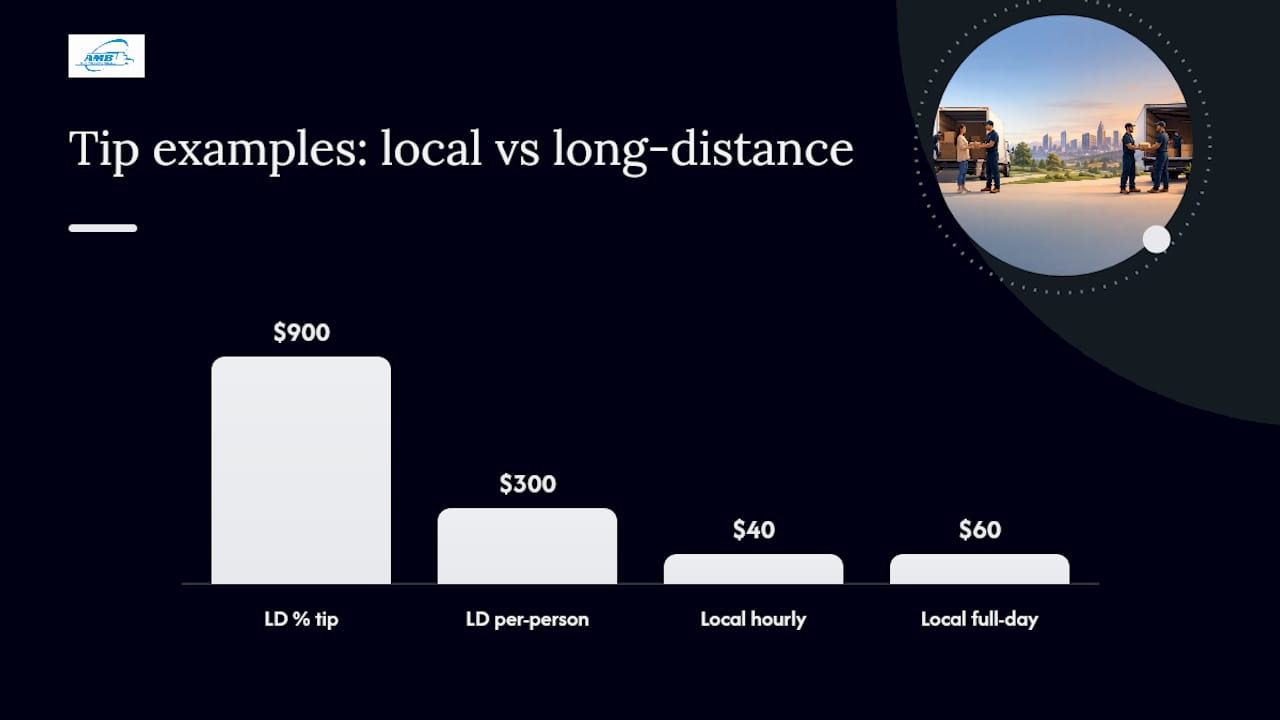
Here’s why the percentage method gets shaky on interstate jobs: a $6,000 cross-country move might include $4,500 in transport, fuel, and logistics costs that have nothing to do with the two guys carrying your dresser up three flights of stairs. Tip 15 percent of that bill and you’re handing over $900, which is generous for a crew that spent maybe six hours total on load and unload combined. Calculate per-person instead, and a $50-per-mover, per-end tip for a three-person crew lands at $300, a number that actually reflects the labor performed.
For a local move, the math is more forgiving. Picture a four-hour job with three movers hauling boxes and furniture out of a two-bedroom apartment. At $10 per hour per mover, that’s $40 each, landing comfortably inside the standard $40 to $80 full-day range once you account for setup and drive time. Pro Tip: Round up to the nearest $5 or $10 bill so you’re not fumbling for exact change while a truck idles in your driveway.

Whichever method you use, budget it as its own line item rather than an afterthought. AMB Moving Services builds tipping guidance into every moving cost estimate conversation so clients know what to set aside before the truck ever shows up.
Tipping Etiquette for Long-Distance Movers With Multiple Crews
Cross-country and interstate moves almost always involve two separate crews: one that loads your belongings at the origin, and a different one that unloads at the destination, sometimes days or weeks apart. Tip each crew separately. The origin team never sees what happens at delivery, and the destination team had nothing to do with how carefully your piano got wrapped in Ohio.
- Set aside $50 to $100 per mover for the loading crew and the same range again for the unloading crew.
- In rare cases where one crew drives the truck and handles both ends, a single combined tip works, but confirm this arrangement with your moving coordinator ahead of time.
- Keep two separate cash envelopes, one for each end, so you’re not scrambling to divide a single stack of bills between strangers on delivery day.
- If your move spans multiple days at either end, tip daily rather than saving everything for the final hour, since split shifts and rotating crew members are common on bigger jobs.
Budgeting two tip pools instead of one takes an extra five minutes during planning and saves you from realizing, mid-unload, that you handed all your cash to the wrong team three weeks earlier.
Cash, Card, or Digital: How to Actually Hand Over the Tip
Cash remains the gold standard because it’s instant and doesn’t depend on a company’s internal payroll process. Hand it directly to each mover when possible rather than routing everything through one person.
- Carry a mix of small bills ($10s and $20s) so you can tip individually without needing to make change.
- If you’d rather tip by card, ask your moving company whether gratuities get processed separately from the bill or whether they’re pooled and distributed later.
- Apps like Venmo or Zelle work in a pinch, but collecting phone numbers or handles from four or five movers on a busy day is rarely practical.
- If you hand a lump sum to the foreman, say out loud how you want it split. A quiet assumption that “he’ll figure it out” is how one guy ends up shorted.
Pro Tip: A small premium on top of the standard rate for the foreman is common practice, especially if that person coordinated the inventory list, handled a tricky staircase, or fielded your last-minute change of plans.
What Changes the Tip: Difficulty, Weather, and Service Quality
The baseline ranges assume a reasonably normal move. Plenty of jobs aren’t normal.
- Add $10 to $20 per mover when the crew deals with multiple flights of stairs, no working elevator, extreme heat or cold, or a piece of furniture that needs three people and a dolly just to clear a doorway.
- Tight or distant parking that forces a long carry from truck to door justifies bumping toward the top of your planned range.
- Extra stops, like a mid-route storage drop-off, are additional labor and deserve additional tip.
- Reduce or skip the tip only when there’s a legitimate reason: undocumented damage the crew refuses to acknowledge, unprofessional or unsafe behavior, or billing practices that feel deceptive. Address those problems through a formal claim, not by quietly shortchanging the crew that showed up and did the work.
- In higher cost-of-living metro areas, lean toward the top of the standard range rather than the bottom.
Common Mistakes and Non-Cash Ways to Show Appreciation
Don’t accept a mystery “gratuity” line item baked into your invoice without an explanation. That’s a billing question, not a tip, and it belongs in a dispute with the company or, if warranted, a complaint to your state’s regulator.
- Feeding the crew, water, snacks, or a pizza run at lunch, is genuinely appreciated but doesn’t replace a monetary tip.
- Under 49 CFR §375.401, some companies restrict tip collection until delivery because binding estimates limit what can be collected before the shipment arrives. If cash tipping seems off-limits mid-move, ask about approved card options.
- When cash truly isn’t an option, a detailed online review naming the crew and a referral to friends carry real value for movers building a reputation with their company.
AMB’s Practitioner Tips for Interstate and Long-Distance Moves
Ask your mover two questions before the truck loads: is the estimate binding, and when are tips typically accepted relative to the final invoice? Getting clear answers upfront avoids an awkward exchange at delivery.
- Plan for two separate tip envelopes on any long-distance job, one for the loading crew, one for the unloading crew, and treat them as fixed costs in your moving budget.
- Write down the first names of your crew members. It takes ten seconds and makes a review or a request for that same team next time far more specific and useful.
- If your household goods get loaded and unloaded by different teams days apart, don’t assume the second crew heard anything about how well the first one performed.
Pro Tip: Ask about card-tip options during your initial quote call, not on moving day, so you’re not stuck improvising in the driveway.
If you’re planning a state-to-state relocation and want a nationwide moving company that’s upfront about crew logistics, binding estimates, and how tipping fits into the process, AMB Moving Services can walk you through it before you book. Get a moving cost estimate and ask about tipping norms for your specific route while you’re at it.
An Honest Take on Tipping Culture in the Moving Industry
Most tipping advice online treats every move like a local weekend job with two guys and a rented truck. That’s not the reality of an interstate relocation, where your belongings pass through two crews, a warehouse transfer, and sometimes a multi-day transit window. The conventional “10 to 20 percent” rule was built for restaurant tabs, not 1,200-mile hauls, and applying it to a long-distance bill either shortchanges the crew or way overpays them relative to the actual labor involved.
What gets overlooked is the paperwork side. Binding estimates and federal payment rules genuinely do affect when and how tips can change hands, and readers who skip that conversation with their mover end up guessing on delivery day. The single best thing you can do is ask your moving company, at the quote stage, how tipping works with their contract and crew structure. Budget separate cash for origin and destination. Everything else, the exact dollar amount, the foreman premium, is secondary to getting that logistics question answered first.
— AMB