


Yes, you can move most houseplants across state lines. The safest method for any long-distance or interstate move is transporting them yourself in a climate-controlled passenger cabin. Your car gives you direct control over temperature, humidity, and handling — none of which a moving truck or shipping carrier can reliably match.
Before you load a single pot, though, there are three things that matter more than packing technique: deciding which plants are worth the effort, checking whether your destination state restricts certain species, and timing your pre-move care correctly. Skip any of those and even a perfectly packed plant can arrive stressed, quarantined, or confiscated.
The short version: Most houseplants can make a long-distance move successfully. Drive them in your car when possible. Check USDA APHIS and destination-state rules before you go. Inspect for pests two weeks out. Water one to two days before travel, not the morning of. Unpack promptly and quarantine newcomers for 2–4 weeks on arrival.
Quick TL;DR checklist:
- Triage your collection: keep rare, sentimental, or hard-to-replace plants; let go of common ones
- Check USDA APHIS plant permit requirements and your destination state’s rules
- Inspect and treat for pests at least two weeks before moving day
- Water to moist (not soggy) 24–48 hours before travel
- Secure pots upright in boxes or bins; fill voids with crumpled paper
- Keep plants in the passenger cabin, not the cargo hold or truck trailer
- Quarantine plants from your existing collection for 2–4 weeks after arrival
Key Takeaways
Moving plants across state lines is manageable for most collections when you check regulations early, prepare plants two weeks out, and keep them in a climate-controlled passenger cabin during transport.
| Point | Details |
|---|---|
| Drive plants yourself | A passenger cabin offers the best temperature and humidity control for any long-distance plant move. |
| Check APHIS and state rules | Use the National Plant Board summaries and USDA APHIS portal to verify destination-state restrictions before moving day. |
| Pre-move care timing | Inspect for pests two weeks out; water 24–48 hours before travel; avoid repotting within three weeks of the move. |
| Quarantine on arrival | Keep moved plants separate from your existing collection for 2–4 weeks and delay repotting and fertilizing. |
| Ambmovingservices for complex moves | For large collections, oversized specimens, or moves needing climate-controlled trucking and storage, Ambmovingservices offers interstate moving services built for exactly this. |
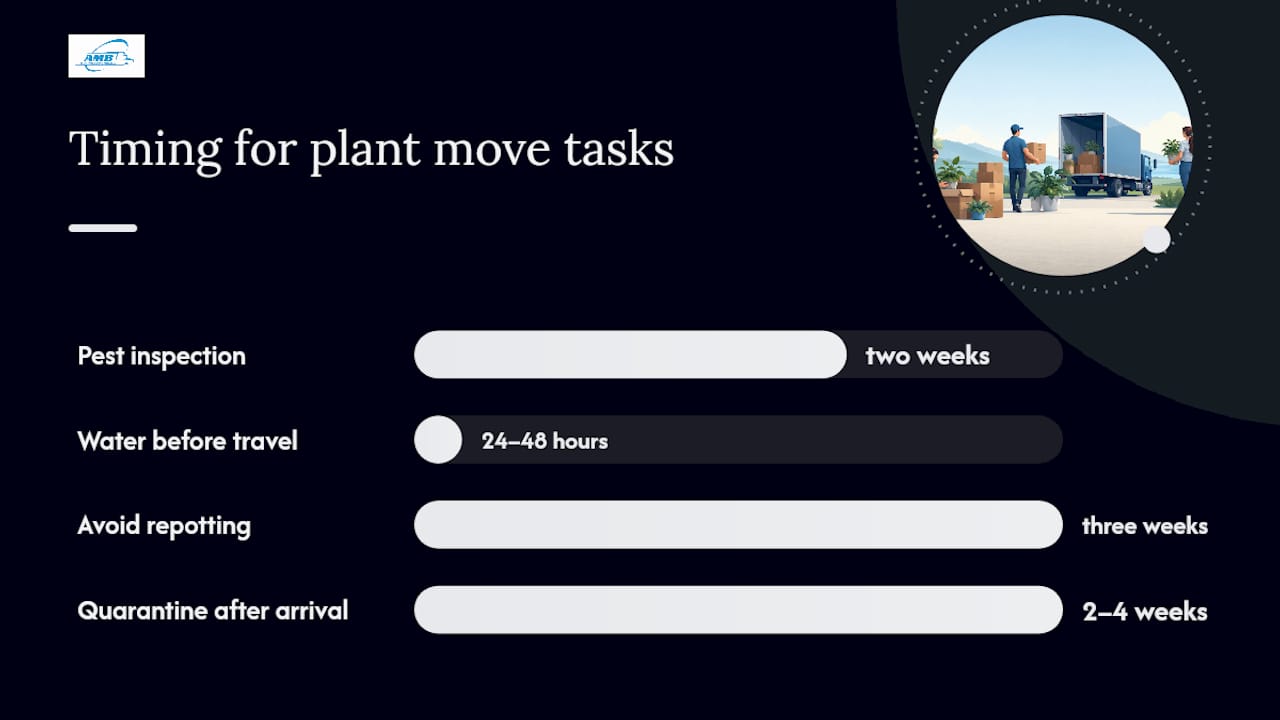
Table of Contents
- How to decide which plants are worth moving
- What regulations apply when you’re moving plants across state lines
- Which transport method works best for your plants?
- How to pack plants for a car or moving truck
- Flying with plants: what the rules actually say
- When and how to ship plants
- Pre-move plant care: a two-week timeline
- Unpacking and acclimating plants after the move
- Species-specific tips for common plant types
- Why driving your plants usually gives the best results
- When hiring professional movers is the right call for plant moves
- AMB Moving & Storage is built for interstate plant moves
- Sources
How to decide which plants are worth moving
Not every plant in your collection deserves a cross-country trip. The honest calculus is this: moving a plant costs time, packing materials, vehicle space, and sometimes legal paperwork. A $12 pothos from a big-box store is not worth any of that. A 15-year-old monstera your grandmother propagated is a different story.
Run each plant through these four questions before moving day:
- Can I replace it easily at the destination? Common houseplants (pothos, snake plants, spider plants, basic succulents) are available at garden centers nationwide. If you can buy a healthy specimen for under $20 within a week of arriving, let it go.
- Is it rare, sentimental, or irreplaceable? Heirloom cuttings, unusual cultivars, or plants you’ve grown for years from seed belong in the “keep” column regardless of size.
- Does my destination state restrict or prohibit it? Some states ban specific genera or require inspection certificates. Check before you pack.
- Is the climate at my destination compatible? The USDA Plant Hardiness Zone Map tells you whether a plant that thrives in your current zone will survive outdoors at the destination — relevant if you plan to move any porch or patio plants indoors permanently.
- How difficult is transport? A 6-foot fiddle-leaf fig in a heavy ceramic pot is a logistical challenge. A 4-inch cutting of the same plant is not.
Pro Tip: For large specimens you love but can’t realistically transport, take cuttings or rooted divisions instead of moving the whole plant. A 6-inch cutting of a monstera, a bird of paradise, or a rubber tree will root and grow into a full plant within a season — and it fits in a zip-lock bag.
Seasonal timing matters too. Plants in active growth handle transport stress better than those in dormancy or mid-bloom. If a plant is currently flowering, it will likely drop its blooms during the move regardless of how carefully you pack it. Factor that in when deciding whether the timing is right.
What regulations apply when you’re moving plants across state lines
This is the section most people skip, and it’s the one that can get your plants confiscated at a state border or quarantine station. Federal and state rules on transporting plants across state lines are real, enforced, and worth understanding before you load the car.
Who regulates interstate plant movement:
- USDA APHIS (Animal and Plant Health Inspection Service) governs the federal framework for moving regulated plant pests, biological control organisms, and associated plant material across state lines under 7 CFR Part 330.
- State departments of agriculture enforce their own rules, which can be stricter than federal minimums. California, Florida, Hawaii, and Arizona are among the most active at border inspections.
- The National Plant Board coordinates state plant regulatory agencies and publishes state-by-state summaries of plant shipment rules — the fastest way to check your destination state’s specific requirements.
When permits are required:
Under 7 CFR § 330.201, formal APHIS permits are required for the interstate movement of regulated plant pests, biological control organisms, and associated articles. The permit types include import, interstate movement, transit, and continued curation permits. Applications must be submitted in writing or electronically in advance, and APHIS may require site assessments or impose conditions on approval.
For most common houseplants, you are not moving a regulated pest — you’re moving a plant. But if your plant is infested, if it’s a species on a restricted list, or if it’s in native or backyard soil rather than commercial potting mix, the picture changes.
Key regulatory fact: Not every plant movement requires a permit. Under 7 CFR § 330.204, APHIS maintains an exceptions list of plant pests that may move interstate without permits. The agency also runs a petition process to add or remove taxa from that list. Check the exceptions list before assuming you need formal paperwork.
Practical steps before you move:
- Visit the National Plant Board’s state law summaries and look up your destination state
- Check your destination state’s department of agriculture website for any restricted species lists or soil import bans
- Inspect every plant for pests and treat any infestations before packing (more on this in the pre-move care section)
- Use only commercial potting mix, never backyard or garden soil. Extension and university guidance consistently flag native soil as the primary trigger for inspection refusals at state borders — it can carry pests, pathogens, and invasive species that commercial mix does not
- If you’re moving to Hawaii, Puerto Rico, or any U.S. territory, the rules are significantly stricter. Declare all plants on arrival and expect inspection
- If a permit may apply to your situation, submit your application through USDA APHIS’s permit portal well in advance of your move date
Which transport method works best for your plants?
The right choice depends on your collection size, move distance, and how much climate control you can guarantee. Here’s how the four main options compare:
| Method | Best for | Climate control | Carrier restrictions | Cost |
|---|---|---|---|---|
| Drive yourself (passenger cabin) | Any collection size, any distance | Excellent — you control it | None | Fuel only |
| Professional movers | Large household moves; plants as secondary cargo | Varies; many interstate carriers decline plants | Many interstate movers refuse plants | Included in move cost |
| Fly (carry-on or checked) | Small collections, urgent long-distance hops | Moderate (cabin) / Poor (cargo hold) | Airline-specific; always call ahead | Baggage fees |
| Ship (USPS, UPS, freight, specialty shippers) | Single specimens, oversized plants, when driving isn’t possible | Poor to moderate | Carrier rules vary; soil often restricted | Moderate to high |
The consensus from plant movers and long-distance moving guides: driving your plants in a personal vehicle is the best balance of cost, control, and survival rate for most private collections. The passenger cabin maintains a stable temperature and humidity that no truck trailer or cargo hold can replicate consistently.
Moving companies and interstate plant transport: Many interstate movers decline to transport live plants for long-distance moves. The reasons are practical: plants are perishable, they can harbor pests that create liability under state regulations, and standard moving trucks are not climate-controlled in the way a passenger cabin is. If a mover does agree to take your plants, ask specifically whether the truck is climate-controlled, whether plants are covered under the liability policy, and what happens if a plant dies in transit. Most standard moving contracts exclude plants from coverage.
Flying with plants works well for small collections — a few cuttings, a compact succulent, or a single orchid. TSA allows plants in both carry-on and checked baggage for domestic flights, but airline size and containment rules vary. Always call the airline before you travel. For routes into Hawaii or U.S. territories, declare all plants and expect agricultural inspection on arrival.
Shipping is the option of last resort for most houseplants. Carriers like USPS and UPS have restrictions on soil and regulated plant materials. Transit times can expose plants to temperature extremes, and there’s no way to monitor conditions in a box. Use it for specimens you genuinely cannot transport yourself, and verify carrier rules and any APHIS or state requirements before booking.
How to pack plants for a car or moving truck
Packing for a car move and packing for a climate-controlled truck follow the same logic: keep the plant upright, stabilize the soil, protect the foliage, and manage temperature. The difference is that your car gives you real-time control; a truck requires more preparation upfront.
Pre-move preparation (days before packing)
- Prune only dead or damaged material. Healthy leaves and stems should stay. Fresh cuts are open wounds during transport.
- Treat any pest issues. A plant with spider mites or fungus gnats should not travel until treated. Pests spread to other plants in a confined space.
- Pause fertilizing 1–2 weeks before the move. Fertilizer pushes new growth, which is more fragile and stress-prone during transport.
- Water one to two days before travel. Soil should be moist but not soggy. Wet soil is heavy, can shift, and invites mold in a closed box. Dry soil cracks and pulls away from roots.
Packing materials you’ll need
- Plastic nursery pots (lighter than ceramic; switch heavy pots before the move)
- Cardboard collars or stretch wrap to stabilize soil surface
- Cardboard boxes or plastic bins sized to hold pots snugly
- Crumpled newspaper or packing paper to fill voids around pots
- Breathable plant sleeves or paper cones to protect foliage
- Painter’s tape for labeling
- Insulated boxes or moving blankets for cold-weather moves
Pro Tip: Slip each pot into a plastic bag secured around the base of the stem with a rubber band. This contains any soil that shifts during the drive without suffocating the plant.
Loading and placement
- Place plants in the passenger cabin whenever possible. The back seat or footwells are ideal — stable, climate-controlled, and visible.
- For a moving truck, insist on a climate-controlled unit. Load plants last so they come off first, and never stack anything on top of them.
- Label every box clearly: LIVE PLANTS and THIS SIDE UP on at least two sides.
- Secure tall plants with soft stakes or foam tubing to prevent stems from snapping during turns or sudden stops.
- Maintain moderate temperatures throughout the drive, avoiding extremes of heat and cold. Avoid parking in direct sun with plants inside.
For more on best packing practices for long-distance moves, including materials and sequencing for fragile items, AMB’s packing guide covers the full process.
Flying with plants: what the rules actually say
Flying with plants is more straightforward than most people expect — at least for domestic routes. TSA does not prohibit plants in carry-on or checked baggage. The complications come from airline-specific size rules, destination state agricultural requirements, and international entry regulations.
Steps for flying with plants
- Call the airline before you book. Ask specifically: Are live plants allowed in carry-on? What are the size and containment requirements? Is there a policy on soil?
- Consider bare-rooting for carry-on travel. Remove the plant from its pot, shake off as much soil as possible, wrap the roots in damp paper towels, and seal in a plastic bag. This reduces weight, eliminates soil-related inspection issues, and fits more plants into carry-on space.
- Pack for the overhead bin. Use a rigid container or a well-padded box that fits airline carry-on dimensions. Wrap foliage loosely in paper to prevent bruising.
- For checked baggage, use a ventilated box, secure the pot so it can’t tip, and mark the box LIVE PLANTS. Checked cargo holds are not climate-controlled on all aircraft, so this method carries more risk for tropical plants sensitive to cold.
- Declare all plants on arrival when flying into Hawaii, Puerto Rico, Guam, or any U.S. territory. Agricultural inspectors will examine them, and restricted species may be confiscated.
What to confirm before flying:
- Destination state’s agricultural restrictions (check the National Plant Board summaries)
- Airline’s specific policy on live plants and soil
- Whether your plant species appears on any restricted or prohibited list for the destination
- For international arrivals into the U.S., USDA APHIS permit requirements apply — check the APHIS permits portal for your specific situation
When and how to ship plants
Shipping is the right call in specific situations: you’re moving a single large specimen you can’t fit in your car, you’re sending a plant ahead to arrive before you do, or you’re dealing with an oversized or high-value plant that warrants a specialized shipper. For most collections, it’s not the first choice.
Before you book any carrier:
- Verify that the carrier accepts live plants and soil. Many carriers restrict or prohibit soil outright, and some won’t accept live plant material at all
- Check APHIS and destination-state rules for the specific species you’re shipping
- Confirm transit time. A 5-day ground shipment in July can kill most tropical plants through heat exposure alone
Packaging checklist for shipped plants:
- Use a sturdy double-walled cardboard box sized to the plant with 2–3 inches of clearance on all sides
- Secure the pot so it cannot tip. Wrap the base in crumpled paper or foam and wedge it firmly
- Stabilize the soil surface with cardboard collars or stretch wrap to prevent displacement
- Wrap foliage loosely in paper or breathable plant sleeves
- Add ventilation holes on the sides of the box (not the top or bottom)
- Mark the box LIVE PLANTS, THIS SIDE UP, and PERISHABLE on all four sides
- Include a moisture source (damp paper towel in a sealed bag near the roots) for shipments over 48 hours
When to hire a specialized plant shipper or freight service:
- The specimen is oversized (a 7-foot palm, a mature bonsai, a large-format tree)
- The plant has significant monetary value and you want documented handling
- The shipment requires APHIS permits or state inspection certificates
- You need temperature-controlled freight for tropical specimens in winter
Specialized plant shippers handle permits, packaging, and carrier coordination. For high-value specimens, the cost is usually worth it.
Pre-move plant care: a two-week timeline
The two weeks before a move are when most plant problems start. Over-watering, last-minute repotting, and skipped pest checks are the three most common mistakes. Here’s the timeline that avoids all three.
| Timeframe | Task | Why it matters |
|---|---|---|
| 2 weeks before | Inspect every plant for pests; treat any infestations | Pests spread in transit; treated plants need time to recover |
| 2 weeks before | Reduce or stop fertilizing | New growth is fragile under transport stress |
| 2 weeks before | Take cuttings of sentimental plants you can’t move | Insurance against loss; cuttings travel in a zip-lock bag |
| 24–48 hours before | Water to moist, not wet | Wet soil is heavy and mold-prone in a closed box |
| 24–48 hours before | Secure soil with cardboard collars or stretch wrap | Prevents displacement during loading and driving |
| 24–48 hours before | Move plants to a stable indoor environment | Avoids temperature shock before the move |
| Moving day | Final pest check on all plants | Last chance to catch hitchhikers before they enter a new state |
| Moving day | Stake tall plants; label all boxes | Prevents stem damage and ensures correct handling |
| Moving day | Set vehicle temperature before loading | Plants should enter a pre-conditioned environment |
The most important rule from University of Illinois Extension guidance: avoid stacking interventions. Don’t repot, prune heavily, fertilize, and move a plant in the same week. Each action is a stressor. Do one thing at a time and give the plant time to respond before adding another variable.
- If a plant needs repotting, do it at least three weeks before the move, not the week of.
- If a plant has a pest problem, treat it and wait for the treatment to work before packing.
- If a plant is in bloom, accept that it will likely drop flowers during the move and plan accordingly.
Unpacking and acclimating plants after the move
The first 14 days after arrival are when plants either recover or decline. The instinct to immediately repot, fertilize, and rearrange is understandable — resist it. University of Illinois Extension recommends single-step corrections and observation rather than stacking interventions post-move.
- Unpack within a few hours of arrival. Plants left in boxes overnight lose light and air circulation. Even a dim corner is better than a sealed box.
- Match the light level to where the plant lived before. A plant from a bright south-facing window should not go into a dark corner on day one. Start close to the original light level and adjust gradually over 1–2 weeks.
- Quarantine all moved plants from your existing collection for 2–4 weeks. Even a plant that looks healthy can carry pests that weren’t visible during inspection. A separate room or isolated shelf is enough.
- Don’t repot immediately. Repotting is a significant stressor. Wait at least 2–3 weeks, ideally until the plant shows signs of active growth.
- Delay fertilizing for 1–3 weeks. The root system needs to settle before it can process nutrients effectively.
- Increase humidity for tropicals. A humidifier, pebble tray with water, or grouping plants together helps replicate the moisture levels most tropical houseplants prefer.
- Water based on soil and leaf signals, not a schedule. Check the soil before watering. Wilting, yellowing, or leaf drop in the first week is usually stress-related, not a watering problem.
Pro Tip: Place a sticky yellow insect trap near your quarantined plants for the first two weeks. It catches fungus gnats, whiteflies, and other pests before they establish in your new home.
Watch for these stress signals in the first two weeks: yellowing lower leaves (normal stress response), leaf drop (common in figs and tropicals), wilting despite moist soil (root stress), and new pest activity. Most plants stabilize within 2–4 weeks if the light, temperature, and watering are consistent.
Species-specific tips for common plant types
Different plant groups have different vulnerabilities during a move. Here’s what actually matters by category:
Succulents and cacti
- Tolerate short temperature swings better than most houseplants, which makes them good candidates for shipping
- Water sparingly before the move — they prefer dry conditions during transport
- Wrap cactus spines in newspaper or foam before packing; loose spines in a box damage other plants and your hands
- Use shallow, lightweight containers; heavy ceramic pots add unnecessary weight
Orchids and epiphytes
- Prefer aerated packaging — avoid sealing them in airtight containers
- Bark-based potting media is less prone to shifting than soil; secure the pot but don’t compress the media
- Stable humidity matters more than temperature precision for most orchids
- Avoid disturbing the root system; orchid roots are sensitive and slow to recover from damage
Large-leaf tropicals (monsteras, fiddle-leaf figs, bird of paradise)
- Protect leaves with paper cones or breathable sleeves; a single crease in a large leaf becomes a brown scar
- Stake tall stems before transport; a stem that snaps at the base is usually unrecoverable
- These plants drop leaves readily under stress — that’s normal, not fatal
- Never stack anything on top of or against large leaves
Bonsai and potted trees
- Heavy, structurally complex, and highly sensitive to root disturbance
- If the specimen has significant value, consider hauling it yourself in the passenger seat rather than in any cargo space
- Secure the pot in a rigid container with foam padding on all sides
- Avoid any root pruning or repotting within 6 weeks of the move
Why driving your plants usually gives the best results
The micro-climate inside a passenger cabin is genuinely different from what any shipping or trucking option provides. Temperature in a car cabin can be maintained within a 10-degree range throughout a multi-day drive. Humidity stays relatively stable. You can respond in real time to a plant that’s wilting or a pot that’s tipped.
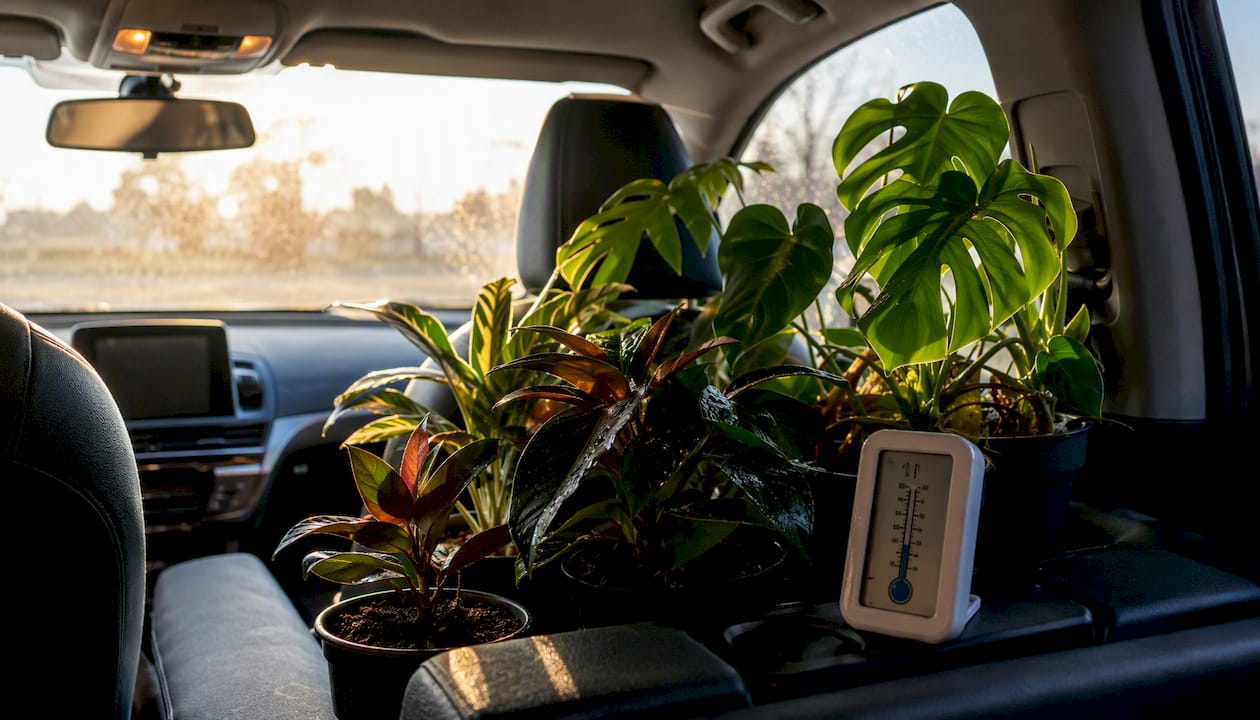
Truck trailers, cargo holds, and shipping boxes offer none of that. Temperature in an uninsulated truck trailer can swing 40°F or more between a sunny afternoon and a cold night. A sealed shipping box traps heat in summer and loses it in winter. Neither environment is forgiving for tropical plants or anything with active growth.
Common failure modes during transport and how to prevent them:
- Soil displacement: Secure the soil surface with cardboard collars or stretch wrap before loading. Fill voids in the box with crumpled paper so the pot can’t shift.
- Pest transfer: Inspect every plant before it goes into the vehicle. One infested plant in a closed car can spread mites or gnats to the entire collection within hours.
- Heat exposure: Never leave plants in a parked car in direct sun. Cabin temperatures can exceed 120°F within 20 minutes on a summer day.
- Cold exposure: In winter, pre-warm the car before loading. Use insulated boxes or wrap pots in moving blankets for plants sensitive to temperatures below 50°F.
- Foliage damage: Use paper cones or breathable sleeves on large-leaf plants. Leaves that are compressed or folded during transport develop permanent damage.
Pro Tip: For winter moves, UMass Extension recommends pre-warming insulated boxes before loading plants into them. A cold box pulled from a garage will chill roots even in a warm car. Bring the box inside for an hour before packing.
The reason many professional moving companies decline interstate plant loads isn’t arbitrary. Plants are perishable, they can harbor regulated pests, and standard moving contracts exclude them from liability. When a mover does accept plants, it’s typically for local moves in climate-controlled vehicles, not multi-day cross-country hauls. For long-distance moving that involves plants, the practical answer for most people is: drive the plants yourself and let the movers handle everything else.
When hiring professional movers is the right call for plant moves
Most people can handle a small to medium plant collection in their own vehicle. But there are situations where professional help is the smarter choice, and being honest about those scenarios saves time, stress, and plant losses.
Situations where a professional mover makes sense:
A very large collection — dozens of pots, oversized specimens, or plants in heavy ceramic containers — is difficult to manage safely in a personal vehicle alongside everything else you’re transporting. If you’re also moving furniture, boxes, and household goods, splitting the load makes sense. A professional nationwide moving company can handle the household goods while you focus on the plants in your car.
Oversized specimens (a 10-foot palm, a mature olive tree, a large-format bonsai) require equipment and handling expertise that most people don’t have. These plants also often require permits or inspection certificates for interstate movement, which a professional mover with experience in specialty moves can help coordinate.
If your move involves a gap between leaving your current home and arriving at the new one, plants may need short-term storage. Standard storage units are not climate-controlled for live plants, so this requires planning. Ask your mover specifically about climate-controlled storage options.
Questions to ask any mover before booking:
- Do you transport live plants for interstate moves?
- Is the truck climate-controlled throughout the journey?
- Are plants covered under your liability policy, or are they excluded?
- Do you have experience with specialty or fragile items that require permits?
- Can you accommodate a request to load plants last and unload them first?
Ambmovingservices offers packing services for fragile and specialty items, climate-controlled options for long-distance moves, and secure storage for situations where timing gaps require it. The practical advice: call early, be specific about what you’re moving, and ask the plant questions directly rather than assuming the standard contract covers them.
AMB Moving & Storage is built for interstate plant moves

Moving plants across state lines adds a layer of complexity that most moving companies aren’t equipped to handle. Ambmovingservices specializes in exactly the kind of long-distance and interstate moves where that complexity shows up: multi-day hauls, multi-state logistics, and moves where fragile or specialty items need careful handling from the start.
For plant owners, that means climate-controlled trucking options, professional packing for valuable specimens, and a team that understands the permit and documentation questions that come with transporting plants across state lines. If your collection includes oversized specimens or plants that require inspection certificates, Ambmovingservices can help coordinate the logistics so nothing gets left behind or confiscated at a state border.
The next step is straightforward: request a moving quote and mention your plants specifically when you do. Ask about climate-controlled options, packing services for fragile items, and whether your destination state has any requirements the team has encountered before. The earlier you call, the more options you have.
Sources
These are the primary sources to consult for permits, state-specific rules, and species guidance. Each one covers a different layer of the regulatory and practical picture.
- 7 CFR § 330.201 – Permits for plant pests, biological control organisms, and associated articles.
- USDA APHIS—Plant permits (permits index).
- USDA Plant Hardiness Zone Map / ARS
- National Plant Board — state law & regulation summaries
- Tips for moving houseplants indoors and overwinter care — University of Illinois Extension
State departments of agriculture publish their own restricted species lists and inspection requirements separately from the National Plant Board summaries. Search “[destination state] department of agriculture plant import rules” to find the primary source for your specific move. University extension offices in your destination state are also worth contacting for species-specific acclimation advice, particularly for plants moving into significantly different climate zones.
This article is general information, not a substitute for advice from a qualified lawyer. Consult a qualified legal professional about your own circumstances before acting on anything here.