


TL;DR:
- Planning your move early and decluttering beforehand reduces costs and stress significantly.
- Verifying USDOT registration and obtaining at least three binding estimates is essential before booking.
A stress-free moving workflow comes down to one principle: start planning early well in advance, cut your volume before you book, hire a licensed interstate mover with a written binding estimate, pack by priority, and execute moving day with assigned roles. Everything else is detail.
TL;DR — Your six phases:
- Plan: Lock your move date and build a master checklist this week
- Cut volume: Declutter room by room before you book so you pay to move less
- Book movers: Verify USDOT/FMCSA, get at least three written binding estimates
- Pack strategically: Label by room and fragility; build your essentials box last
- Move day: Assign roles, verify the bill of lading, carry valuables yourself
- Unpack essentials: Beds, bathrooms, and kitchen first — everything else within seven days
Start right now:
- Pick your move date and block 2–3 hours this week to build a master checklist in Google Sheets, Notion, or a printed template
- Look up any mover you’re considering on the FMCSA USDOT lookup before you call them
- Designate one box as your “essentials box” and start filling it with documents, chargers, and medications
AMB Moving & Storage Inc. is a licensed, insured nationwide mover that specializes in long-distance and interstate relocations across the United States. Every move they handle comes with written estimates, valuation coverage options, and a dedicated point of contact.
Table of Contents
- What does a stress-free moving workflow actually look like week by week?
- How do you declutter and build an inventory before a long-distance move?
- How do you choose and vet a long-distance or interstate moving company?
- What’s the most efficient packing strategy for a long-distance move?
- How do you run moving day without things going sideways?
- When and how should you handle utilities and change of address?
- What should you unpack first in a new home?
- What drives moving costs, and how do you keep them down?
- How do you stay calm and focused during a move?
- When does hiring professional interstate movers make more sense than DIY?
- Is your vehicle ready for a long-distance drive to your new home?
- Key Takeaways
- What most people get wrong about making a move less stressful
- AMB Moving & Storage Inc. handles the complexity so you don’t have to
- Useful resources for planning an interstate move
What does a stress-free moving workflow actually look like week by week?
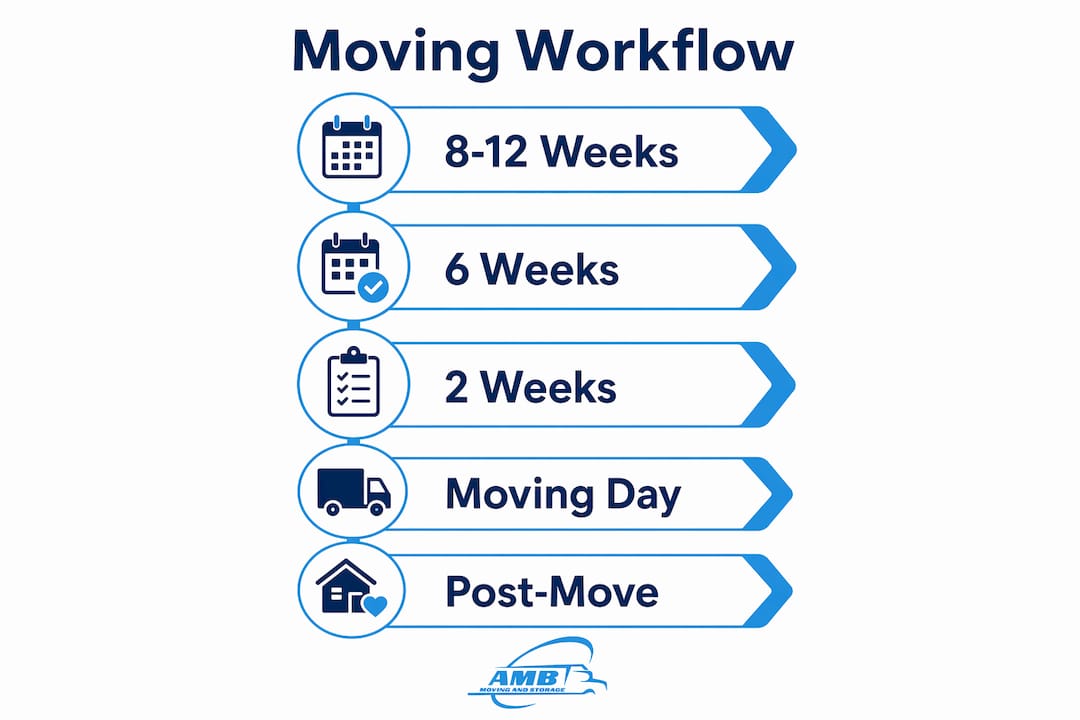
Starting 8–12 weeks before your move gives you enough runway to declutter, compare movers, and avoid the premium pricing that hits anyone who books late. Here’s how the phases break down.

Phase timeline table
| Timeframe | Key tasks | Owner | Priority |
|---|---|---|---|
| 8–12 weeks out | Set move date; research and contact 3+ movers; begin decluttering | You | Critical |
| 6–8 weeks out | Book mover; get written binding estimates; start packing non-essentials | You + Mover | Critical |
| 4–6 weeks out | Notify utilities; file USPS change of address; arrange school/DMV transfers | You | High |
| 2–4 weeks out | Confirm mover logistics; finish packing all but daily essentials | You + Mover | High |
| 1 week out | Confirm delivery window; pack essentials box; arrange parking/elevator | You + Mover | High |
| Moving day | Final walkthrough; verify bill of lading; carry valuables yourself | You + Crew | Critical |
| Days 1–2 after | Unpack essentials box; set up beds, bathrooms, basic kitchen | You | High |
| Days 3–7 after | Unpack high-use zones; confirm utilities active; update DMV/insurance | You | Medium |
A phased checklist like this converts what feels like a wall of tasks into a sequence. Each week has a clear owner and a clear finish line.
Master checklist summary
Copy these into your planner or a checklist app:
- Confirm move date and sign lease/closing documents
- Research movers: verify USDOT, read reviews, request in-home or video estimates
- Book mover and get written binding estimate with delivery window
- Declutter and donate/sell items you won’t move
- File USPS mail forwarding (do this at least 2 weeks before move)
- Notify electric, gas, internet, and water providers (7–14 days notice)
- Update address with bank, IRS, DMV, insurance, and subscriptions
- Pack non-essentials; label every box with room, contents, and fragility
- Confirm parking permits and elevator reservations at origin and destination
- Build essentials box; keep it accessible on moving day
- Carry all important documents and valuables in your personal vehicle
- Contingency items: Save a backup mover’s contact number; note alternate move dates in case of severe weather; keep a 3-day essentials stash in your car
Pro Tip: Use a cross-country moving checklist tool that adapts to your origin, destination, and move type. Personalized checklists catch state-specific DMV and tax deadlines that generic lists miss.
How do you declutter and build an inventory before a long-distance move?
Decluttering before you book is one of the highest-leverage moves you can make. Long-distance charges are weight-based, so reducing shipment volume directly cuts your bill. Do this before you get estimates so the quotes reflect your actual load.
Room-by-room process
Work one room at a time with four physical piles: keep, sell, donate, discard. Assign a time window to each room (kitchen: 2 hours; bedroom: 1 hour; garage: 3 hours) so it doesn’t bleed into your whole weekend. Tackle the garage and storage areas first — they hold the most forgotten volume.
- Sell: Facebook Marketplace, OfferUp, and local consignment shops move furniture fast
- Donate: Many charities offer free furniture pickup; keep donation receipts for tax deductions
- Discard: Hazardous materials (paint, propane, chemicals) cannot travel on moving trucks — dispose of them locally
Inventory approach
Photograph every room before you pack. For electronics, photograph the back-panel cable setup so reassembly at the destination takes minutes instead of an hour of guesswork. Log high-value items (serial numbers, estimated values) in a spreadsheet or an app like Sortly. This documentation is your first line of defense if a damage claim becomes necessary.

Pro Tip: Declutter at least 6 weeks before your move date. Getting estimates after you’ve cut volume means the quote reflects reality — not a padded number based on a full house.
How do you choose and vet a long-distance or interstate moving company?
Vetting a mover properly takes about two hours and can save you thousands of dollars and significant stress. The single most important step: verify the USDOT number on the FMCSA’s SAFER database before you sign anything.
USDOT and licensing verification
Every legitimate interstate carrier has a USDOT number registered with the FMCSA. Brokers are different — they arrange moves but don’t operate trucks. Know which one you’re talking to, because brokers can hand your shipment to a carrier you’ve never vetted. Search the company name and USDOT number at safer.fmcsa.dot.gov and confirm their operating authority is “active.”
Estimate comparison table
| Estimate type | What it means | When to use it |
|---|---|---|
| Binding estimate | Price is fixed; mover cannot charge more | Always request this for long-distance |
| Non-binding estimate | Final price can exceed the quote | Avoid for interstate moves |
| In-home/video survey | Mover sees your actual inventory | Required for accurate binding estimates |
| Phone-only quote | Based on your verbal description only | Reject — too much room for error |
Insist on in-home or video-survey estimates and get at least three. Compare not just the base price but the delivery window, valuation coverage options, included services (packing, disassembly, storage), and the claims process.
Red flags to watch for
- No USDOT number or an inactive FMCSA registration
- Refuses to do an in-home or video estimate
- Demands full payment upfront before the move
- Vague or unlimited delivery window (“2–21 days”)
- Quote is dramatically lower than all competitors
Ask every mover these questions during the survey: “What valuation coverage options do you offer, and what is the claims window?” “Who are the crew members — your employees or subcontractors?” “What is your process if my items are damaged in transit?” A mover who answers these clearly and specifically is worth a second look. One who deflects or gives vague answers is not.
What’s the most efficient packing strategy for a long-distance move?
Packing is where most moves lose time and money. A repeatable system — same method, same labeling, every room — means you spend less time searching for things at the destination and less time arguing with movers about what’s fragile.
Supplies checklist
- Small boxes (books, tools, heavy items)
- Medium boxes (kitchen, toys, general household)
- Large boxes (linens, pillows, lightweight bulky items)
- Heavy-duty packing tape and dispenser
- Bubble wrap and packing paper
- Furniture blankets and stretch wrap
- Permanent markers (multiple colors for color-coding)
- Pre-printed or handwritten labels
- Basic toolkit (screwdrivers, Allen keys) for disassembly
Packing cadence
Pack non-essentials first: off-season clothes, books, decorative items, extra linens. Work toward daily-use items in the final week. Small boxes for heavy items (books in small boxes only — large boxes of books break and injure movers). Large boxes for pillows and comforters.
Labeling system: Write the destination room, a brief content summary, and a fragility level (FRAGILE / HEAVY / STANDARD) on at least two sides of every box. Add a color-coded dot or number that matches your master inventory spreadsheet. This lets movers place boxes in the right room without asking you 40 times.
Essentials box checklist
This box rides in your car, not the truck:
- 3–7 days of clothing per person
- Toiletries and medications
- Phone, laptop, and all chargers
- Important documents (passports, leases, insurance, medical records)
- Basic kitchen items (coffee maker, one pot, utensils, paper plates)
- Pet food, leash, and carrier
- Kids’ comfort items and a few toys
Pro Tip: Photograph electronics setups before you unplug anything. A 10-second photo of the back of your TV stand saves 45 minutes of cable confusion at the destination.
For fragile items: wrap each piece individually in packing paper, add a bubble wrap layer, and never fill a box to the point where the lid doesn’t close flat. For very fragile or high-value pieces, double-box — one box inside a larger one with padding between them. Check the residential moving checklist for a room-by-room packing breakdown.
How do you run moving day without things going sideways?
Moving day is an operations problem. The more you pre-assign, the less you improvise under pressure.
Role assignments
| Role | Person | Key responsibilities |
|---|---|---|
| Crew supervisor | You or a trusted adult | Greets movers, confirms crew IDs, supervises loading order |
| Kids/pets coordinator | Partner or family member | Keeps children and pets away from loading zones |
| Parking/elevator manager | You or a neighbor | Holds parking spots, coordinates elevator reservations |
| Document handler | You | Manages bill of lading, payment, keys, meter readings |
Moving day checklist
- Confirm crew arrival time the night before
- Get the foreman’s name upon arrival; confirm crew identity and do not sign blank documents
- Walk through every room with the foreman before loading begins
- Verify your inventory list against items being loaded
- Review the bill of lading carefully — get a signed copy before the truck leaves
- Note utility meter readings at origin
- Do a final walkthrough of every room, closet, and cabinet after loading
- Carry valuables and important documents in your personal vehicle
Common pitfalls and how to avoid them
Blocked parking is the most common delay. Reserve a parking zone with your building or city permit office at least a week out. Elevator reservations at high-rise buildings often require 48–72 hours notice — call the building manager, not just the front desk. If the crew includes subcontractors you weren’t told about, ask for their identification and confirm with the mover’s dispatch before loading begins.
If a mover presents last-minute fees not on your binding estimate, stop the process. Ask for the charge in writing, reference your binding estimate, and call the company’s main office before signing anything. A legitimate mover will have a clear explanation; a fraudulent one will pressure you to pay before unloading.
When and how should you handle utilities and change of address?
Utility timing is the most commonly botched part of a move. Schedule disconnections and reconnections to overlap by one day at both locations — this prevents a night without power or internet at either end.
Utility timing
- Electric and gas: Contact providers 7–14 days before your move date
- Internet/cable: Schedule disconnect at origin and install at destination simultaneously; ISPs often need 5–10 business days for a new install
- Water: Notify your municipality or landlord at least 7 days out
- Overlap strategy: Set disconnect at origin for the day after your move; set connect at destination for the day before you arrive
Change-of-address checklist
- USPS mail forwarding (file at usps.com — takes effect within 3–5 business days; forwarding lasts up to 12 months)
- Bank accounts and credit cards
- DMV (required in most states within 30–60 days of an interstate move)
- IRS (file Form 8822 or update via your next tax return)
- Health, auto, and homeowner’s/renter’s insurance
- Employer HR and payroll
- Subscriptions: streaming, magazines, meal kits, Amazon, and any auto-ship services
- Voter registration (varies by state; most allow online updates)
Pro Tip: Create a single cloud folder (Google Drive or Dropbox) labeled “Move Admin.” Drop every confirmation number, installer window, and contract PDF into it. When something goes wrong — and something usually does — you’ll have everything in one place instead of hunting through emails.
USPS mail forwarding covers a 12-month window, giving you time to update addresses without missing critical mail. Check tips to minimize downtime for a utility-transfer timeline you can adapt to your specific move.
What should you unpack first in a new home?
The first 48 hours set the tone for how settled you feel. Prioritize function over organization — you can arrange the living room later, but you need to sleep and shower tonight.
Two-day priority list
- Essentials box first — locate it before the truck is even unloaded
- Beds: Set up bed frames and put on sheets before anything else goes into bedrooms
- Bathrooms: Hang shower curtain, put out towels, set up toiletries
- Basic kitchen: Coffee maker, one pot, utensils, and enough plates for the household
Seven-day settle plan
- Days 1–2: Essentials only (above)
- Days 3–4: Unpack kitchen fully; set up living room basics; confirm all utilities are active
- Days 5–6: Unpack bedrooms; schedule appliance installations (washer/dryer, dishwasher)
- Day 7: Post-move admin — update DMV registration if you’ve crossed state lines, register kids in school, update insurance policies with new address, do a neighborhood safety walkthrough
Layout tip: Before moving day, sketch a rough furniture placement plan for each room using photos of the space (from your walkthrough or listing photos). Share it with the movers so they place heavy furniture once, not twice.
Immediate post-move admin checklist:
- Update auto and homeowner’s/renter’s insurance with new address
- Register vehicles with the new state DMV (deadline varies; typically 30–60 days)
- Enroll children in local schools
- Locate nearest hospital, urgent care, and pharmacy
- Introduce yourself to neighbors and note any HOA rules
What drives moving costs, and how do you keep them down?
Long-distance moving costs are driven by a handful of variables. Understanding them before you get quotes puts you in a much stronger negotiating position.
Main cost drivers
- Weight and volume: The heavier and bulkier your shipment, the higher the base rate
- Distance: Longer hauls cost more; fuel surcharges often apply above certain mileage thresholds
- Service level: Full-service (packing, loading, unloading, unpacking) costs more than load-only
- Seasonality: Peak seasons (summer and year-end) can raise rates noticeably; booking early mitigates those increases
- Access fees: Elevator fees, long-carry charges, and stair fees add up fast in urban buildings
- Storage: Short-term storage between move-out and move-in adds a daily or monthly rate
Savings strategies
- Declutter aggressively before getting estimates — every pound you cut saves money
- Book on a weekday or mid-month; demand (and rates) peak on weekends and at month-end
- Pack non-fragile items yourself; pay the mover only for specialty packing
- Get at least three binding estimates and compare total cost, not just the headline number
- Use storage strategically if your move-in date doesn’t align with move-out — short-term storage is often cheaper than a rushed double-move
Budgeting tip: Add a 10–15% contingency fund on top of your binding estimate. Unexpected charges — a last-minute storage day, a parking permit, or a replacement item — are common enough that planning for them is just good math.
How do you stay calm and focused during a move?
Moving consistently ranks among the most stressful life events. The physical and mental load is real, and ignoring it makes everything slower and more error-prone.
Practical tactics
Schedule micro-breaks. Work in two-hour packing blocks with a 15-minute break built in. Set a timer. When it goes off, stop — walk outside, drink water, eat something. Continuous packing without breaks produces diminishing returns after about 90 minutes.
Sleep hygiene matters more than you think. The week before a move is not the time to stay up until 2 AM packing. A tired decision-maker makes expensive mistakes. Aim for 7 hours minimum and pack during daylight hours.
Delegate single task owners. Assign one person to utilities, one to school transfers, one to address updates. When everyone owns everything, nothing gets done. When one person owns one task, it gets done.
Meal planning for moving week: Pre-cook or order meals for the 3 days before and 2 days after the move. Cooking is the first thing to disappear under moving pressure, and hunger accelerates stress.
Pro Tip: Between packing sessions, try a 2-minute breathing reset: inhale for 4 counts, hold for 4, exhale for 6. It sounds small, but it interrupts the cortisol spiral that makes a misplaced box feel like a catastrophe.
Check 12 proven ways to simplify your move for additional time-saving tactics that reduce the cognitive load during moving week.
When does hiring professional interstate movers make more sense than DIY?
The honest answer: for most long-distance moves over 500 miles, professional movers save money when you account for your time, the risk of damage, and the physical toll of a cross-country haul.
Professional vs. DIY vs. hybrid comparison
| Factor | Full-service professional | DIY (truck rental) | Hybrid (you pack, pros move) |
|---|---|---|---|
| Upfront cost | Highest | Lowest | Middle |
| Physical effort | Minimal | Very high | Moderate |
| Risk of damage | Low (insured) | High (your liability) | Low to moderate |
| Time required | Low | Very high | Moderate |
| Admin burden | Low (mover handles logistics) | High (all on you) | Moderate |
| Best for | Large volume, long distance, specialty items, tight timelines | Short distance, small load, flexible schedule | Budget-conscious; comfortable packing but not lifting |
Full-service interstate movers make the most sense when your household is large, your timeline is tight, you have specialty items (piano, art, antiques), or you simply cannot afford the physical risk of a DIY long haul. The moving coordinator role — a single point of contact who manages logistics from booking through delivery — is one of the clearest advantages of hiring a professional mover for a complex interstate move.
AMB Moving & Storage Inc. handles nationwide moving with licensed and insured crews, written binding estimates, and packing and storage options built into the service. For specialty moves — senior relocations, military, government — they have dedicated processes that a DIY approach simply can’t replicate.
Is your vehicle ready for a long-distance drive to your new home?
If you’re driving your own car to the destination rather than shipping it, a pre-trip vehicle check is non-negotiable. A breakdown mid-move adds cost and stress you don’t need.
Long-distance vehicle preparation checklist
- Oil and fluids: Check engine oil, coolant, brake fluid, transmission fluid, and windshield washer fluid; top off or change as needed
- Tires: Check pressure (including the spare) and tread depth; rotate if due
- Brakes: Have pads and rotors inspected if you haven’t in the past 12 months
- Battery: Test the battery, especially if it’s more than 3 years old
- Lights: Confirm all headlights, brake lights, and turn signals work
- Wipers: Replace blades if they streak or skip
- Emergency kit: Pack jumper cables, a flashlight, a basic toolkit, a first-aid kit, and a reflective triangle
- Navigation: Download offline maps for your route in case of dead zones
- Fuel: Plan fuel stops in advance for remote stretches; don’t let the tank drop below a quarter
- Documents: Keep registration, insurance card, and roadside assistance info in the glove box
For moves where shipping the vehicle makes more sense than driving it, long-distance vehicle transport is a practical alternative that removes the wear and driver fatigue from the equation entirely.
Key Takeaways
A stress-free moving workflow requires starting 8–12 weeks early, cutting shipment volume before booking, verifying USDOT licensing, securing written binding estimates, and executing moving day with pre-assigned roles and a packed essentials box.
| Point | Details |
|---|---|
| Start 8–12 weeks early | Early planning prevents last-minute cost spikes and gives time to declutter and compare movers. |
| Cut volume before booking | Decluttering before estimates reduces weight-based charges and speeds unpacking at the destination. |
| Verify USDOT and get binding estimates | Check FMCSA registration and get at least three written binding estimates; reject phone-only quotes. |
| Pack essentials separately | An essentials box in your personal vehicle keeps critical items accessible regardless of delivery timing. |
| Ambmovingservices for interstate moves | AMB Moving & Storage Inc. provides licensed, insured nationwide service with written estimates and dedicated coordination. |
What most people get wrong about making a move less stressful
The conventional advice is to “stay organized.” That’s true but incomplete. The real problem most people face isn’t disorganization — it’s that they underestimate how many decisions a move requires and try to make all of them in real time.
The moves that go smoothly share one structural feature: decisions were made in advance and written down. Which room gets unpacked first. Who handles the movers. Where the essentials box goes in the car. When that structure exists, moving day becomes execution, not improvisation.
There’s also a tendency to treat professional movers as a luxury rather than a risk-management tool. For a long-distance move, the question isn’t whether you can physically do it yourself — it’s whether the time, physical risk, and liability exposure of DIY are worth the savings. For most households moving across state lines, they aren’t.
One habit AMB recommends to every customer: designate a single point of contact for all mover communications and keep a shared digital checklist that every household member can see and update. It eliminates the “I thought you called them” problem and keeps everyone working from the same information.
AMB Moving & Storage Inc. handles the complexity so you don’t have to
Planning a long-distance or interstate move is manageable when you have the right team behind it. Ambmovingservices offers licensed, insured nationwide moving services with written binding estimates, dedicated move coordinators, professional packing, and secure short- and long-term storage — all under one roof.
What AMB brings to your move:
- USDOT-licensed and FMCSA-registered interstate carrier
- Written binding estimates based on in-home or video survey
- Full-service packing, specialty-item handling, and furniture disassembly
- Secure storage options for moves with gap days between move-out and move-in
- A single point of contact from booking through delivery
To get a fast, accurate quote, have your move date, approximate inventory size, and origin and destination zip codes ready. AMB typically schedules a binding in-home or video estimate within a few business days, and the written proposal follows shortly after. Request your moving quote and get a clear number before you commit to anything.
Useful resources for planning an interstate move
Use these official and high-authority resources at the stages noted:
- FMCSA SAFER database (safer.fmcsa.dot.gov) — Use at the booking stage to verify any mover’s USDOT number and operating authority. An active status is non-negotiable for interstate carriers.
- USPS Change of Address (usps.com/move) — File at least 2 weeks before your move date. Forwarding activates within 3–5 business days and runs for up to 12 months.
- State DMV websites — Each state sets its own deadline for updating vehicle registration and driver’s license after an interstate move; most require action within 30–60 days of establishing residency.
- IRS Form 8822 (irs.gov) — File to update your address with the IRS separately from your tax return, especially if you move between filing seasons.
- AMB Moving & Storage Inc. (ambmovingservices.com) — For binding estimates, interstate logistics, packing, and storage coordination.
Documentation habit: Save every confirmation number, contract, and installer window in a dedicated cloud folder. If a damage claim or billing dispute arises, your documentation is the difference between a resolved claim and a prolonged one. Keep photos of your inventory, your bill of lading, and your binding estimate until at least 90 days after delivery.