
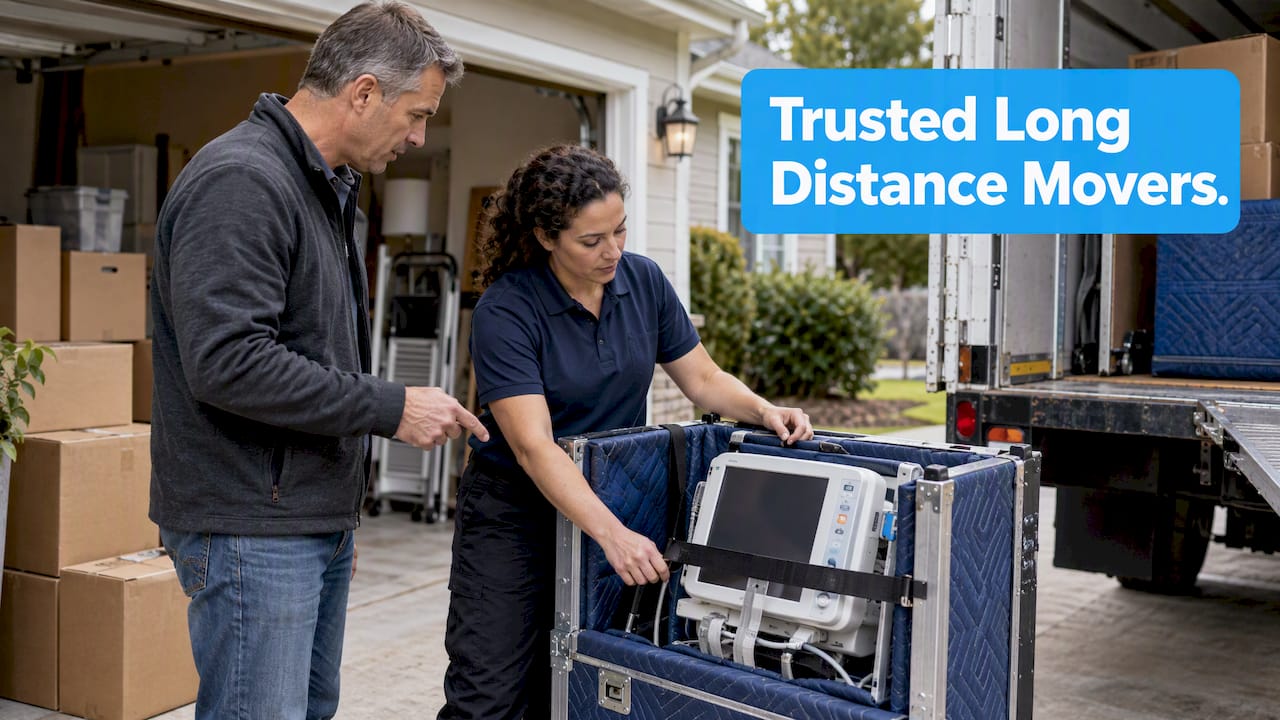

Hire a licensed, insured medical equipment mover for sensitive devices: a specialized crew handles decontamination, HIPAA and ePHI steps, custom crating, and rigging while keeping clinical downtime to a minimum. The right next step is simple: schedule an onsite survey or a virtual scoping call so a mover can quote the job against your actual equipment list and timeline.
TL;DR:
- Equipment that may have contacted blood must be decontaminated before shipment; if that is not feasible, facilities must label it and document the method.
- Before reuse, covered entities must clear, purge, degauss, or destroy media containing electronic protected health information, and assign sanitization responsibility in writing.
- Released value and declared value coverage can produce sharply different payouts, so review bill of lading terms and itemized insurance limits before signing.
- After hours scheduling, phased department moves, or replacement equipment staged in advance can keep patient care running while crews reinstall, recalibrate, and test devices.
Table of Contents
- What Specialized Medical Equipment Moving Services Include
- Types of Equipment and Their Special Handling Needs
- Regulatory and Safety Musts in the U.S.
- Planning Timeline, Downtime Reduction, and Cost Drivers
- Packing, Crating, and Transport Methods That Protect High-Value Items
- How to Choose the Right Mover: Checklist and Questions to Ask
- Why a licensed and insured nationwide moving company is positioned for interstate medical equipment moves
- What Most Moving Advice Gets Wrong About Medical Equipment
- Get a Scoped Site Survey and Quote From AMB
- FAQ
- Sources
What Specialized Medical Equipment Moving Services Include
A mover built for healthcare clients does more than load a truck. The scope should cover the full chain from first walkthrough to final sign-off, with every handoff documented so biomedical staff and facility managers know exactly where their equipment is at any hour.
A properly scoped engagement typically includes:
- An onsite survey that tags each item, builds an asset inventory, and sets a chain-of-custody record before anything moves.
- Coordination with your biomedical engineers and IT staff for technical disconnect and reconnect windows.
- Custom crating, padded transport, and rigging for oversized or sensitive components.
- Secure staging or short-term storage when a move happens in phases.
- Documentation at each stage, from pickup condition notes to delivery sign-off.
Confirming these line items upfront keeps every quote comparable and prevents gaps between what the facility assumes is included and what the mover actually delivers.
Types of Equipment and Their Special Handling Needs
Not every device in a clinic or lab needs the same treatment, and matching handling to equipment class is where most moving plans succeed or fail.
- Imaging equipment such as MRI, CT, and X-ray systems carry significant weight and, for MRI units, magnet and superconducting constraints that require staged disassembly and manufacturer-approved rigging.
- Laboratory analyzers and sterile equipment are vibration-sensitive and need contamination controls that match the facility’s own decontamination procedures.
- Life-support equipment and patient monitors often store or transmit electronic protected health information, which means software and hardware reconnection steps need to be planned with IT before the truck arrives.
- Equipment age, calibration status, and general fragility all affect how a piece is crated and how much buffer time is built into the reinstallation schedule.
Grouping your inventory by these categories before the survey gives the mover a clearer starting point and usually tightens the quote.
Regulatory and Safety Musts in the U.S.
Moving medical equipment across state lines is not just logistics. Two federal frameworks shape what a compliant move actually looks like, and both carry real documentation requirements.
Under the OSHA Bloodborne Pathogens standard, equipment that may have contacted blood or other potentially infectious material must be examined and decontaminated before it is serviced or shipped. When complete decontamination is not feasible, OSHA requires the item to be labeled and the method documented in the employer’s exposure control plan. Properly labeled equipment can still be shipped if exposure is minimized through correct packaging and trained handling.
Equipment that cannot be fully decontaminated must be labeled, and the employer’s exposure control plan must document the method used.
OSHA’s bloodborne pathogens rule ties shipping eligibility directly to decontamination and labeling, not just visual cleanliness. Confirming decontamination responsibility in writing before the move avoids disputes about who signed off on an exposure control plan update.
On the data side, HHS guidance requires covered entities to remove electronic protected health information from media before reuse, or to destroy the media outright, using methods such as clearing, purging, degaussing, or physical destruction. NIST SP 800-88 is the practical federal reference HHS points to for these sanitization steps. Before the move, get in writing who performs decontamination, who handles ePHI sanitization, and who is authorized to transport labeled items.
Planning Timeline, Downtime Reduction, and Cost Drivers
A medical equipment move generally runs through five phases, and skipping or compressing any one of them tends to show up later as damage, downtime, or a billing dispute.
- Survey: the mover walks the site, builds the inventory, and confirms access points, elevator size, and loading dock constraints.
- Prep and decontamination: facility staff and mover coordinate on cleaning, labeling, and exposure control documentation.
- Disassembly and crating: technicians stage components and build custom crates for anything fragile or oversized.
- Transport: equipment travels under controlled conditions, often air-ride, to the destination site.
- Reassembly and testing: devices are reinstalled, recalibrated, and verified operational before the crew leaves.
To limit disruption to patient care, many facilities schedule moves after hours, split the relocation into phases by department, or pre-stage replacement equipment so testing can run in parallel with the move itself.
Cost typically depends on equipment weight and size, distance traveled, the amount of custom crating and rigging required, and any elevator, stair, or long-carry charges at either address. Declared value and the insurance level you select also factor into the total. Ask for an itemized estimate and read the bill-of-lading liability terms closely before signing, since those terms determine what you can recover if something goes wrong in transit.
Packing, Crating, and Transport Methods That Protect High-Value Items
The physical handling methods matter as much as the paperwork. Magnetics and heavy imaging components generally call for museum-style custom crating, built to the dimensions and weight distribution of the specific unit rather than a generic box. Electronics, including lab analyzers and monitors, benefit from air-ride trailers and padded transport that control vibration, moisture, and temperature swings over long distances.
- Request shock and tilt sensors plus sealed tags on crates carrying your most expensive or hardest-to-replace equipment.
- Ask for a documented chain-of-custody log that travels with the shipment, not just a delivery receipt at the end.
- Use custom crating rather than released-value packing for anything irreplaceable, since standard coverage rarely matches true replacement cost.
- Confirm secure staging or short-term storage options if your project moves in phases rather than all at once.
Pro Tip: Ask the mover to photograph each crate’s exterior and interior before sealing, so condition at origin is on record if a claim ever comes up.
How to Choose the Right Mover: Checklist and Questions to Ask
Vetting a mover for medical equipment takes more than comparing two quotes side by side. Use this checklist during the selection process:
- Verify active interstate carrier registration, licensing, and insurance limits before requesting a quote.
- Confirm whether the bill of lading offers released value or declared value coverage, and understand the difference in payout if equipment is damaged.
- Ask for references tied to hospital, clinic, or lab moves similar in scale to yours.
- Confirm in writing who performs decontamination and ePHI sanitization, and request their written standard operating procedures.
- Request an itemized scope covering timeline, installation and testing steps, and the claims process if something is damaged.
Carrier liability disputes over MRI and imaging equipment have reached federal court, including Essex Ins. Co. v. Barrett Moving & Storage, where Carmack Amendment liability and bill-of-lading terms shaped the outcome. Asking about these terms before you sign is the single most useful question on this list.
Why a licensed and insured nationwide moving company is positioned for interstate medical equipment moves
A licensed, insured nationwide mover with a focus on interstate and long-distance relocations is the exact combination a multi-state equipment move requires. Service pages often lay out specifics facility managers typically need to plan around:
- Our packing services page covers specialty packing approaches relevant to sensitive equipment.
- Our long-distance moving page details cross-country capabilities and planning steps.
- Our commercial and office moving page addresses business relocation logistics, including staging and scheduling.
- Our IT relocation checklist walks through network and device handoff planning that applies directly to ePHI-connected equipment.
Onsite surveys, commercial relocation experience, and secure storage solutions are generally available for facilities that need to move equipment in stages rather than all at once.
What Most Moving Advice Gets Wrong About Medical Equipment
Most guidance on this topic treats medical equipment moves as a packing problem, when the real risk sits in the handoffs: between facility staff and movers, between decontamination and transport, between IT and the crew reconnecting a monitor. A crate built perfectly for an MRI coil does nothing if nobody documented who sanitized the attached workstation’s hard drive.
The conventional advice to “get multiple quotes and pick the cheapest” also falls short here, because a released-value quote and a declared-value quote for the same equipment can differ sharply in what they actually protect. Readers comparing bids should prioritize written decontamination and ePHI responsibility over sticker price, since the Carmack Amendment and bill-of-lading terms determine what happens after something goes wrong, not before.
If there is one thing to prioritize first, it is getting every compliance responsibility in writing before the truck is booked. The crating and transport methods matter, but they are solvable problems. A verbal agreement about who handled the exposure control plan is not.
— AMB
Get a Scoped Site Survey and Quote From AMB
A proper process for moving medical equipment involves careful planning around decontamination and ePHI requirements, custom crating for sensitive devices, and scheduling that minimizes disruption to clinical hours.
Tell us your equipment list and timeline and we will scope a plan around it. Request your quote to start an onsite or virtual survey, or review our interstate moving and nationwide moving pages for more on how we handle multi-state relocations.
FAQ
How do you safely move sensitive medical equipment?
Safe relocation starts with an onsite survey, documented decontamination where required under OSHA’s bloodborne pathogens standard, and custom crating matched to the specific device. Reconnection and calibration testing at the destination close out the process before the equipment returns to clinical use.
What are OSHA’s decontamination rules for shipping medical equipment?
OSHA requires equipment that may carry bloodborne pathogens to be examined and decontaminated before shipping. When full decontamination is not possible, the item must be labeled and the method documented in the facility’s exposure control plan.
What happens to electronic health data on equipment during a move?
Devices or media storing electronic protected health information must have that data removed or the media destroyed before reuse or disposal, following methods such as clearing, purging, or degaussing referenced by HHS and NIST SP 800-88. Facilities should confirm in writing who performs this sanitization before the move date.
Can you ship medical equipment internationally?
International shipment of medical equipment involves additional customs, export, and import regulations beyond what applies to domestic interstate moves. We focus on nationwide moving within the United States, so facilities with international shipment needs should confirm specific requirements with a provider licensed for that scope.
Who is liable if medical equipment is damaged in transit?
Liability depends on the bill-of-lading terms and whether the carrier offered released value or declared value coverage, as illustrated in Essex Ins. Co. v. Barrett Moving & Storage. Reviewing these terms and the Carmack Amendment’s liability standards before the move clarifies what you can recover if equipment is damaged.
Sources
- Decontamination and labeling requirements for BBP-contaminated equipment and sharps. | Occupational Safety and Health Administration
- Hhs
- Essex Ins. Co. v. Barrett Moving & Storage, Inc.