


Pack artwork using an archival first-contact layer, rigid support boards, and either a soft-pack sandwich for short trips or a custom wooden crate for long-distance and interstate transit. That single decision, more than any tape or box brand, determines whether a painting arrives intact or arrives with a hairline crack you won’t notice until it’s hanging on the wall again.
The method below borrows directly from conservator-level practice. The Smithsonian’s “Art in Transit” handbook has guided museum registrars for decades, and its core principles (rigid backing, controlled humidity, minimal vibration) apply just as much to a family heirloom crossing three state lines as to a painting on loan to a gallery. Before you tape a single box, confirm any interstate carrier you’re considering holds active operating authority through the FMCSA SAFER System. If you’d rather skip the guesswork entirely, Ambmovingservices handles this exact process daily and can get you a quote before your move date sneaks up on you.
Here’s the checklist version, if you want to start gathering supplies right now:
- Glassine paper or acid-free tissue touching the artwork surface, never plastic or newspaper
- Rigid foamcore or MDF boards sandwiching the front and back
- Foam or cardboard corner protectors on every frame corner
- Silica gel packs inside sealed crates or boxes for humidity control
- A custom wooden crate for long-distance, high-value, or oversized pieces; a reinforced double-box for smaller, lower-risk items
- Written declared-value insurance, separate from a mover’s standard weight-based liability
Key Takeaways
Packing artwork safely comes down to controlling what touches the surface, supporting it rigidly, and matching your packaging method to the distance and value of the piece.
| Point | Details |
|---|---|
| Archival first layer only | Glassine, acid-free tissue, or photo release paper should be the only material touching the artwork surface. |
| Rigid support prevents flex | Foamcore or MDF boards sandwiched front and back stop pressure damage during handling and transit. |
| Verify carrier authority | Check USDOT and FMCSA registration before booking any interstate art shipment. |
| Buy declared-value insurance | Standard carrier liability is often weight-based and won’t cover a piece’s real value. |
| Ambmovingservices handles specialty packing | Ambmovingservices offers custom crating, condition reports, and climate-controlled interstate transport for fine art. |
Table of Contents
- Essential Packing Artwork Supplies and What Each One Does
- Preparing Artwork Before You Start Packing
- How to Pack Framed Artwork With Glass or Plexi
- Packing Canvas and Unframed Works Without Damaging the Surface
- Packing Flat Works on Paper and Photography
- Custom Crating vs. Soft-Packing: Making the Right Call
- Choosing a Carrier, Buying Insurance, and Planning Your Timeline
- A Scenario-Based Packing Checklist You Can Actually Use
- When Hiring Professional Art Packers Makes Sense
- How Ambmovingservices Handles Specialty Art Packing
- Frequently Asked Questions
- Sources
Essential Packing Artwork Supplies and What Each One Does
Not every material that touches your painting is interchangeable, and mixing them up is where most amateur packing jobs go wrong. The materials divide into two categories: what’s allowed to touch the artwork, and what only provides outer cushioning.
Glassine paper is a smooth, moisture-resistant sheet that won’t stick to varnish, paint, or ink even after weeks in transit. It’s the standard first layer for both framed and unframed work. Acid-free tissue serves a similar role for works on paper and photographs, where you need something breathable that won’t leach acid into the fibers over time. If you’re packing photographs specifically, photo release paper is worth sourcing since it’s coated to prevent emulsion sticking, something glassine doesn’t fully guarantee on gelatin-silver prints.
Once the surface layer is on, structural support takes over. Rigid foamcore or MDF boards sandwich the piece front and back, spreading out pressure so no single point of the frame or canvas bears the load. Foam or cardboard corner protectors guard the most vulnerable part of any framed piece, since corners take the brunt of drops and shifting cargo. Moving blankets and polyethylene foam or extruded polystyrene (XPS) panels add cushioning outside that rigid sandwich. Bubble wrap belongs strictly in this outer layer too. It should never contact a painted or textured surface directly, a point echoed across collector guidance and practical moving how-tos alike.
Silica gel or desiccant packs round out the list for anything going into a sealed box or crate. Enclosed spaces trap humidity, and temperature swings during a cross-country haul can cause condensation that seeps into wood, canvas, or paper. A handful of desiccant packs tucked into the crate corners costs a few dollars and prevents a problem that’s expensive to fix after the fact.
Pro Tip: Never substitute newspaper for tissue paper. The ink transfers under pressure and humidity, and it can stain a painted surface or a mat board permanently within days.
For any interstate move involving a crate, skip the household-grade materials entirely. Museum-grade archival paper and true rigid board (not cardboard) aren’t optional extras. They’re the baseline the Art in Transit handbook assumes you’re using.
Preparing Artwork Before You Start Packing
Skipping preparation is how people lose insurance claims, not just how they scratch a frame. Do this groundwork before any tape touches the piece.
- Wash and dry your hands or wear clean cotton or nitrile gloves. Skin oils etch into unvarnished surfaces and gilded frames faster than you’d think.
- Photograph the piece from every angle front, back, edges, and any existing damage, in bright, even light. Timestamp the photos if your phone doesn’t do it automatically.
- Measure height, width, and depth, including frame thickness. This determines whether you need a standard box or a custom crate.
- Note the current condition in writing. A scuff on the frame’s lower left corner, a hairline craquelure pattern, a small paper tear. Write it down even if it seems minor.
- Decide whether to remove the hanging wire. Loose wire snags on packing materials and can scratch the back of the piece; tuck it flat or remove it if the D-rings allow.
- Tape glazed frames in an X pattern across the glass with painter’s tape, purely as shard containment if the glass breaks. This is standard practice among professional packers, and it matters because regular packing tape leaves adhesive residue that’s tough to remove from glass and impossible to remove from a painted surface.
A few smaller habits matter too:
- Clear a clean, flat surface before you start. Debris on the packing table transfers to the artwork.
- Label every box with an arrow indicating “up” and a note on which side faces out, but avoid writing “artwork” or “fragile fine art” on the outside. That’s an invitation for theft during transit.
- Keep a running inventory with photos attached to each entry. If you ever need to file an insurance claim, this becomes your chain-of-custody documentation.
How to Pack Framed Artwork With Glass or Plexi
Start with the glass. If the piece is antique, has non-glare or museum glass coating, or is heading out on a long-distance haul with multiple transfers, consider having the glass removed and packed separately rather than risk it shattering against the artwork underneath. Acrylic glazing (plexi) is more forgiving for shorter trips since it doesn’t shatter, but it scratches easily, so it still needs a protective layer.
Once you’ve made that call, the packing sequence looks like this:
- Lay a sheet of glassine paper flat across the glass or plexi face.
- Apply the painter’s tape X across the glass on top of the glassine, as containment in case of breakage.
- Fit foam or cardboard corner protectors onto all four corners of the frame.
- Sandwich the framed piece between two rigid foamcore or MDF boards, cut slightly larger than the frame itself.
- Wrap the sandwich in a layer of bubble wrap as external cushioning only, never in direct contact with the glass or frame face.
- Secure the wrap with stretch film, not adhesive tape, so nothing sticks to the frame’s finish.
- Place the wrapped piece into a snug box. If it’s a standard-sized frame under 30 inches, a single well-fitted box with additional packing material around the edges usually suffices. Anything larger, more valuable, or with a delicate gilt or antique frame should go into a second outer box (double-boxing) or a custom crate.
When a single box no longer feels sufficient, that’s your signal to move to a crate rather than force a piece into packaging that’s structurally borderline. Position the rigid boards so they extend past the frame’s edge on all sides by at least an inch, and never let tape or stretch wrap touch the artwork’s face directly, especially on pieces with non-glare coatings that scratch under adhesive pressure.
Packing Canvas and Unframed Works Without Damaging the Surface
Unframed canvases need the opposite instinct from what feels natural. Your grip reflex says “hold it by the edges and wrap it tight.” What actually protects the paint is a rigid sandwich that never lets plastic or bubble wrap touch the surface, combined with straps applied only to the outer boards, never the canvas itself.
Here’s the sequence for a standard stretched canvas:
- Lay glassine or acid-free tissue flat across the painted face.
- Cut two panels of rigid foamcore or MDF slightly larger than the canvas stretcher bars.
- Position one panel against the front (over the glassine) and one against the back.
- Secure the sandwich with non-stretch straps or painter’s tape applied only to the external boards, keeping pressure even and never cinched so tight it bows the canvas.
- Wrap the entire sandwich in stretch film for a final protective seal.
- Transport and store the piece vertically, never flat, to avoid uneven pressure across the surface.
Textured or impasto paintings, where the paint sits thick enough to have physical relief, need a step further. Standard boards pressed against raised brushstrokes will flatten or crack the texture. For these, use a handling frame or collar, essentially a wooden or foam border built around the perimeter of the canvas that holds the boards away from the painted surface entirely. If the piece is large, heavily textured, or genuinely irreplaceable, this is where a custom crate earns its cost.
Pro Tip: If the painting was finished within the last six months, ask about the artist’s estimated curing time before packing it tightly. Oil paint can remain soft under the surface far longer than it looks, and pressure from a snug sandwich can leave permanent indentations in paint that hasn’t fully cured.
Long-distance moves add a wrinkle that local moves don’t: temperature swings inside a moving truck. Guidance on long-distance oil painting transport points out that non-breathable wraps can trap condensation as the truck moves between climates, so breathable first layers and desiccants matter more the farther the piece travels.
Packing Flat Works on Paper and Photography
Flat beats rolled, every time distance and box size allow it. Rolling a print or photograph introduces stress along the roll’s curvature that can crack emulsion or crease paper fibers permanently, so treat it as a last resort for oversized pieces that genuinely won’t fit flat in any available box or crate.
For flat transport:
- Interleave the piece with acid-free tissue or photo release paper, depending on the medium.
- Slide it into an archival sleeve if one is available, particularly for photographs and limited-edition prints.
- Sandwich the sleeved piece between two rigid boards cut to extend slightly beyond the artwork’s edges.
- Seal the outer package with plastic or stretch film applied only outside the board sandwich, never touching the paper directly.
- Double-box for parcel shipping: place the rigid sandwich into a snug inner box, then that box into a slightly larger outer box with cushioning material filling the gap.
If rolling is unavoidable, use a wide-diameter tube (at least 3 inches, larger for bigger prints), interleave the paper with release paper before rolling, and roll the image facing outward for most media unless the piece is a photograph, where facing inward often protects the emulsion better.
Pastels and charcoal pieces are the exception to nearly every rule above. These media sit loosely on the paper’s surface and shed with any vibration or shift. They need to be under glass and transported flat, never rolled, regardless of size or distance.
Custom Crating vs. Soft-Packing: Making the Right Call
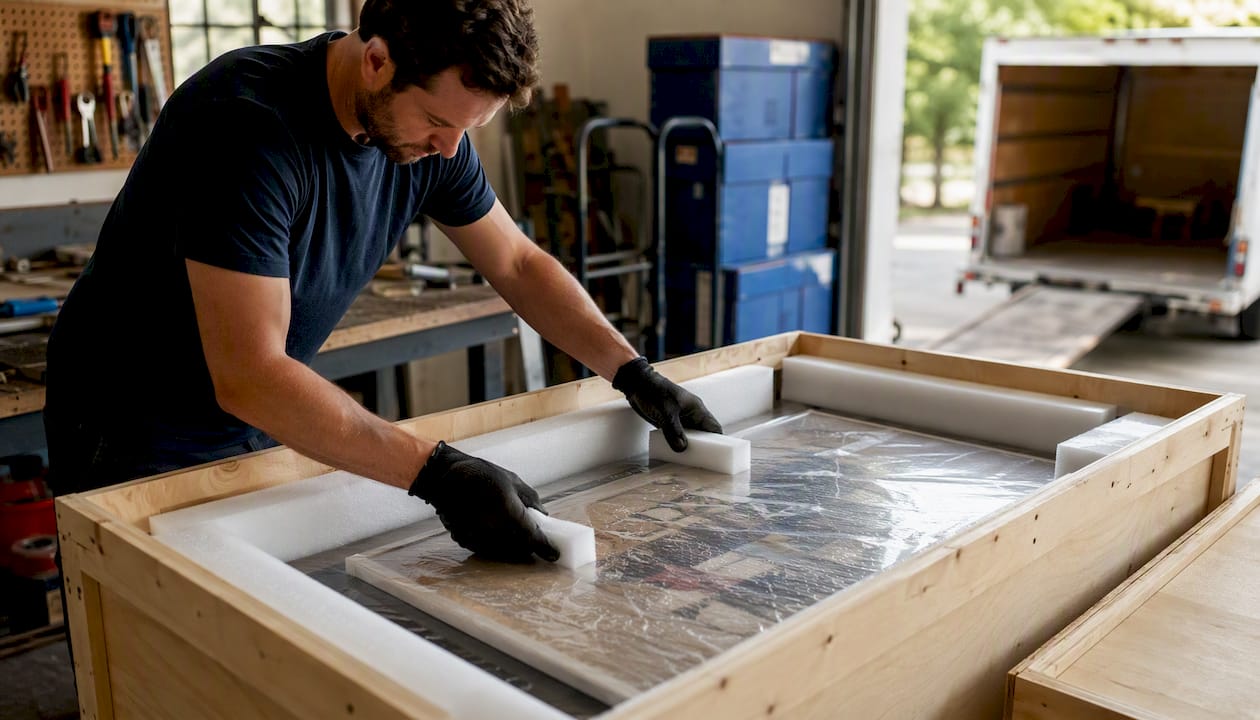
Crate it if the piece is traveling long-distance, carries significant monetary or sentimental value, exceeds roughly 40 inches in any dimension, or has a textured, antique, or otherwise fragile surface. Soft-pack it if the move is local, the value is modest, and the surface is flat and stable.
A properly built crate follows a few non-negotiable specs pulled from professional crating standards: at least 2 inches of clearance between the artwork and the crate’s interior walls, a vapor barrier lining to manage humidity, interior foam blocking to immobilize the piece, skids on the base for forklift handling, and a bolted or buckled lid rather than nails driven near the artwork. International and long-haul crating guidance also recommends shock and tilt indicators on the outside, giving you a visible flag if the crate was mishandled in transit.
| Variable | Soft-pack sandwich | Reinforced double-box | Custom wooden crate |
|---|---|---|---|
| Distance | Local, same-day | Regional, one transfer | Interstate, multi-stop |
| Value | Low to moderate | Moderate | High or irreplaceable |
| Fragility | Stable, flat surface | Stable, moderate size | Textured, antique, or oversized |
| Typical cost range | Low, mostly materials | Moderate | Higher, custom-built |
Cost climbs with complexity, but so does protection. A soft-pack sandwich might run you the price of a few boards and a roll of glassine. A custom crate built to museum specifications costs considerably more and takes longer to build, so factor that lead time into your moving date if you’re commissioning one. For any piece where you’re unsure which column it falls into, the safer call is almost always to size up.
Choosing a Carrier, Buying Insurance, and Planning Your Timeline
Verify the mover’s authority before anything else. Look up the company’s USDOT number on the FMCSA SAFER System to confirm active operating authority for interstate transport. This single step filters out unlicensed operators who may not carry adequate liability coverage.
Then handle these steps in order:
- Confirm the carrier’s standard liability basis in writing before booking.
- Purchase a separate declared-value or fine-art transit insurance policy if the piece’s worth exceeds what standard liability covers.
- Get a condition report signed by both parties before pickup, referencing the photos you took during preparation.
- Require chain-of-custody documentation for any piece changing hands between packer, carrier, and receiver.
Standard carrier liability is typically calculated by weight, often around $0.60 per pound, not by the item’s actual value. A 12-pound framed painting worth $8,000 would be covered for roughly $7.20 under that formula. That gap is exactly why declared-value coverage exists, and why skipping it is the single most common regret collectors report after a damaged shipment.
On timeline: small framed pieces typically take 20 to 40 minutes to pack properly per item. Custom crating adds days to weeks depending on the builder’s schedule, so book that piece of the move early. After delivery, follow the 24-hour acclimation rule before unwrapping anything, letting the piece adjust to indoor temperature and humidity gradually rather than exposing it to a sudden shift that can cause condensation or warping.
A Scenario-Based Packing Checklist You Can Actually Use
Different pieces need different time budgets. Here’s a rough breakdown by scenario, useful whether you’re doing this yourself or briefing a hired packer.
- Small framed piece (under 20 inches): Measure and photograph (5 min) → glassine and tape X (5 min) → corner protectors and rigid boards (10 min) → outer wrap and box (10 min). Total: about 30 minutes.
- Large framed piece (over 40 inches): Measure, photograph, condition-note (15 min) → glass removal decision and glassine layer (15 min) → rigid board sandwich and corner protection (20 min) → crate or double-box assembly (30 to 60 min). Total: 1.5 to 2 hours.
- Unframed canvas: Cure-time check and surface inspection (10 min) → glassine layer (5 min) → rigid board sandwich (15 min) → strapping and outer wrap (15 min). Total: about 45 minutes.
- Prints and photographs: Interleaving and sleeving (10 min) → board sandwich (10 min) → double-box assembly (15 min). Total: about 35 minutes.
- Sculptural or three-dimensional pieces: Remove any detachable elements and pack separately, build a custom foam cavity matching the piece’s silhouette, and distribute weight so the base bears the load rather than protrusions or thin points. These almost always warrant a purpose-built crate rather than standard boxing.
Before handing anything off to a carrier, run a final check: confirm seals are intact, orientation labels are visible and legible, photos match the current condition, and the waybill or bill of lading has been reviewed and signed by both sides.
When Hiring Professional Art Packers Makes Sense
Rule of thumb: if the piece is high-value, large, structurally delicate, or the move crosses state lines with multiple transfer points, professional packing pays for itself the first time it prevents a claim. Chain-of-custody documentation alone is worth the cost for anything you’d genuinely hate to lose.
Professional fine-art packers and movers typically provide:
- Signed condition reports with photo documentation at pickup and delivery
- Custom crating built to the piece’s exact dimensions and fragility profile
- Climate-controlled transport, though it’s worth asking what temperature range the provider actually guarantees, since standard trailers can still allow a noticeable swing
- White-glove deinstall and install service, handling the piece from wall to wall
- Coordination with fine-art insurance providers for declared-value coverage
If you’re weighing DIY against professional help for an interstate move, Ambmovingservices explains why hiring professional packers changes the risk profile substantially, particularly for pieces you can’t easily replace. Ambmovingservices operates as a licensed, insured nationwide moving company with experience in long-distance and interstate relocations, and getting a quote costs nothing but a few minutes of your time.
Why Methodical Packing Beats Rushed Handling
Most damage to artwork doesn’t happen mid-transit on the highway. It happens in the first and last thirty minutes: the rushed pickup, the hurried unwrap, the moment someone sets a frame down too fast because the truck is idling outside. That pattern holds whether you’re moving a $200 print or a $50,000 painting, and it’s the reason methodical, unhurried handling at the two endpoints of a move matters more than almost any material choice discussed above.
Unpacking deserves the same discipline as packing. Let the crate or box sit at room temperature for the full 24-hour acclimation window before opening it. Remove outer packaging first, check for any shifted straps or compressed corners, then work inward layer by layer, comparing the piece against your condition photos as you go. If something looks off, stop and document it before continuing. A rushed unwrap under deadline pressure, “the movers are waiting to take the truck back,” is where careful packing gets undone in the final five minutes.
If you’re staring down a piece worth real money or real memory, use the checklist above as your baseline, and don’t hesitate to bring in a professional for the pieces that genuinely can’t be replaced.
How Ambmovingservices Handles Specialty Art Packing
If your interstate move includes anything requiring museum-grade handling, custom crating, or climate-controlled transport, that’s exactly the kind of job Ambmovingservices packs, documents, and moves every week.

Ambmovingservices provides signed condition reports at pickup and delivery, custom-built crates sized to your specific piece, and climate-controlled trailers for long-distance hauls, backed by full licensing and insurance coordination across the country. Rather than piecing together boxes and hoping the sandwich method holds up over a thousand miles, you get a documented process built around the exact museum standards this guide describes. Check your dates and request a quote for your long-distance move to see what specialty art packing costs for your specific piece and route.
Frequently Asked Questions
What’s the safest way to pack a framed painting for a long-distance move?
Layer glassine paper against the glass or frame face, tape an X pattern across any glass for shard containment, add corner protectors, sandwich the piece between rigid foamcore boards, and box or crate it depending on size and value. For interstate moves, a custom crate is the safer call for anything valuable or oversized.
Can I use bubble wrap directly on a painting?
No. Bubble wrap should only touch outer packaging materials, never the painted surface directly. Direct contact can stick to wet or tacky varnish and leave a textured imprint on the paint over time.
Do I need special insurance to ship artwork with a moving company?
Yes, in most cases. Standard carrier liability is typically calculated by weight rather than actual value, so a separate declared-value or fine-art transit policy is worth purchasing for anything meaningfully valuable.
When should I crate artwork instead of soft-packing it?
Crate any piece that’s traveling long-distance, exceeds roughly 40 inches, carries high monetary or sentimental value, or has a textured or antique surface. Soft-packing works fine for smaller, stable, lower-value pieces on local or regional moves.
How long should I wait to unpack artwork after an interstate move?
Wait at least 24 hours before unwrapping, letting the piece acclimate to the room’s temperature and humidity gradually. Opening a crate or box too soon after a temperature-controlled truck ride can cause condensation that damages the surface.
Sources
- Art in Transit: Handbook for Packing and Transporting Paintings
- FMCSA SAFER System
- Getting smart about moving your art (Chubb guide)
- Art-Safe Transit: Packing Oil Paintings for Long-Distance Moves
For readers verifying a carrier’s regulatory standing more broadly, Logivo’s guide to MC numbers explains how operating authority works for interstate haulers, useful background alongside the FMCSA lookup above.