

Professional packing typically adds a few hundred to over two thousand dollars to a move, with most households landing somewhere in the mid-range depending on home size, crew, and materials. For long-distance and interstate moves, hiring professional packers almost always makes financial sense once you factor in damage risk, specialty items, and the opportunity cost of your own time.
Here’s what that headline number actually covers:
- Labor only: Most base quotes cover packer wages per hour, not materials. Confirm whether boxes, tape, and bubble wrap are included or billed separately.
- Materials add-on: Packing materials run roughly $180 for a one-bedroom up to $750 for a three-bedroom when purchased new, Movers.
- Specialty fees: Pianos, safes, large mirrors, and antiques are almost always priced as separate line items, often running several hundred to several thousand dollars extra.
Key Takeaways
Professional packing for a long-distance move typically costs $280–$2,200+ in labor, with materials adding $80–$750 depending on home size, and the break-even against DIY narrows sharply for any three-bedroom or larger cross-country move.
| Point | Details |
|---|---|
| National labor range | Professional packing runs $280–$2,200+ depending on home size, crew, and scope. |
| Materials are extra | New packing materials add roughly $180 (1BR) to $750 (3BR) unless explicitly included in the quote. |
| Packer-hours matter | Always confirm whether the hourly rate is per packer or per crew; crew size changes the real hourly spend. |
| DIY break-even narrows fast | For a 3BR cross-country move, DIY packing savings often shrink to a few hundred dollars once time and risk are included. |
| Ambmovingservices | AMB provides itemized interstate packing quotes covering labor, materials, and specialty crating as separate line items. |
Table of Contents
- How does packing service cost get calculated?
- What factors push your packing price up or down?
- Sample packing costs by home size
- DIY vs. hiring packers: when does the math actually favor pros?
- Practical ways to cut packing costs without adding risk
- What to expect when you hire professional packers
- How to get accurate packing quotes and spot red flags
- How AMB derived the price ranges in this guide
- The case for professional packing on interstate moves
- Get a firm packing quote for your interstate move
- Sources
How does packing service cost get calculated?
Professional packers bill in two primary ways: hourly per packer, or flat-rate per room or per box. Understanding which model you’re being quoted is the single most important step in comparing estimates accurately.
Hourly pricing and the “packer-hours” concept
Most companies charge by the hour, per packer. Industry data from Extra Space Storage puts the typical range at $60–$80 per hour per packer, with some metro markets running higher. The critical concept here is packer-hours: two packers working four hours equals eight packer-hours, not four. A quote that says “$70/hour” means nothing until you know how many packers are on the crew.
A two-packer crew at $70/hour packing a two-bedroom for five hours costs $700 in labor alone. That same job with a three-packer crew at the same rate takes roughly three hours and costs $630. Crew size and speed interact directly with your final bill.
Flat-rate and per-box pricing
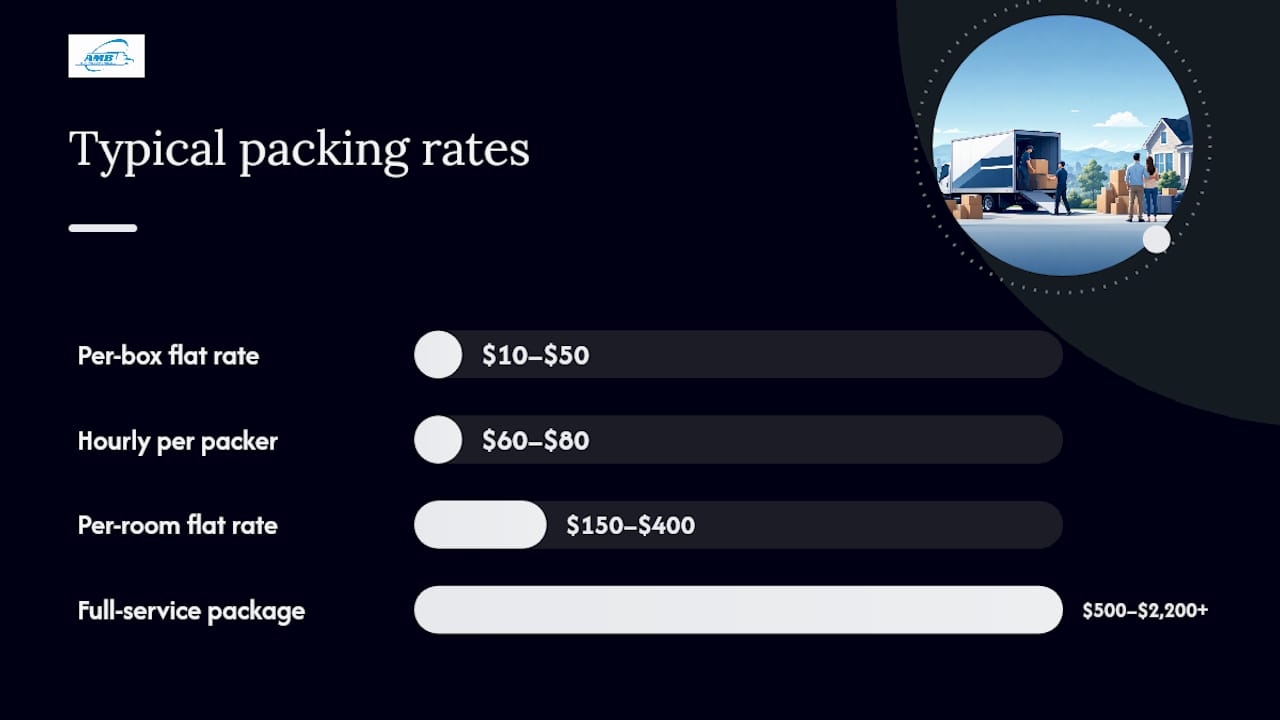
Some companies offer per-room packages or per-box rates. SpareFoot reports that per-box flat pricing typically runs $10–$50 per box depending on box type, with specialty boxes like dish packs priced at the higher end. Flat rates simplify budgeting but can cost more than hourly when a compact, fast crew could finish the job quickly. Request both rate forms from every company you contact.
| Pricing Model | Typical Rate | What’s Usually Included | Common Exclusions |
|---|---|---|---|
| Hourly per packer | $60–$80/hr (national avg.) | Labor, basic supplies | Specialty boxes, crating, travel fee |
| Per-room flat rate | $150–$400/room | Labor + standard boxes | Electronics, fragile items, specialty crating |
| Per-box flat rate | $10–$50/box | Labor for that box | Dish packs, wardrobe boxes often extra |
| Full-service package | $500–$2,200+ | Labor + materials + standard boxes | Piano/safe crating, long-carry fees |
Common inclusions: standard cardboard boxes, packing paper, tape, basic labeling, room-by-room organization.
Common exclusions: custom crating, electronics disassembly, wardrobe boxes, dish packs, travel fees beyond a set radius, and short-notice surcharges.
What factors push your packing price up or down?
The national range of $280–$2,200+ is wide for a reason. These are the variables that move the needle most:
- Home size and volume: More rooms mean more packer-hours. A studio might take one packer three hours; a four-bedroom can take a three-packer crew a full day.
- Fragile and specialty items: Dishes, artwork, electronics, and antiques require more time per box and often specialty materials. Budget extra for any room with significant fragile content.
- Stairs, elevators, and access: Long carries, narrow hallways, and multi-floor homes slow crews down. Many companies charge a long-carry or stair fee, typically $50–$150 per flight.
- Specialty crating: Pianos, safes, large aquariums, and high-value artwork are almost always billed separately. Custom crating can run several hundred to several thousand dollars per item.
- Peak-season scheduling: Moving demand peaks May through September and on weekends. SpareFoot’s data confirms that shifting to a weekday or off-peak date commonly reduces rates or yields discounts.
- Short-notice booking: Scheduling within one to two weeks of your move date often triggers a premium. Book at least four to six weeks out when possible.
- Metro location: NerdWallet notes that local full-service crews with a truck run $150–$300/hour in many metro areas, reflecting higher labor costs in dense urban markets.
Pro Tip: When you receive a written quote, ask explicitly: “Is this rate per packer or for the whole crew?” A quote that says “$80/hour” for a three-packer crew means $240/hour in real labor spend. Get the crew-count assumption in writing before signing anything.
Sample packing costs by home size
The figures below blend published industry averages with typical crew-size and materials assumptions. They are estimates, not guarantees. Your actual cost depends on the factors above, and a written quote from your mover is the only reliable number.
Assumptions used: Two-packer crew at $70/hour average; materials at published new-purchase averages; no specialty crating included; standard access (ground floor or elevator building).
Materials range sourced from Movers.com, which puts new-purchase materials at roughly $180 (1BR) to $750 (3BR).
A few scenario notes worth keeping in mind:
- The low column assumes a fast, efficient crew and minimal fragile content. Realistic for a studio or a sparsely furnished one-bedroom.
- The typical column is the most useful planning number for a normally furnished home with standard kitchen and bedroom contents.
- The high column reflects a slower pace, significant fragile content, or a metro market with above-average labor rates.
- Add $200–$500+ per specialty item (piano, safe, large mirror) on top of any row above.
For a full picture of how packing fits into your total moving costs breakdown, these labor and materials figures are just one line item alongside transport, fuel, and insurance.
DIY vs. hiring packers: when does the math actually favor pros?
The honest answer is that DIY packing is cheaper on paper for local moves and increasingly hard to justify for long-distance ones. Here’s how to run the numbers yourself.
The break-even formula
DIY all-in cost = materials + helper wages + equipment rental + your time (at your hourly rate) + risk premium
Pro packing cost = labor quote + materials (if not included)
When DIY all-in cost exceeds the pro packing quote, hiring wins financially. When it doesn’t, DIY saves money only if you’re comfortable absorbing the damage risk yourself.
Example 1: Local 1-bedroom move
- Materials purchased at a hardware store: $150
- Helper (one friend, one day, dinner and gas): $60
- Your time: 8 hours at $25/hour opportunity cost = $200
- DIY total: $410
- Pro packing quote for a 1BR (typical): $490–$700
In this scenario, DIY saves roughly $80–$290 on a local move. That’s real money, and for a straightforward local job with no fragile items, DIY is defensible.
Example 2: 3-bedroom cross-country move
- Materials: $600
- Helper wages (two people, two days): $400
- Your time: 16 hours at $35/hour = $560
- Risk of damage on a 2,000-mile haul (one broken item at replacement cost): $300 estimated
- DIY packing total: $1,860
- Pro packing quote for a 3BR (typical): $1,260–$1,960
The numbers converge fast. MovingRated’s analysis shows that once you add helper wages and opportunity cost, full-service and hybrid options become cost-competitive for larger cross-country moves. And that’s before accounting for the fact that professionally packed items are easier to claim against if something breaks in transit.
Hybrid container services (portable storage units) typically run $2,800–$5,500 for a long-distance lane, sitting between DIY truck rental and full-service pricing. They’re worth including in your comparison math.
Non-monetary factors that tip the decision
- Time pressure: If you’re working full-time and have two weeks to move, buying back 16 hours of packing labor is often worth every dollar.
- Physical limitations: Packing a three-bedroom is physically demanding. For seniors, people with injuries, or anyone managing a move solo, professional packing isn’t a luxury.
- Fragile and high-value items: NerdWallet’s moving guide makes the point clearly: hiring professionals shifts damage risk to them, and their liability coverage applies when they pack. If you pack it yourself, most movers won’t cover damage to those items.
Pro Tip: These items almost always warrant professional packing on an interstate move: upright or grand pianos, marble or glass tabletops, large mirrors and artwork, antiques, aquariums over 30 gallons, and safes. The crating cost is real, but so is the replacement cost.
Practical ways to cut packing costs without adding risk
Reducing your packing bill doesn’t require cutting corners. It requires being strategic about which corners you actually need covered.
- Partial packing: Have pros pack the kitchen, fragile items, and artwork. Pack your own clothes, books, and linens. This is often the highest-ROI approach for a two- or three-bedroom home, cutting labor by 30–50% while keeping the high-risk items professionally handled.
- Book off-peak: Weekday moves in October through April consistently yield lower rates. Even a Tuesday booking versus a Saturday booking in peak season can save $100–$300 on a packing job.
- Bundle packing with transport: Many full-service movers discount packing when it’s booked as part of the move package rather than as a standalone service. Ask specifically whether a bundle discount applies.
- Source your own materials: Buying boxes from U-Haul, Home Depot, or a local liquor store costs less than purchasing through your mover. Movers typically mark up materials. The exception: specialty boxes (dish packs, wardrobe boxes, mirror boxes) are often priced fairly through the mover and are worth buying there for convenience.
- Declutter before the crew arrives: Packers charge by the hour. Every item you donate, sell, or trash before packing day reduces the volume they touch. A pre-move purge of one room can save an hour of labor.
- Reuse materials where safe: Towels, blankets, and clothing work well as padding for non-fragile items. Reserve bubble wrap and packing paper for glass, ceramics, and electronics.
What to expect when you hire professional packers
Knowing what’s included in a standard packing visit prevents surprises on moving day and helps you compare quotes on equal footing.
Standard services typically included:
- Room-by-room packing of all household contents
- Labeling of boxes by room and general contents
- Wrapping of fragile items in packing paper or bubble wrap
- Basic disassembly of small furniture (bed frames, shelving units) in some packages
- Placement of packed boxes in a staging area for loading
Common add-ons (usually billed separately):
- Unpacking service at the destination (typically priced similarly to packing labor)
- Wardrobe boxes and dish packs
- Electronics disassembly and cable labeling
- Custom crating for specialty items
- Long-carry or stair fees
Valuation and insurance basics
When a mover packs your items, their liability coverage generally applies to those boxes. If you pack your own boxes and something breaks, most carriers invoke the “PBO” (packed by owner) exclusion and deny the claim. For an interstate move, this distinction matters. Ask your mover whether their valuation coverage requires professional packing to apply, and review the difference between Released Value (free, minimal coverage) and Full Value Protection (additional cost, full replacement). For more on how coverage works, relocation insurance basics are worth reading before you sign a contract.
Tipping etiquette
Tipping is not required but is standard practice. A common range is $20–$50 per packer for a full-day packing job, paid in cash at the end of the visit. For a particularly complex job or exceptional service, $50–$100 per packer is appropriate.
How to get accurate packing quotes and spot red flags
A written, itemized quote is the only number you can rely on. Here’s how to get one that’s actually comparable across companies.
Questions to ask every packer or moving company:
- Is the hourly rate per packer or for the entire crew?
- How many packers will be on the crew?
- Are packing materials included, or billed separately?
- Is there a travel fee or minimum charge?
- What’s the estimated time to pack my home?
- Are specialty items (piano, safe, large mirrors) included, or quoted separately?
- What is your valuation/liability coverage for items you pack?
- Do you offer a bundle discount if packing is booked with transport?
Red flags to watch for:
- A quote given over the phone without a walkthrough or virtual inventory
- No written estimate, or a quote that lumps packing and transport into one undifferentiated number
- An unusually low estimate with no explanation of crew size or hours
- Vague language like “approximately” or “around” without a defined scope
- No mention of specialty item fees when you’ve disclosed you have them
What to require in writing:
- Crew size and hourly rate (per packer, not per crew)
- Estimated hours and total labor cost
- Materials list and cost (or confirmation they’re included)
- Specialty item fees as separate line items
- Travel fee, minimum charge, and any peak-season surcharges
- Valuation/insurance terms for packed items
Separating packing cost from transport cost in the written estimate is worth insisting on. It lets you compare packing quotes across companies even when transport pricing differs, and it gives you a clear number to negotiate if the packing line is higher than expected.
How AMB derived the price ranges in this guide
The ranges in this guide blend Ambmovingservices’s internal packing-hour data from completed interstate and long-distance moves with published national averages from industry sources including Movers.com, Extra Space Storage, SpareFoot, MovingRated, and NerdWallet.
Key assumptions used to build sample scenarios:
- Two-packer crew at $70/hour (national midpoint of the $60–$80 published range)
- Materials at new-purchase averages: $80–$120 (studio), $150–$180 (1BR), $250–$400 (2BR), $500–$750 (3BR)
- Standard building access (ground floor or elevator); no specialty crating included
- No peak-season surcharge applied
Important caveats:
- Rates in high-cost metros (New York, San Francisco, Seattle) regularly exceed the national averages shown here by 20–40%.
- Peak-season moves (May through September, weekends) typically add 10–25% to labor rates.
- Specialty crating is not included in any scenario above and must be quoted as a separate line item.
Ambmovingservices is licensed, insured, and federally compliant as a registered interstate carrier. For a firm, lane-specific packing quote that reflects your actual home size, crew requirements, and specialty items, a written estimate from AMB is the most reliable number you can get.
The case for professional packing on interstate moves
Most of the debate around packing services focuses on cost, and that’s fair. But for interstate and cross-country moves, the cost framing misses the more important variable: risk transfer.
When you pack your own boxes for a 1,500-mile move, you own every outcome. A cracked dish is annoying. A shattered piece of irreplaceable artwork or a damaged piano is a different conversation entirely. Professional packers who work for a licensed, insured interstate carrier carry liability that applies to what they pack. That’s not a marketing point; it’s a structural difference in how damage claims work under federal moving regulations.
The break-even math in this guide shows that DIY packing saves real money on local moves and modest amounts on smaller long-distance jobs. For a three-bedroom cross-country move with fragile items, the savings narrow to a few hundred dollars at best, and that margin disappears the moment one high-value item is damaged in transit.
The readers who get the most value from professional packing are the ones who are honest about what they’re actually moving. If your home has a piano, significant artwork, antiques, or a kitchen full of china, the packing cost is not the biggest number in that decision.
Get a firm packing quote for your interstate move
When you’re planning a long-distance or interstate move, a ballpark range is useful for budgeting. A written, itemized quote is what you actually need before committing.
Ambmovingservices provides itemized packing quotes that break out labor, materials, specialty crating, and crew estimates as separate line items, so you know exactly what you’re paying for before moving day. As a licensed, insured, and federally compliant interstate carrier, AMB handles long-distance, cross-country, and state-to-state moves with professional packing included as a bookable service. Whether you need full-house packing, partial packing for fragile rooms only, or specialty crating for a piano or safe, AMB’s team can scope it accurately. Request your written packing quote and get a firm number for your move.
Sources
These are the primary external references used to build the cost estimates and scenarios in this guide.
- Movers
- How Much Do Professional Packers Cost? – SpareFoot
- DIY vs. Hire Movers: Decision Guide | MovingRated
- How Much Does It Cost to Hire Packers in 2026?
- DIY Moving vs. Hiring Professionals: What’s Best? – NerdWallet